With Alibaba's Big Debut, 10 Things to Know
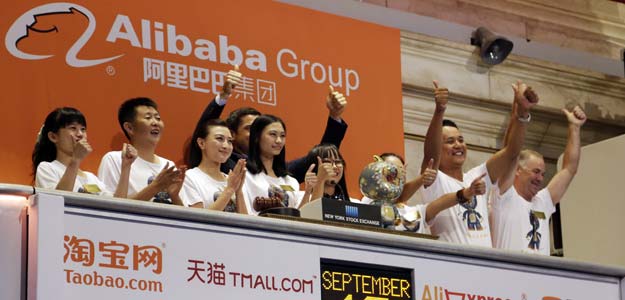
New York: China's e-commerce giant Alibaba began trading its shares Friday on the New York Stock Exchange. Here are ten things to know about Alibaba, and why its initial public offering made history:
The Biggest: Alibaba raised $21.8 billion in its debut, making it the biggest US-listed IPO in history after the IPO of credit card processing company Visa in 2008. If Alibaba's investment banks were to exercise their option to sell an additional 48 million shares, it could make Alibaba's IPO the biggest in the world, beating out the $22 billion IPO of Agricultural Bank of China in 2010. (Read: Largest IPOs in Stock Market History)
Don't forget Yahoo: It may have been a big day for Alibaba and its founder Jack Ma, but Yahoo's investors are feeling pretty good after Alibaba's IPO. Yahoo was an early investor in Alibaba, paying $1 billion for a stake in the company in 2005. Yahoo likely made $8.3 billion to $9.5 billion in Alibaba's IPO, and will still own a 16 per cent stake in the company worth $37.7 billion. (Read: Yahoo Rakes in Another Jackpot From Alibaba's IPO)
Alibaba eclipses Silicon Valley: Alibaba now has a market capitalization of roughly $219.8 billion, according to FactSet. That makes the company bigger than some of the US technology industry's most successful names, such as Facebook, eBay, and even Amazon.com.
All in one: Investors are interested in Alibaba because the company dominates many businesses in China that, here in the US, are run by individual companies. Alibaba owns the websites Tmall and Taobao, which are similar to Amazon.com and eBay, respectively. The company also earns money from transaction fees related to its various businesses through Alipay, which is like PayPal. That's just three of Alibaba's many subsidiaries.
Big profits: Unlike the US e-commerce giant Amazon, Alibaba has been consistently profitable. The company had $8.5 billion in sales in its latest fiscal year ending in March, with net income of $3.8 billion. The year prior, Alibaba had $5.4 billion in sales and $1.4 billion in profits. In comparison, Amazon sold $74.4 billion in goods in 2013, but made only $274 million in profits that year. In 2012, Amazon reported a net loss of $39 million. (Also Read: Alibaba: China's Giant Online Shopping 'Crocodile')
Risks: If Alibaba does well for investors, it will be the exception to what has been the trend for Chinese companies. When Chinese companies have listed stocks on American markets, their shares have lost an average 1 per cent a year for the next three years, compared with an average 7 per cent annual gain for other US IPOs, according to research by Jay Ritter, a finance professor at the University of Florida.
Second time around: This isn't Alibaba's first time going public. Alibaba took its online shopping portal Alibaba.com public in 2007 in Hong Kong. Alibaba.com was a publicly traded company only for a few years. Alibaba took Alibaba.com private in 2012.
Solid gold: Jack Ma, who started Alibaba in 1999 in his apartment in the Chinese city of Hangzhou, is now among the richest people in the world. Ma's ownership in the company is worth roughly $18.2 billion, based on Alibaba's closing share price Friday. That doesn't include the shares he sold in the IPO, which are worth another $867 million, and his other investments. Bloomberg put his entire net worth at $21.9 billion, making him the 34th richest person in the world.
Big win for NYSE: Alibaba chose to list its shares on the New York Stock Exchange, making it the second A-list technology company to go public on the Big Board in less than a year. The NYSE handled Twitter's IPO last year. NYSE's competitor, the Nasdaq Stock Market, has struggled to win the business of big tech companies since Facebook's IPO in 2012, which was plagued with technical problems.
Life is like a box of...: Jack Ma biggest hero is the fictional character Forrest Gump. "I really like that guy," Ma said, in an interview with business channel CNBC on Friday. "Every time I'm frustrated, I watch the movie. (The movie tells) me that no matter whatever changed, you are you." (Read: Alibaba's Jack Ma Rides 'Forrest Gump' Story to Riches)

-
Where You Live Shapes How You Get To Work | The Reason Why

Two-wheelers are the most popular way to get to work in India, accounting for nearly 43% of workplace commutes.
-
High US Salaries, No Green Card Certainty: The Financial Calculation Facing Indian H-1B Families
The suspension of PERM processing at eight technology employers does not cancel existing H-1B visas. What it does is force a question many Indian families have been avoiding: is the US salary worth tying your career and family plans to one employer?
-
Unhedged Position: Can India See An Indonesia-Style Time Correction?
The Nifty is trading below levels it first clocked in 2024. Is there, then, as I have suggested in the headline, potential that the current time correction drags on painfully for the next three-five, even ten years?
-
Navigating Friction And Energy Realities: An Analysis Of Marco Rubio's October Visit To India
Occurring at a critical juncture marked by stalled trade negotiations and escalating geopolitical pressures over global energy supplies, the visit offers a profound window into modern US-India relations.
-
India Exports Capital. Why Not Export Trusteeship?
The big question, then, is whether India can build an institution that global borrowers, investors, banks, and lawyers can trust, even without an Indian connection.
-
France's Economy & Politics Are In Crisis | The Reason Why
Let's look at how the French economy and politics evolved under Nicolas Sarkozy, Franois Hollande and Emmanuel Macron.
-
You May Inherit The Business. You Must Earn Its Credibility.
Succession tests the founder's ability to share authority as much as it tests the next generation's readiness to assume it.
-
Signing Deals Is One Thing; Making Them Work Is Another | The Week In Whys
Sometimes, things don't turn out as planned. Indian companies have lost some bids to rivals, some projects won't produce until 2030.
-
FOMC Wall, PERM Suspension, Hospital Stocks | Talking Points This Week
A PERM suspension would directly affect green-card sponsorship rather than H-1B visas, so the near-term earnings impact could remain relatively limited. The key question is whether this marks a new phase in US scrutiny of Indian IT.
-
Everything, Everywhere, All At Once: Dalal Street's Week To Forget | Joining The Dots
Visa curbs, a Starlink spat and cancer drug caps: what connects this week's shocks for Indian markets









