Why The BJP Continues To Win
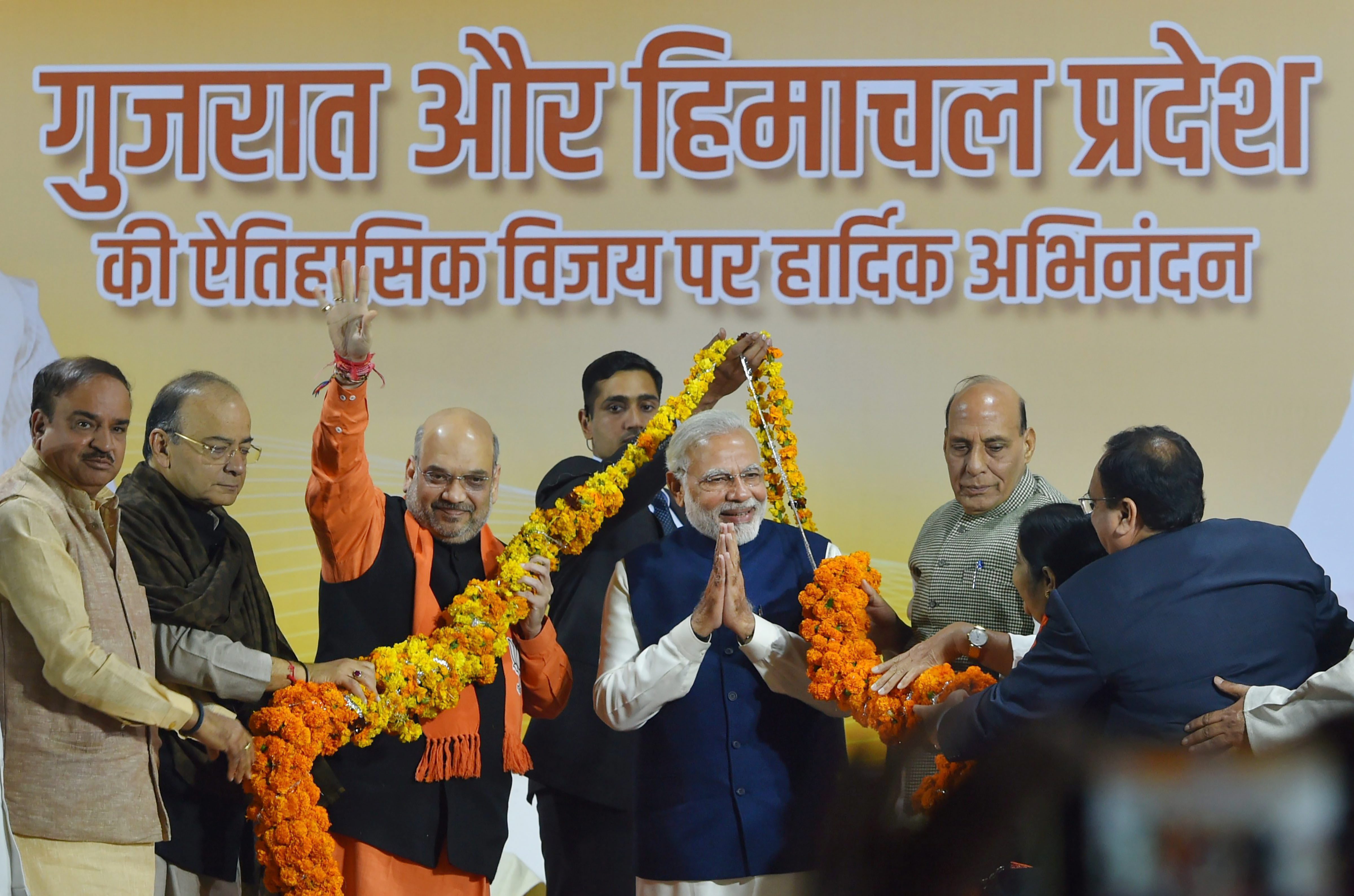
The success of the Bharatiya Janata Party in the Gujarat and Himachal Pradesh assembly elections cannot entirely be read as a state-specific electoral phenomenon. Although the party's electoral campaign eventually became highly state-centric in the last phase — especially when Narendra Modi was presented as a political symbol to the electorate — these elections were envisaged as a kind of national referendum. In fact, there has been a consensus that the Gujarat (not Himachal) election is going to redefine the outcome of 2019 Lok Sabha polls.
This overtly national reading of recent elections, nevertheless, poses two important questions.
- First, is it appropriate to describe the BJP's victory in Himachal and Gujarat as an outcome of a national trend in the country that begins in 2014?
- Second, what is the political significance of BJP's emergence as the single dominant party?
Is This Still The 2014 Wave?
To make sense of the outcome of the Gujarat and HP electoral results of 2017, one must go beyond the rhetoric of the Modi/BJP wave. In 2014 BJP only received 31 percent votes and translated it into 282 seats. By all conventional standards, it was a simple victory for the BJP.
Although it lost a few assembly elections, the BJP consolidated its political presence as a dominant player at the national level. The party expanded its regional base, especially in the regions where it did not have any conventional political support, and continued to improve its vote share in almost every election.

This regional expansion of the party redefined the configuration of Parliament in a significant way. The pre-electoral alliances and strategic pacts with regional parties strengthened the position of the National Democratic Alliance in the Lok Sabha and established the BJP as the most powerful political entity.

A very similar political trajectory unfolded in the Rajya Sabha. The BJP now has the same number of seats as the Congress in the upper house. The growing regional success of the BJP has consolidated the NDA and this trend is likely to continue till 2019. If the elections of the President and the Vice-President are also considered as open contests, the dominance of the BJP on Indian parliamentary democracy is apparent.

What Does The BJP Dominance Mean?
BJP's dominance is being compared with that of the Congress of the past — positively as well as negatively. In a positive sense, the rise of the BJP is seen as BJP-system, like the pre-1967 Congress-led ‘one-party-dominance system'. At the same time, the highly centralised mode of functioning of the present BJP regime is equated with the Emergency government of Indira Gandhi.
These comparisons, analytically speaking, are inappropriate.
The Congress system evolved in 1950-70 period when competitive electoral politics in India was taking a decisive shape.
The political-ideological differences with Congress were not yet fully translated into electoral agendas by the non-Congress opposition parties. That was the reason behind the rhetoric of anti-Congressism.
No political party — including the BJP — describes itself as an ideological party these days.
As a result, the electoral competition has become more professionalised.
The BJP has understood this technicality of Indian politics very well. The party has worked at two levels. It presents Modi as the decisive leader and rhetoric of aggressive nationalism — read Hindu nationalism — at the national level to carve out its political distinctiveness. At the same time, it continues to work at the bottom level of society by creating winnable equilibriums. This grassroots engagement helps the party to translate the narrative of Modi-led development and nationalism into electoral promises in a variety of ways.
Of course, the RSS/VHP network helps the party to channelise its support base. Yet, the manner in which elections are contested by the BJP shows its political seriousness and unmatched professionalism. This has been one of the reasons behind the party's aggressive attitude towards the opposition.
The opposition has not fully understood the correlation between constituency management and manufacturing a nationally relevant political narrative.

The old binaries such as secular versus communal and identity politics versus developmental politics are successfully appropriated by the BJP.
This intellectual weakness of the opposition does not allow them to produce an overarching yet positive alternative which could link the urban unemployment and agrarian distress with the growing climate of hate and insecurity.
BJP's professionalism versus opposition's lethargy, it seems, is going to determine the outcome of 2019.
Hilal Ahmed is Associate Professor at the Centre for the Study of Developing Societies.
The views expressed here are those of the author's and do not necessarily represent the views of BloombergQuint or its editorial team.

-
High US Salaries, No Green Card Certainty: The Financial Calculation Facing Indian H-1B Families

The suspension of PERM processing at eight technology employers does not cancel existing H-1B visas. What it does is force a question many Indian families have been avoiding: is the US salary worth tying your career and family plans to one employer?
-
Unhedged Position: Can India See An Indonesia-Style Time Correction?
The Nifty is trading below levels it first clocked in 2024. Is there, then, as I have suggested in the headline, potential that the current time correction drags on painfully for the next three-five, even ten years?
-
Navigating Friction And Energy Realities: An Analysis Of Marco Rubio's October Visit To India
Occurring at a critical juncture marked by stalled trade negotiations and escalating geopolitical pressures over global energy supplies, the visit offers a profound window into modern US-India relations.
-
India Exports Capital. Why Not Export Trusteeship?
The big question, then, is whether India can build an institution that global borrowers, investors, banks, and lawyers can trust, even without an Indian connection.
-
France's Economy & Politics Are In Crisis | The Reason Why
Let's look at how the French economy and politics evolved under Nicolas Sarkozy, Franois Hollande and Emmanuel Macron.
-
You May Inherit The Business. You Must Earn Its Credibility.
Succession tests the founder's ability to share authority as much as it tests the next generation's readiness to assume it.
-
Signing Deals Is One Thing; Making Them Work Is Another | The Week In Whys
Sometimes, things don't turn out as planned. Indian companies have lost some bids to rivals, some projects won't produce until 2030.
-
FOMC Wall, PERM Suspension, Hospital Stocks | Talking Points This Week
A PERM suspension would directly affect green-card sponsorship rather than H-1B visas, so the near-term earnings impact could remain relatively limited. The key question is whether this marks a new phase in US scrutiny of Indian IT.
-
Everything, Everywhere, All At Once: Dalal Street's Week To Forget | Joining The Dots
Visa curbs, a Starlink spat and cancer drug caps: what connects this week's shocks for Indian markets
-
India Is Going Abroad For Critical Minerals. But It May Take Years To Pay Off | The Reason Why
Although India's steps are in the right direction, they remain modest compared with India's growing dependence.









