Here Are Hong Kong’s Crackdown Leaders Rewarded In New Cabinet
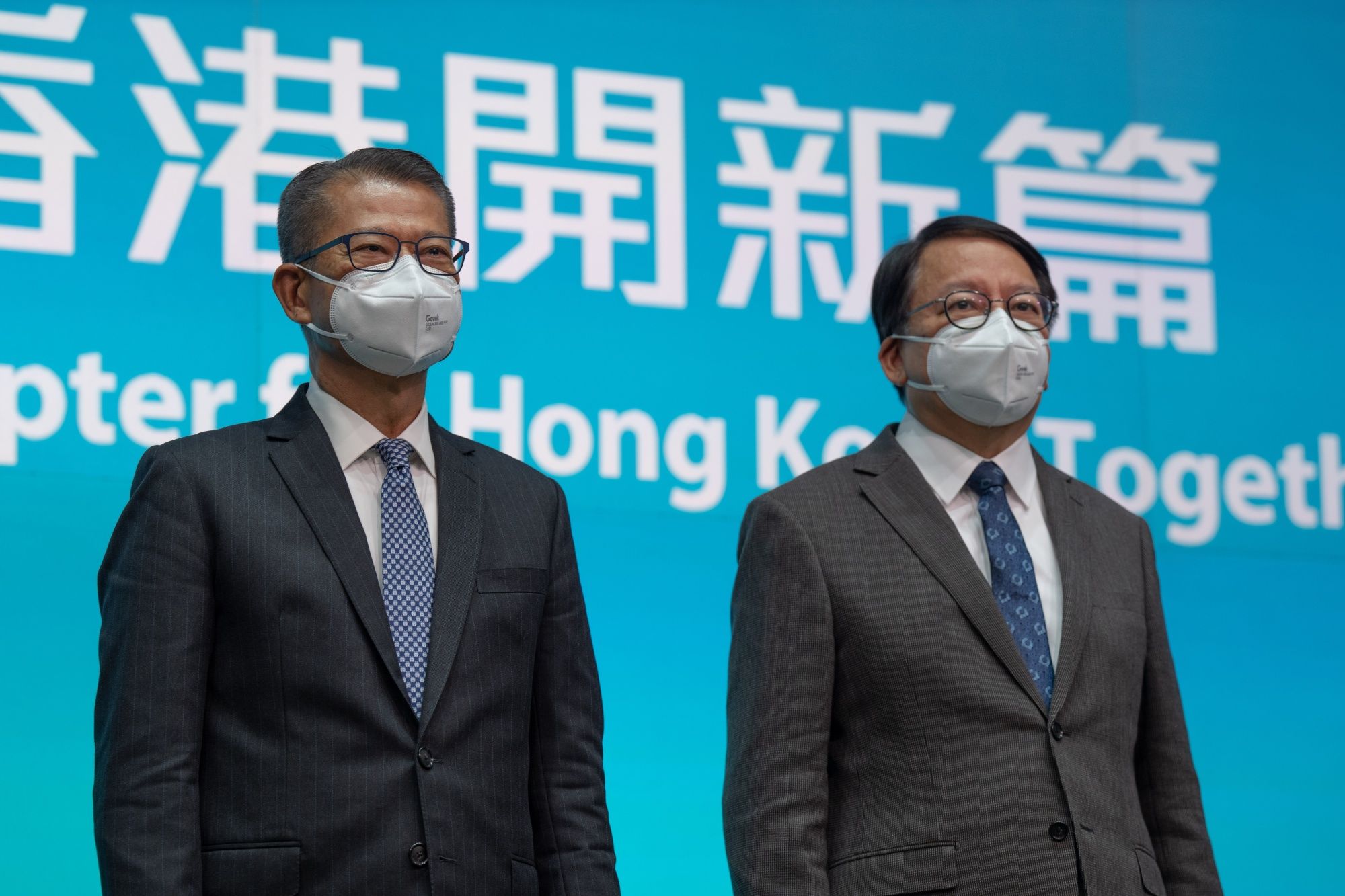
(Bloomberg) -- Hong Kong Chief Executive John Lee will install a cabinet that retains national security hardliners and elevates officials with strong China ties on Friday, as President Xi Jinping touts his greater control over the financial hub.
The 21-member group approved by China's State Council keeps just six members of outgoing leader Carrie Lam's team, with almost all those remaining having overseen the city's crackdown on dissent. The new line-up includes three people who -- like Lee -- have been sanctioned by the US for suppressing democratic freedoms, hands the health portfolio to a one-time defender of China's Covid Zero strategy, and sees a controversial pro-Beijing figure lead education policy.

Six members -- or 30% of the cabinet -- are women, the most in any initial pick since the city's return to Chinese rule in 1997, handling portfolios cited by the central government as top priorities, such as housing and youth affairs. At least three officials earned professional qualifications or worked on the mainland, with Beijing-born Innovation Secretary Sun Dong telling reporters he can't speak the local language Cantonese very well, according Ta Kung Pao newspaper.

Lee and his cabinet take office Friday, a date that marks 25 years of Chinese rule in the city in celebrations attended by Xi. Here are the key officials to watch:
Eric Chan, Chief Secretary
Chan, 63, was Lam's right-hand man during her five-year term, joining her at meetings with top mainland officials including Xi. The former Immigration Department chief is also secretary-general of the Committee for Safeguarding National Security that oversees implementation of the sweeping legislation Beijing imposed in June 2020. The US sanctioned Chan and 10 other officials for their role in “undermining Hong Kong's autonomy” shortly after the security law passed.

Paul Chan, Financial Secretary
Paul Chan, 67, became financial secretary in 2017. A certified public accountant, he steered the economy through a historic two-year recession and the deep impact of the city's worst Covid outbreak earlier this year. He's liked by the business community, and was once seen as a contender for the chief executive's role. His recent policies include consumption vouchers to boost consumer spending and pandemic relief for businesses. His inclusion will likely ease fears of further political turmoil that could rock markets.
Paul Lam, Secretary for Justice
Paul Lam, 54, was vice chairman and chairman of the Hong Kong Bar Association from 2014 to 2017. During his tenure, the HKBA issued a statement saying it was “appalled” by the decision of China's top legislative body to put a joint immigration checkpoint for a high-speed rail on Hong Kong soil. Despite that, he has strong mainland ties: he was an arbitrator at the Shenzhen Court of International Arbitration, and passed the Guangdong-Hong Kong-Macao Greater Bay Area Legal Professional Exam, connections that could bring the city closer to southern China.
Chris Tang, Security Secretary

The former police officer, 56, became the city's top security official during Lam's cabinet reshuffle last year, and is also sanctioned. Tang led the city's police force amid 2019's pro-democracy unrest, when officers were heavily criticized for using what protesters said was excessive force. Since then, he's been vocal about protecting the city's national security and eradicating any forms of domestic “terrorism.”
Lo Chung-mau, Health Secretary
Lo, 61, said in February that living with the virus would “get us all killed.” Since then, he's softened saying not all China's pandemic policies are right for Hong Kong. Lo will be key in deciding whether the city finally breaks with China's zero-tolerance pandemic policy that's shut its international borders for years. The Macau-born surgeon previously ran the University of Hong Kong-Shenzhen Hospital, in southern China, and has more than 30 years experience in Hong Kong and mainland health care systems.
Christine Choi, Education Secretary
Choi, 55, will likely back further “patriotic” reforms to the city's education system, which Beijing has partly blamed for fostering anti-government sentiment. Hong Kong recently imposed a more pro-China curriculum that educates children as young as six on national security law offenses. Some 17,000 people signed a petition against Choi's appointment to undersecretary for education in 2017, amid perceptions she was too pro-China. Choi told reporters she hopes to help students establish a national identity and love their country.
Sun Dong, Innovation, Technology and Industry Secretary
Beijing-born scientist Sun Dong was one of only two lawmakers to take his Legislative Council oath in Mandarin. When asked about his ability to speak Cantonese, Sun said he can understand the local language and will try to speak more of it. His cabinet post could mark the “beginning of the participation of mainland elite in the government's top leadership,” said Eilo Yu, associate professor in government and public administration at the University of Macau. “There could be a tendency of mainland elites who migrate to Hong Kong to join the cabinet.”
The full list:
- Chief Secretary, Eric Chan
- Financial Secretary, Paul Chan
- Justice Secretary, Paul Lam
- Deputy Chief Secretary for Administration, Cheuk Wing-hing
- Deputy Financial Secretary, Michael Wong
- Deputy Justice Secretary, Horace Cheung
- Culture, Sports and Tourism Secretary, Kevin Yeung
- Constitutional and Mainland Affairs Secretary, Erick Tsang
- Financial Services Secretary, Christopher Hui
- Security Secretary, Chris Tang
- Environment Secretary, Tse Chin-wan
- Commerce and Economic Development Secretary, Algernon Yau
- Health Secretary, Lo Chung-mau
- Transport Secretary, Lam Sai-hung
- Development Secretary, Bernadette Linn
- Housing Secretary, Winnie Ho
- Civil Service Secretary, Ingrid Yeung
- Education Secretary, Christine Choi
- Innovation, Technology and Industry Secretary, Sun Dong
- Home and Youth Affairs Secretary, Alice Mak
- Labor and Welfare Secretary, Chris Sun
More stories like this are available on bloomberg.com
©2022 Bloomberg L.P.

-
A New Samvat Wishlist: Inclusive Prosperity And Human Development

India has strengthened its economic foundations through infrastructure, digital access and enterprise. Its next growth chapter must deepen productivity, create better livelihoods and widen participation in prosperity.
-
Love, Sex Aur Dhokha: The Audacious Plot To Spy On Jensen Huang
A Taipei dinner, a Singapore chip buyer and a suspected Chinese asset: inside the alleged spy operation that got close to NVIDIA's Jensen Huang.
-
Ten Things I Learnt This Samvat
Patience can be a trap. Cheap stocks can stay cheap. Leverage can wipe you out. What did Samvat 2082 teach us? Niraj Shah writes on 10 lessons from the year gone by.
-
Talking Points This Week: Tech Nerves, FII Buying, And A Faraway Banking Shock
The global markets are not shining this Diwali. The exception in the large markets is, India.
-
Midterm Rally Lasted A Day. The Hard Reality Of A Divided US May Last Two Years | Opinion
Between a contested AI boom, a debt ceiling that arrives in 2027 and a president with every incentive to act alone, the next two years may prove more volatile than the first day's rally suggests.
-
Blue Wave Will Derail the AI Trade but Won't Dismantle the AI Era | Unhedged Position
The Democrats' sweep of the US Congress will see politics collide with economic forces both over the long and short term.
-
It's Time To Take The GST Council's Bet On Trust Global
Payment records can prove India's services exports, and clear, proportionate rules can bring foreign digital sellers into the tax net.
-
Opinion | India at 38: From Innovation Overperformer to Innovation Powerhouse
India now has 453 VC-backed deep science startups, 18 of them late-stage, after 117 percent growth since 2020. Laurus Labs, at USD 9.3 billion, is the most valuable deep science company in any middle-income economy outside China.
-
Navigating Energy Crossroads: S Jaishankar's Call For Diversified Supply Chains At G20 Ministerial Meeting
As geopolitical fault lines continue to test maritime trade routes and commodity flows, Jaishankar's message remains pertinent: true economic resilience requires open markets, protected transit lines, and a genuine commitment to multilateral cooperation rather than coercion.









