Where 3 Million Electric Vehicle Batteries Will Go When They Retire
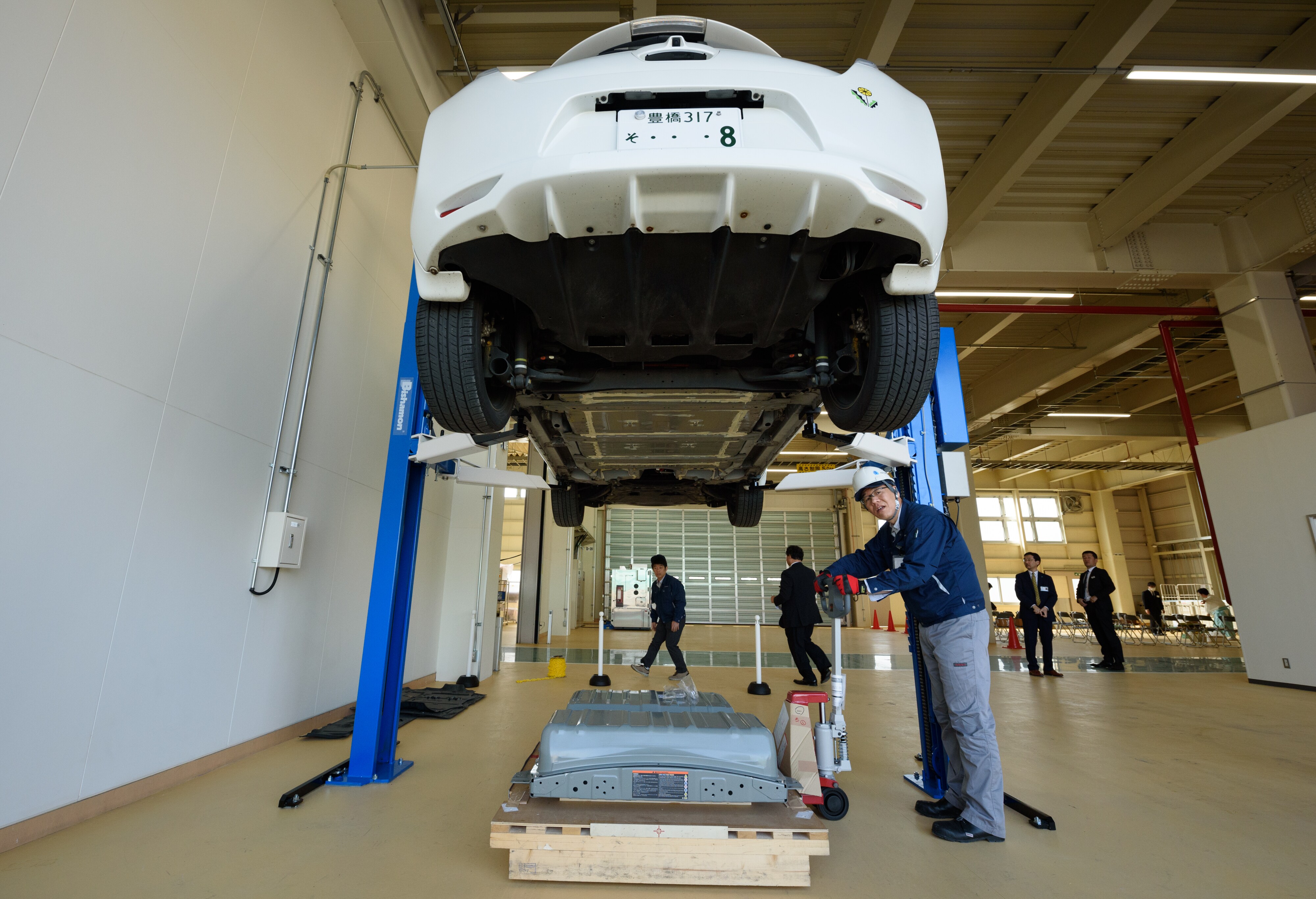
(Bloomberg) -- The first batches of batteries from electric and hybrid vehicles are hitting retirement age, yet they aren't bound for landfills. Instead, they'll spend their golden years chilling beer at 7-Elevens in Japan, powering car-charging stations in California and storing energy for homes and grids in Europe.
Lithium-ion car and bus batteries can collect and discharge electricity for another seven to 10 years after being taken off the roads and stripped from chassis -- a shelf life with significant ramifications for global carmakers, electricity providers and raw-materials suppliers.


General Motors Co., BMW AG, Toyota Motor Corp., BYD Co. and a clutch of renewable-energy storage suppliers are among those trying to create an aftermarket and extra profits for a device that only recently coalesced into its own market. Second lives generate second revenue streams for the same product, and those could help lower prices for EVs.
“The car manufacturers have an upcoming problem, and one that we are already starting to see: this massive volume of batteries,'' said Johan Stjernberg, chief executive officer of Box of Energy AB, a Swedish company working with Porsche and Volvo Cars. “The market will be enormous for second-life applications with storage.''
“The logic behind this is the circular economy,” said Cecile Sobole, program manager for Renault SA's EV business. “The battery coming from the electric vehicle will become more and more a part of the energy world.”
Yet as many companies dive in, the biggest U.S. electric-car maker -– Tesla Inc. –- stays on the sidelines. The Palo Alto, California-based company said its batteries probably won't be suitable for a new task after 10 to 15 years of use, and it's focusing on recovering the raw materials.

“A lithium-ion battery actually never dies,” said Hans Eric Melin, founder of London-based Circular Energy Storage Research and Consulting. “It's just like you can take an alkaline battery out of your flashlight and put it into a remote control, and it'll still be good enough.”
By 2025, about three-quarters of spent EV batteries will be reused and then recycled to harvest raw materials, Melin said. That means automakers and battery producers such as China's Contemporary Amperex Technology Ltd. can profit from the same pack several times.

Box of Energy, London-based Powervault Ltd. and Melbourne-based Relectrify Pty. are among those helping develop the second acts. And a slew of automakers are either partnering with them or doing it alone.
In the basements of a three-tower apartment complex in western Sweden, Box of Energy installed silver cabinets about the size of a large refrigerator, each using 20 battery modules recovered from Volvo hybrid cars. They store energy from rooftop solar panels to run the elevators and lights in common areas.

“So far, it's worked without a hitch,'' said Lennart Nord, caretaker of the buildings in Gothenburg.
The technology can cut a household electricity bill by more than a third, said Powervault, which plans to break down Renault Zoe battery packs for use in homes and schools in England this summer. Powervault's dishwasher-sized units can calculate when it's most economical to recharge from the grid and when it's best to tap into stored power.

Jeff Hardy, 44, is putting a Powervault unit in his Victorian terrace house in southeast London, and he expects to save about 110 pounds a year.
“It can basically supplement my solar and allow me to do more for free,'' said Hardy, an academic and consultant on the energy sector. “The manufacturing of EV batteries does have an impact on the environment. The fact that this is a reused product means that it's really reducing that footprint.''

Larger-scale systems also can cut costs for businesses. Batteries from Nissan's Leaf will soon help illuminate streets in the Japanese coastal town of Namie, which is recovering from the 2011 disaster at the nearby Fukushima Daiichi nuclear plant.
A new facility sifts through a mattress-sized battery in four hours to prepare its cells for several applications, including going back into an EV. Nissan envisions the site eventually churning through 10,000 batteries annually.

Toyota, maker of the Prius hybrid, will install retired batteries outside 7-Eleven stores in Japan next year. The hybrid batteries will store power from solar panels, and then use the juice when needed to help run the drink coolers, fried chicken warmers and sausage grills inside the stores.
A typical EV battery retains about 50 percent to 70 percent of its power capacity upon removal, said Tom Zhao, managing director of global sales for BYD's battery group. The Warren Buffett-backed company uses secondhand packs to power wireless transmission towers and to help run one of China's biggest energy-storage systems in Shenzhen.
“If you don't reuse, it's a huge waste,” Zhao said.
©2018 Bloomberg L.P.

-
Talking Points This Week: Tech Nerves, FII Buying, And A Faraway Banking Shock

The global markets are not shining this Diwali. The exception in the large markets is, India.
-
Midterm Rally Lasted A Day. The Hard Reality Of A Divided US May Last Two Years | Opinion
Between a contested AI boom, a debt ceiling that arrives in 2027 and a president with every incentive to act alone, the next two years may prove more volatile than the first day's rally suggests.
-
Blue Wave Will Derail the AI Trade but Won't Dismantle the AI Era | Unhedged Position
The Democrats' sweep of the US Congress will see politics collide with economic forces both over the long and short term.
-
It's Time To Take The GST Council's Bet On Trust Global
Payment records can prove India's services exports, and clear, proportionate rules can bring foreign digital sellers into the tax net.
-
Opinion | India at 38: From Innovation Overperformer to Innovation Powerhouse
India now has 453 VC-backed deep science startups, 18 of them late-stage, after 117 percent growth since 2020. Laurus Labs, at USD 9.3 billion, is the most valuable deep science company in any middle-income economy outside China.
-
Navigating Energy Crossroads: S Jaishankar's Call For Diversified Supply Chains At G20 Ministerial Meeting
As geopolitical fault lines continue to test maritime trade routes and commodity flows, Jaishankar's message remains pertinent: true economic resilience requires open markets, protected transit lines, and a genuine commitment to multilateral cooperation rather than coercion.
-
Indians Are Travelling, But Not Every Journey Is A Holiday | The Week In Whys
Pilgrims, patients and working women are the real travellers, and the system hasn't quite caught up with them.
-
Getting To Work Costs Women More | The Reason Why
It is not just about women paying more than men. It is about women paying much more in cities than in villages.
-
AI Bias In Investing Cannot Be Eliminated, But It Can Be Governed
Framing is a particularly important example as identical financial information presented in terms of gains rather than losses can lead an LLM to reach a different assessment.









