What To Expect From US Federal Reserve Meeting Next Week?: ING's Outlook
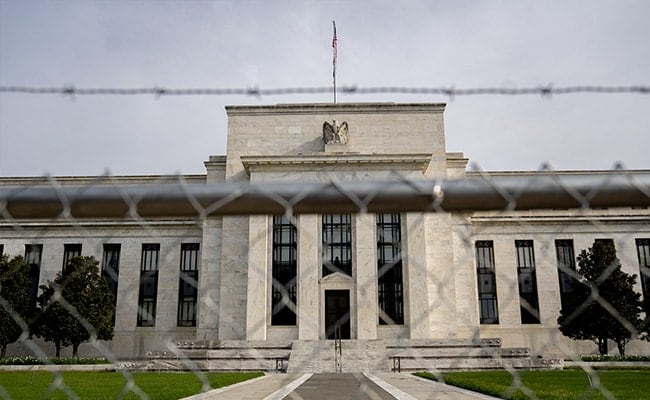
- "A 50bp ( basis point) interest rate hike from the Federal Reserve is widely expected given recent commentary from officials and the fact inflation is well above target and unemployment is just 3.6%. The negative 1Q GDP print will be shrugged off with quantitative tightening also announced. We continue to see the risks skewed toward swifter, more aggressive action"
- "What's priced for Fed tightening and how it stacks up against previous cycles?" "The Federal Reserve is widely expected to raise its policy rate by 50 basis points next Wednesday as 8%+ inflation and a tight labour market trump the surprise 1Q GDP contraction attributed to temporary trade and inventory challenges."
- "Moreover, consumer spending remained firm and the contribution from investment was solid and we expect this to continue into the second quarter. Wages are rising rapidly amid a dearth of workers and this will contribute to keeping inflation elevated through this year. Indeed, we don't expect inflation readings to drop meaningfully below 4% before year end."
- "That said, the weakness in GDP makes it less likely that we will hear the Fed explicitly making the case for a more aggressive 75bp hike at the June or July FOMC meetings. This has been raised as a potential course of action by St Louis Fed President James Bullard. We are open to the possibility, but that would probably require a decent set of consumer spending numbers over the coming months and some very solid jobs gains that contribute to further wage pressures."
- "For now, our base case remains that the Fed will follow up next week's 50bp hike with 50bp increases in June and July before switching to 25bp as quantitative tightening gets up to speed. We see the Fed funds rate peaking at 3% in early 2023."
- "Pulling the trigger on Quantitative Tightening: We will also be looking for the Fed to formally announce quantitative tightening on Wednesday. The minutes to the March FOMC meeting showed 'all participants' felt the need to announce the 'commencement of balance sheet runoff at a coming meeting'."
- "Given the doubling of the size of the balance sheet since the last round of Quantitative Tightening in 2017-19, this would be done at a “faster pace” than back then. The minutes suggested 'participants generally agreed that monthly caps of about $60 billion for Treasury securities and about $35 billion for agency MBS would likely be appropriate' versus the peak total $50bn run-off seen last time around."
- "This would be a 'phased in' roll-off cap of maturing assets that could last 3+ months depending on market conditions. We expect it to start with $50bn being allowed to run off each month before getting up to $95bn by September."
- "As long as the Fed doesn't blink, the dollar stays bid: Trade weighted measures of the dollar are going into next week's Fed meeting on their cyclical highs. Driving this trend remains the conviction that the Fed has the most cause of any G10 central bank to rush monetary policy to normal. At the same time, the external environment of war in Europe and continued lockdowns in China are weighing on pro-cyclical currencies..."
- "Assuming that the Fed does not start to have second thoughts about the pace of its tightening cycle – and that seems unlikely – the re-iteration of an 'expeditious' normalisation of policy should keep the short end of the US yield curve supported and the dollar bid. A key driver of dollar strength since June last year has been the re-pricing of the Fed cycle and it still seems too early to make a call, with any confidence, that the top has been reached."

-
Unhedged Position: Can India See An Indonesia-Style Time Correction?

The Nifty is trading below levels it first clocked in 2024. Is there, then, as I have suggested in the headline, potential that the current time correction drags on painfully for the next three-five, even ten years?
-
Navigating Friction And Energy Realities: An Analysis Of Marco Rubio's October Visit To India
Occurring at a critical juncture marked by stalled trade negotiations and escalating geopolitical pressures over global energy supplies, the visit offers a profound window into modern US-India relations.
-
India Exports Capital. Why Not Export Trusteeship?
The big question, then, is whether India can build an institution that global borrowers, investors, banks, and lawyers can trust, even without an Indian connection.
-
France's Economy & Politics Are In Crisis | The Reason Why
Let's look at how the French economy and politics evolved under Nicolas Sarkozy, Franois Hollande and Emmanuel Macron.
-
You May Inherit The Business. You Must Earn Its Credibility.
Succession tests the founder's ability to share authority as much as it tests the next generation's readiness to assume it.
-
Signing Deals Is One Thing; Making Them Work Is Another | The Week In Whys
Sometimes, things don't turn out as planned. Indian companies have lost some bids to rivals, some projects won't produce until 2030.
-
FOMC Wall, PERM Suspension, Hospital Stocks | Talking Points This Week
A PERM suspension would directly affect green-card sponsorship rather than H-1B visas, so the near-term earnings impact could remain relatively limited. The key question is whether this marks a new phase in US scrutiny of Indian IT.
-
Everything, Everywhere, All At Once: Dalal Street's Week To Forget | Joining The Dots
Visa curbs, a Starlink spat and cancer drug caps: what connects this week's shocks for Indian markets
-
India Is Going Abroad For Critical Minerals. But It May Take Years To Pay Off | The Reason Why
Although India's steps are in the right direction, they remain modest compared with India's growing dependence.
-
When Everyone Has AI, What Gives You An Edge?
India's young workforce is entering an uncertain world of work where powerful AI tools are becoming widely accessible. The advantage will belong to those who combine deep expertise with digital fluency, and the distinctly human capabilities that technology cannot manufacture.









