Currency Devaluation To Promote Exports Detrimental To Nation's Interest: Piyush Goyal
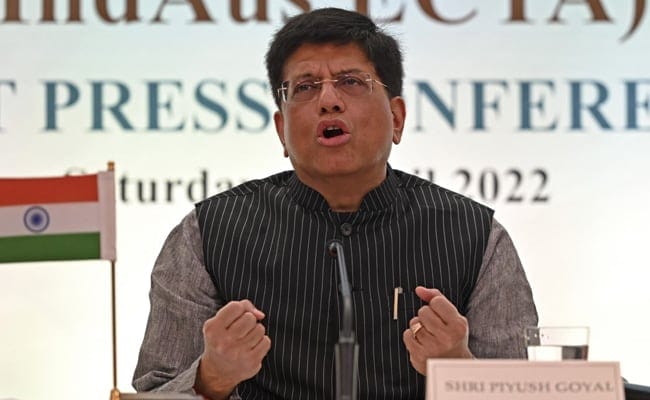
Dismissing the contention that currency devaluation encourages exports, Commerce and Industry Minister Piyush Goyal on Wednesday said weakening of the rupee would not be in the nation's interest in the long run.
He also said it is important for India to expand exports significantly and encourage investments to increase foreign exchange inflows into the country.
"There is a large pool of thought which believes that you need to devalue your currency so that you become competitive in export market...
"I can assure you from my own experience and my engagements with large sections of industry across the board confirms that rupee devaluation or weakening our currency is actually detrimental to our nation's interest, to our growth story and to our ability to be competitive in the long run," Mr Goyal said at an event to mark the 15th Civil Services Day.
The minister added that devaluation increases cost of imports, brings inflation into the country, pushes up interest cost and makes products uncompetitive as India is import-dependent for raw materials.
He added that healthy exports, investments and remittances help in growing foreign exchange reserves, which stand at over $600 billion.
Export helps in earning precious foreign exchange and keeps the rupee stable, he noted.
The minister further said exports during April 1-14 have increased to $18.5 billion.
India's pharma exports hold huge potential and can increase to $200 billion in the coming years, Mr Goyal noted.
On free trade pacts, he said these agreements are "two-way traffic" and help both sides.
Speaking earlier at the event, Commerce Secretary BVR Subrahmanyam emphasised on the need to rewrite old laws, recast processes and embrace technology to boost the size of Indian economy to USD 30-40 trillion in the coming years.
"We also need to improve capacities of our people in our systems...We also need a mindset change," he said at a session titled 'Vision India @2047 - Governance'.
The secretary asked the civil servants to re-engineer their departments and make them world class so that India becomes a global power.
"Re-write the laws...embrace technology as it is the enabler and absolutely essential. Standardise processes and develop SOPs (standard operating procedures) for all activities," he said, adding, "We should work for growth which is led by the private sector." He called for focusing on the needs to private sector as they need lower cost of business and logistics.
"Mark my word, India is not a part of global value chain, we are making great efforts....There are explicit instructions in countries in western economies to source their products from other countries, it's not happening in India through the scale it should happen...," he added.
Addressing the event, Union Labour Secretary Sunil Barthwal said, "India still has wage cost advantage. China has lost that advantage. We have huge demographic dividends which will contribute for 25 years." He also stressed on the huge potential of engaging more workers as labour force participation rate stands at 52 per cent.

-
Midterm Rally Lasted A Day. The Hard Reality Of A Divided US May Last Two Years | Opinion

Between a contested AI boom, a debt ceiling that arrives in 2027 and a president with every incentive to act alone, the next two years may prove more volatile than the first day's rally suggests.
-
Blue Wave Will Derail the AI Trade but Won't Dismantle the AI Era | Unhedged Position
The Democrats' sweep of the US Congress will see politics collide with economic forces both over the long and short term.
-
It's Time To Take The GST Council's Bet On Trust Global
Payment records can prove India's services exports, and clear, proportionate rules can bring foreign digital sellers into the tax net.
-
Opinion | India at 38: From Innovation Overperformer to Innovation Powerhouse
India now has 453 VC-backed deep science startups, 18 of them late-stage, after 117 percent growth since 2020. Laurus Labs, at USD 9.3 billion, is the most valuable deep science company in any middle-income economy outside China.
-
Navigating Energy Crossroads: S Jaishankar's Call For Diversified Supply Chains At G20 Ministerial Meeting
As geopolitical fault lines continue to test maritime trade routes and commodity flows, Jaishankar's message remains pertinent: true economic resilience requires open markets, protected transit lines, and a genuine commitment to multilateral cooperation rather than coercion.
-
Indians Are Travelling, But Not Every Journey Is A Holiday | The Week In Whys
Pilgrims, patients and working women are the real travellers, and the system hasn't quite caught up with them.
-
Getting To Work Costs Women More | The Reason Why
It is not just about women paying more than men. It is about women paying much more in cities than in villages.
-
AI Bias In Investing Cannot Be Eliminated, But It Can Be Governed
Framing is a particularly important example as identical financial information presented in terms of gains rather than losses can lead an LLM to reach a different assessment.
-
Joining The Dots | Dark Skies, Steady Diya: Why Hope Holds This Diwali
With war, a weak rupee and foreign outflows weighing on sentiment, policymakers at the NDTV World Summit and market veterans at NDTV Profit Ignite: Diwali Edition offered the same advice: stay invested and filter out the noise.









