Warren Buffett Upbeat On US, Berkshire, Buys Back Stock Amid Covid-19 Pandemic
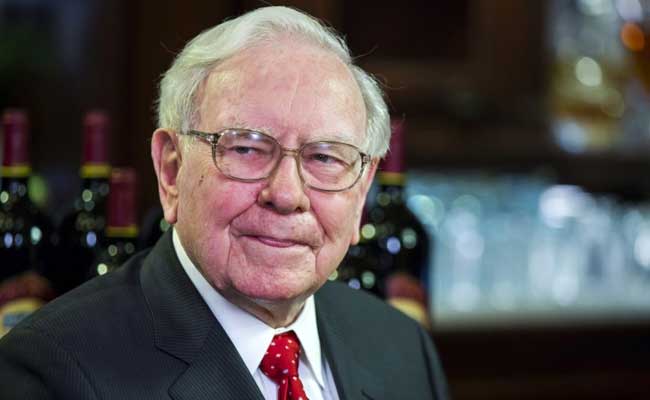
Warren Buffett's enthusiasm for the future of America and his company Berkshire Hathaway Inc has not been dimmed by the coronavirus pandemic.
Mr Buffett used his annual letter to investors to assure he and his successors would be careful stewards of their money at Berkshire, where "the passage of time" and "an inner calm" would help serve them well.
Despite the disappearance last year of more than 31,000 jobs from Berkshire's workforce, Mr Buffett retained his trademark optimism, buying back a record $24.7 billion of its stock in 2020 in a sign he considers it undervalued.
He also hailed the economy's capacity to endure "severe interruptions" and enjoy "breathtaking" progress.
"Our unwavering conclusion: Never bet against America," he said.
Tom Russo, a partner at Gardner, Russo & Gardner in Lancaster, Pennsylvania and longtime Berkshire investor, said: "He's a deep believer in his company and the country."
The letter breaks an uncharacteristic silence for the 90-year-old Mr Buffett, who has been almost completely invisible to the public since Berkshire's annual meeting last May.
But while touching on familiar themes, including Wall Street bankers' avarice for dealmaking fees that benefit them more than companies they represent, Buffett did not dwell on the pandemic, a prime factor behind Berkshire's job losses.
He also did not address recent social upheavals or the divisive political environment that some companies now address more directly.
"The letter highlighted the innovation and values that have become the backbone of America, and that's perfectly acceptable," said Cathy Seifert, an analyst at CFRA Research with a "hold" rating on Berkshire.
"Given the reverence that investors have for him, the letter was striking for what it omitted," she added. "A new generation of investors demands a degree of social awareness, and that companies like Berkshire set out their beliefs, standards and goals."
Mr Buffett also signaled a long-term commitment to Apple Inc, where Berkshire ended 2020 with $120.4 billion of stock despite recently selling several billion dollars more.
He called Apple and the BNSF railroad Berkshire's most valuable assets - "it's pretty much a toss-up" - other than its insurance operations, and ahead of Berkshire Hathaway Energy. "The family jewels," he called those four investments.
Profit Rises Even As Jobs Are Lost
Berkshire on Saturday also reported net income of $35.84 billion in the fourth quarter, and $42.52 billion for the year, both reflecting large gains from its stocks.
Operating income, which Buffett considers a more accurate measure of performance, fell 9% for the year to $21.92 billion.
The stock buybacks have continued in 2021, with Berkshire repurchasing more than $4 billion of its own stock. It ended 2020 with $138.3 billion of cash.
However, Mr Buffett bemoaned fixed income as an investment, saying that "bonds are not the place to be these days." The income from a 10-year U.S. Treasury bond fell 94% from a 15.8% yield in September 1981 to 0.93% at the end of 2020. Benchmark Treasury yields have jumped since but are still low by historic measures.
"Fixed-income investors worldwide - whether pension funds, insurance companies or retirees - face a bleak future," the letter said.
Berkshire, based in Omaha, Nebraska, has more than 90 operating units including the BNSF railroad, Geico car insurer, Dairy Queen ice cream and See's candies.
Its workforce declined 8% from a year earlier to about 360,000 employees. Bigger drops were reported at BNSF, which shed 5,600 jobs, and See's, where employment fell 16%.
The pandemic hit no Berkshire business harder than Precision Castparts Corp, which shed 13,473, or 40%, of its jobs.
Berkshire bought the aircraft and industrial parts maker in 2016 for $32.1 billion, Mr Buffett's largest acquisition, and took a $9.8 billion writedown as the pandemic decimated travel and punished Precision's aerospace customers.
"I paid too much for the company," Mr Buffett wrote. "I was simply too optimistic about PCC's normalized profit potential.
"PCC is far from my first error of that sort," he said. "But it's a big one."
Berkshire said some businesses are beginning to recover form the pandemic.
"Certainly 2021 is going to be a much stronger year, dependent upon the speed of vaccinations and the opening of the U.S. economy," said Jim Shanahan, an analyst at Edward Jones & Co with a "buy" rating on Berkshire.
Mr Buffett also said Berkshire's annual meeting will be held in Los Angeles rather than Omaha, allowing 97-year-old Vice Chairman Charlie Munger, a Californian, to rejoin him and answering about 3-1/2 hours of shareholder questions.
Vice Chairmen Greg Abel, 58, and Ajit Jain, 69, who are widely considered frontrunners to succeed Mr Buffett as chief executive, will also be available to answer questions.
Mr Buffett said he hopes Berkshire will in 2022 resume its annual shareholder weekend in Omaha, which normally draws around 40,000 people - an "honest-to-God annual meeting, Berkshire-style," he wrote.

-
Where You Live Shapes How You Get To Work | The Reason Why

Two-wheelers are the most popular way to get to work in India, accounting for nearly 43% of workplace commutes.
-
High US Salaries, No Green Card Certainty: The Financial Calculation Facing Indian H-1B Families
The suspension of PERM processing at eight technology employers does not cancel existing H-1B visas. What it does is force a question many Indian families have been avoiding: is the US salary worth tying your career and family plans to one employer?
-
Unhedged Position: Can India See An Indonesia-Style Time Correction?
The Nifty is trading below levels it first clocked in 2024. Is there, then, as I have suggested in the headline, potential that the current time correction drags on painfully for the next three-five, even ten years?
-
Navigating Friction And Energy Realities: An Analysis Of Marco Rubio's October Visit To India
Occurring at a critical juncture marked by stalled trade negotiations and escalating geopolitical pressures over global energy supplies, the visit offers a profound window into modern US-India relations.
-
India Exports Capital. Why Not Export Trusteeship?
The big question, then, is whether India can build an institution that global borrowers, investors, banks, and lawyers can trust, even without an Indian connection.
-
France's Economy & Politics Are In Crisis | The Reason Why
Let's look at how the French economy and politics evolved under Nicolas Sarkozy, Franois Hollande and Emmanuel Macron.
-
You May Inherit The Business. You Must Earn Its Credibility.
Succession tests the founder's ability to share authority as much as it tests the next generation's readiness to assume it.
-
Signing Deals Is One Thing; Making Them Work Is Another | The Week In Whys
Sometimes, things don't turn out as planned. Indian companies have lost some bids to rivals, some projects won't produce until 2030.
-
FOMC Wall, PERM Suspension, Hospital Stocks | Talking Points This Week
A PERM suspension would directly affect green-card sponsorship rather than H-1B visas, so the near-term earnings impact could remain relatively limited. The key question is whether this marks a new phase in US scrutiny of Indian IT.
-
Everything, Everywhere, All At Once: Dalal Street's Week To Forget | Joining The Dots
Visa curbs, a Starlink spat and cancer drug caps: what connects this week's shocks for Indian markets









