Buffett’s Apple Sale Brings Value Back To Quality Investing
(Bloomberg Opinion) -- Warren Buffett's longtime business partner Charlie Munger brought quality to value investing. Now Buffett is bringing value to quality investing.
At Berkshire Hathaway Inc.'s annual meeting in May, Buffett revealed that he had trimmed his stake in Apple Inc., inarguably one of the best businesses in the world. Buffett reassured the Berkshire faithful that he is no less enthusiastic about the company, calling the iPhone one of the greatest products of all time and Apple an even more wonderful business than American Express Co. and Coca Cola Co., two prominent investments in Berkshire's portfolio.
That turned out to be just the beginning. Earlier this month, Berkshire announced that it had sold nearly half its position in Apple, presumably not because the iPhone maker became any less wonderful in the intervening three months. Buffett hinted in May that tax planning was behind the sale. Some observers have speculated that Buffett is simply trimming Apple's outsize position in Berkshire's portfolio.
I suspect there's another, more important, reason: Apple has become too expensive.
When Buffett began his career, he was a deep value investor, buying, in Munger's words, fair businesses at wonderful prices. In the 1960s, Munger persuaded Buffett to flip the formula and buy wonderful businesses at fair prices. Investors have started to embrace the strategy of putting quality before value. I counted 115 stock mutual funds and exchange-traded funds with quality in their name. The vast majority are less than 10 years old, but investors have poured in $141 billion so far and that number is growing.
In essence, quality looks for companies that are highly profitable, churn out reliable earnings and have little debt, or some combination of those attributes. Valuation is less important. In fact, the biggest quality funds track indexes that look for high-quality companies with little or no regard for valuation.
The strategy has a lot of data to recommend it. Shares of the most profitable 30% of US companies, sorted by return on equity and weighted by market value, have outpaced the least profitable 30% by 4.1 percentage points a year since 1963 through June, including dividends, according to data compiled by Tuck School of Business Professor Ken French. They also won 92% of the time over rolling 10-year periods. So, on a relative basis, quality stocks won most of the time regardless of valuation.
On an absolute basis, however, valuation was more important. The most profitable stocks in the data are further split based on price-to-book ratio. The weighted average P/B ratio of the cheaper group doesn't vary much and appears to have no impact on future returns (monthly correlation of -0.08 with forward 10-year total returns). The P/B ratio of the pricier group, on the other hand, varies wildly and is strongly negatively correlated with subsequent 10-year returns (-0.67), meaning that a higher ratio was most often followed by a lower return, and vice versa.
When it comes to high-quality stocks, in other words, the more investors pay, the less they should expect to earn. Or, in Munger's parlance, buy wonderful companies but watch that price closely. Which brings us back to Buffett. When he started buying Apple in 2016, it wasn't just a wonderful company at a fair price — it was a steal. I prefer price-earnings ratios to P/B ratios when valuing technology companies because they generally own fewer assets than, say, banks or manufacturers, which can make their P/B ratios seem chronically high by comparison.
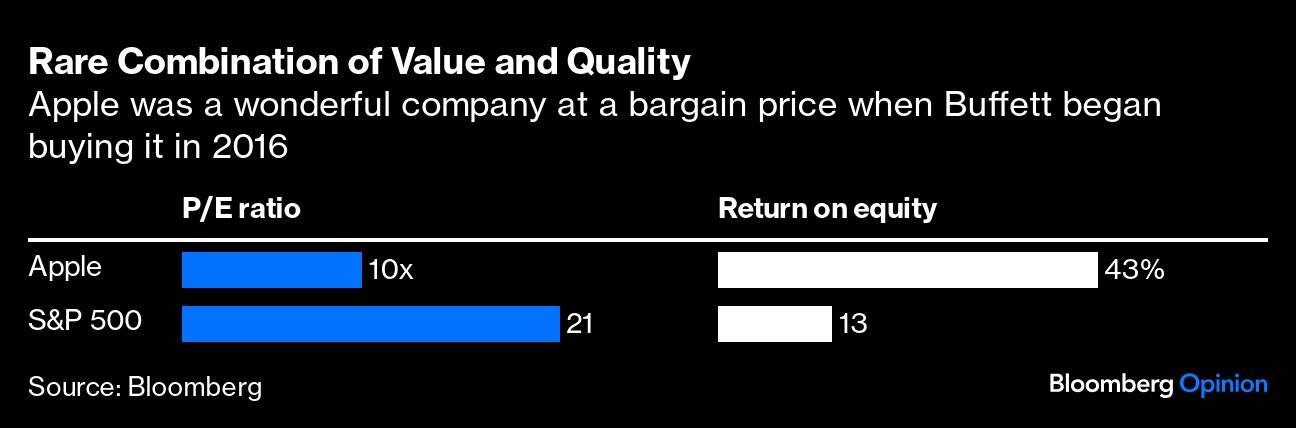
In early 2016, Apple was bona fide high quality. Its return on equity, a common measure of profitability, was 43% for the most recent year, more than three times that of the S&P 500 Index. Amazingly, it was also a deep value company trading at just 10 times its most recent full-year operating earnings, less than half the P/E ratio of the S&P 500.
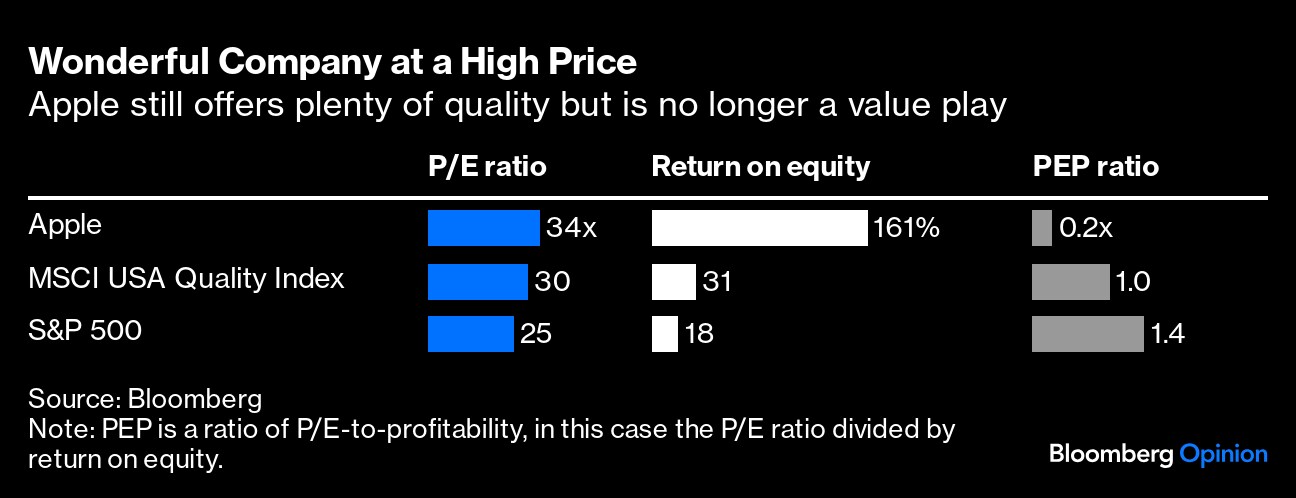
That deal is no longer on the table. Apple is even more profitable now, but at 34 times earnings, it's also more than three times as expensive.
It's not just Apple. The MSCI USA Quality Index traded as low as 12 times its most recent full-year earnings in 2013. It was even cheaper than the S&P 500 at the time despite posting nearly double the return on equity. It's still more profitable today but also more expensive, with a P/E ratio nearly as high as Apple's.
It's easy to ignore valuations when companies post big profits and share prices surge, as US quality stocks have done over the past decade. Buffett's sale of Apple, whatever his motivation, is a reminder that quality is great but not at any cost.More From Bloomberg Opinion:
- Big Tech Broke a Market Barometer. Time to Fix It: Nir Kaissar
- The Tell in Buffett's $277 Billion Cash Hoard: Jonathan Levin
- Is Private Equity a Threat? We Need a Better Answer: Editorial
This column does not necessarily reflect the opinion of the editorial board or Bloomberg LP and its owners.
Nir Kaissar is a Bloomberg Opinion columnist covering markets. He is the founder of Unison Advisors, an asset management firm.
More stories like this are available on bloomberg.com/opinion
©2024 Bloomberg L.P.

-
Ten Things I Learnt This Samvat

Patience can be a trap. Cheap stocks can stay cheap. Leverage can wipe you out. What did Samvat 2082 teach us? Niraj Shah writes on 10 lessons from the year gone by.
-
Talking Points This Week: Tech Nerves, FII Buying, And A Faraway Banking Shock
The global markets are not shining this Diwali. The exception in the large markets is, India.
-
Midterm Rally Lasted A Day. The Hard Reality Of A Divided US May Last Two Years | Opinion
Between a contested AI boom, a debt ceiling that arrives in 2027 and a president with every incentive to act alone, the next two years may prove more volatile than the first day's rally suggests.
-
Blue Wave Will Derail the AI Trade but Won't Dismantle the AI Era | Unhedged Position
The Democrats' sweep of the US Congress will see politics collide with economic forces both over the long and short term.
-
It's Time To Take The GST Council's Bet On Trust Global
Payment records can prove India's services exports, and clear, proportionate rules can bring foreign digital sellers into the tax net.
-
Opinion | India at 38: From Innovation Overperformer to Innovation Powerhouse
India now has 453 VC-backed deep science startups, 18 of them late-stage, after 117 percent growth since 2020. Laurus Labs, at USD 9.3 billion, is the most valuable deep science company in any middle-income economy outside China.
-
Navigating Energy Crossroads: S Jaishankar's Call For Diversified Supply Chains At G20 Ministerial Meeting
As geopolitical fault lines continue to test maritime trade routes and commodity flows, Jaishankar's message remains pertinent: true economic resilience requires open markets, protected transit lines, and a genuine commitment to multilateral cooperation rather than coercion.
-
Indians Are Travelling, But Not Every Journey Is A Holiday | The Week In Whys
Pilgrims, patients and working women are the real travellers, and the system hasn't quite caught up with them.
-
Getting To Work Costs Women More | The Reason Why
It is not just about women paying more than men. It is about women paying much more in cities than in villages.









