Wall Street Rattled by Selloff, Trading Halts at Two Small Banks
(Bloomberg) -- Just a day after Wall Street breathed a sigh of relief with the rescue of First Republic Bank, a tumble in US regional lenders fueled renewed anxiety over financial stability, sinking stocks across the board and spurring a flight to the safest corners of the market.
For many traders, the timing couldn't be worse.
On the eve of the Federal Reserve decision, multiple volatility halts in PacWest Bancorp and Western Alliance Bancorp were seen as disturbing. Both shares were down at least 15% in Tuesday trading. The financial industry weighed heavily on the S&P 500 Index, which sank almost 2% at one point.
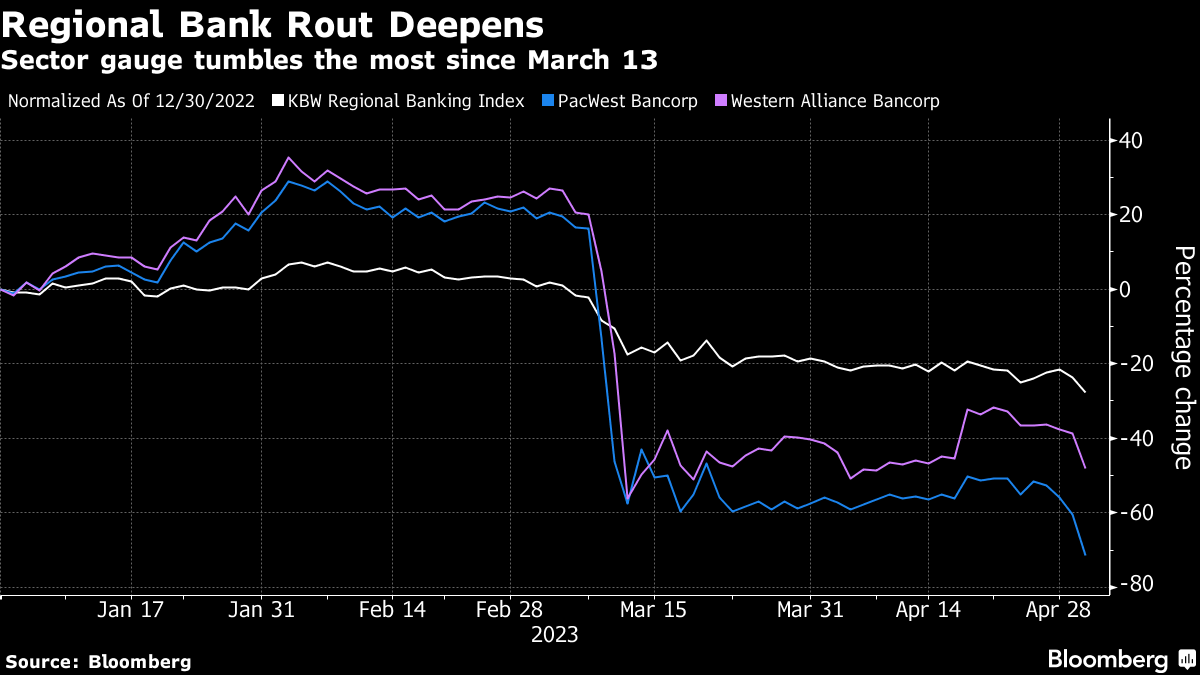
Bearish hedge-fund traders were present in a bout of selling that later prompted long-only investors to sell too, according to a note from John Flood, a partner at Goldman Sachs Group Inc.
“Wall Street is quickly hitting the sell button as banking turmoil appears it is not going away anytime soon,” said Ed Moya, senior market analyst at Oanda. “Risk appetite did not stand a chance as traders focused on lingering doubts over the regional banks, rising recession odds, and growing risks that the US could default on its debt next month.”
All of these factors combined are only deepening a sense of uneasiness among investors about the Fed's conundrum.
In addition to the financial strains stemming from bank failures, officials remain caught between stubbornly high inflation and data pointing to an economic downturn — such as Tuesday's JOLTS record of job openings that fell to the lowest in nearly two years.
Debt Ceiling
To make matters worse, there's brewing angst over the US debt ceiling — which only adds to the whole discussion on whether the Fed should pause after hiking in May to prevent a more severe economic recession.
While swaps are still pricing in a quarter-point Fed rate increase this week, traders trimmed their bets on a subsequent hike — while amping up wagers on cuts before the year is over.
With all those elements in play, it shouldn't come as a surprise that bonds got heavily bid Tuesday — especially after the selloff of the previous session. Two-year rates, which are more sensitive to imminent Fed moves, plunged as much as 21 basis points to below 4%.
Meantime, Treasury bill yields for June topped 5% in the wake of a warning from Janet Yellen that the US government could run into debt-ceiling limitations as soon as the start of next month.
More stories like this are available on bloomberg.com
©2023 Bloomberg L.P.

-
Ten Things I Learnt This Samvat

Patience can be a trap. Cheap stocks can stay cheap. Leverage can wipe you out. What did Samvat 2082 teach us? Niraj Shah writes on 10 lessons from the year gone by.
-
Talking Points This Week: Tech Nerves, FII Buying, And A Faraway Banking Shock
The global markets are not shining this Diwali. The exception in the large markets is, India.
-
Midterm Rally Lasted A Day. The Hard Reality Of A Divided US May Last Two Years | Opinion
Between a contested AI boom, a debt ceiling that arrives in 2027 and a president with every incentive to act alone, the next two years may prove more volatile than the first day's rally suggests.
-
Blue Wave Will Derail the AI Trade but Won't Dismantle the AI Era | Unhedged Position
The Democrats' sweep of the US Congress will see politics collide with economic forces both over the long and short term.
-
It's Time To Take The GST Council's Bet On Trust Global
Payment records can prove India's services exports, and clear, proportionate rules can bring foreign digital sellers into the tax net.
-
Opinion | India at 38: From Innovation Overperformer to Innovation Powerhouse
India now has 453 VC-backed deep science startups, 18 of them late-stage, after 117 percent growth since 2020. Laurus Labs, at USD 9.3 billion, is the most valuable deep science company in any middle-income economy outside China.
-
Navigating Energy Crossroads: S Jaishankar's Call For Diversified Supply Chains At G20 Ministerial Meeting
As geopolitical fault lines continue to test maritime trade routes and commodity flows, Jaishankar's message remains pertinent: true economic resilience requires open markets, protected transit lines, and a genuine commitment to multilateral cooperation rather than coercion.
-
Indians Are Travelling, But Not Every Journey Is A Holiday | The Week In Whys
Pilgrims, patients and working women are the real travellers, and the system hasn't quite caught up with them.
-
Getting To Work Costs Women More | The Reason Why
It is not just about women paying more than men. It is about women paying much more in cities than in villages.









