Volkswagen Says 20,000 Workers Agree To Early Departures
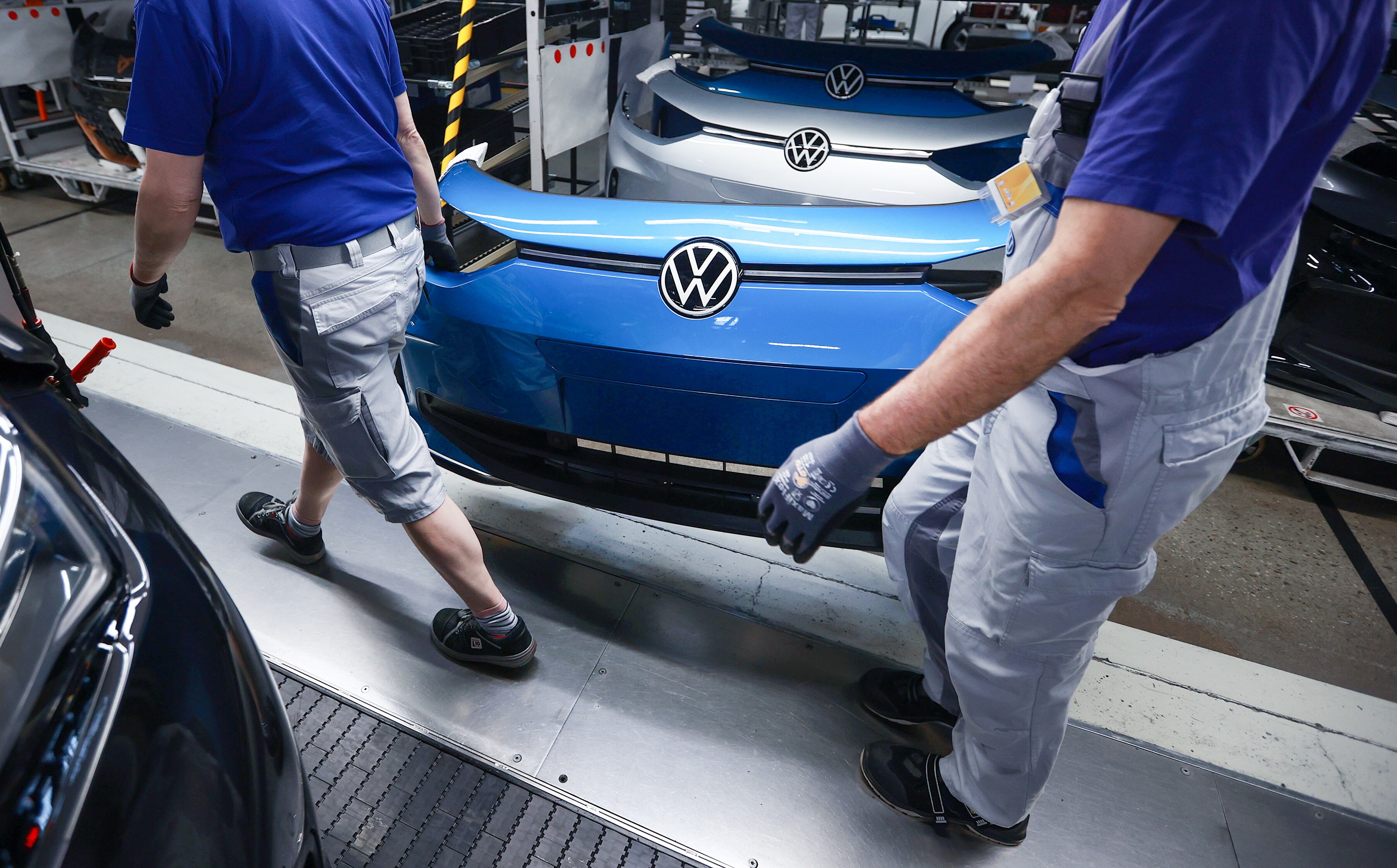
Volkswagen AG said about 20,000 employees will voluntarily leave the company by the end of the decade as the carmaker restructures its German operations to cope with uneven demand for its vehicles.
The result shows that the company's restructuring plans are on track, Gunnar Kilian, Volkswagen's head of human relations and board member, told employees Tuesday at a workers assembly in Wolfsburg.
“With measurable progress on factory costs in Wolfsburg and socially responsible job cuts at Volkswagen AG's six German sites alone, we are accelerating our transformation,” Kilian said. “Around 20,000 departures from the company by 2030 have already been contractually agreed.”
Europe's largest carmaker is in the process of reducing production capacity and headcount in Germany due to rising costs, weaker demand in Europe and the rapid rise of Chinese competitors.
VW brand management and labor leaders struck a deal in December to cut German production capacity by more than 700,000 units and decrease headcount by 35,000 jobs by the end of the decade. Sister brands Audi and Porsche are also cutting jobs to reduce costs.
The VW brand has more than 120,000 employees in Germany. The 35,000 targeted cuts represent about a quarter of the brand's workforce and roughly 12% of Volkswagen group's employees in the country.
Workers have agreed to leave the company by 2030 via early retirement, normal retirement or termination agreements. The bulk of the voluntary departures are retirements, though the carmaker has so far declined to say how many workers agreed to severance packages, for which it set aside €900 million last year.
Employees also heard from the VW brand's chief financial officer, David Powels, who said the company needed to address “excessive investment, low returns on electric vehicles and a break-even point that is too high.”

-
High US Salaries, No Green Card Certainty: The Financial Calculation Facing Indian H-1B Families

The suspension of PERM processing at eight technology employers does not cancel existing H-1B visas. What it does is force a question many Indian families have been avoiding: is the US salary worth tying your career and family plans to one employer?
-
Swiggy vs Eternal: Food Delivery's Two Rivals Are No Longer In The Same Race
Eternal is building a private AI assistant, dark.ai. Swiggy is still working out how to make Instamart pay, with an operating loss of Rs 895 crore in the July-September quarter while Blinkit stayed profitable.
-
Where You Live Shapes How You Get To Work | The Reason Why
Two-wheelers are the most popular way to get to work in India, accounting for nearly 43% of workplace commutes.
-
Unhedged Position: Can India See An Indonesia-Style Time Correction?
The Nifty is trading below levels it first clocked in 2024. Is there, then, as I have suggested in the headline, potential that the current time correction drags on painfully for the next three-five, even ten years?
-
Navigating Friction And Energy Realities: An Analysis Of Marco Rubio's October Visit To India
Occurring at a critical juncture marked by stalled trade negotiations and escalating geopolitical pressures over global energy supplies, the visit offers a profound window into modern US-India relations.
-
India Exports Capital. Why Not Export Trusteeship?
The big question, then, is whether India can build an institution that global borrowers, investors, banks, and lawyers can trust, even without an Indian connection.
-
France's Economy & Politics Are In Crisis | The Reason Why
Let's look at how the French economy and politics evolved under Nicolas Sarkozy, Franois Hollande and Emmanuel Macron.
-
You May Inherit The Business. You Must Earn Its Credibility.
Succession tests the founder's ability to share authority as much as it tests the next generation's readiness to assume it.
-
Signing Deals Is One Thing; Making Them Work Is Another | The Week In Whys
Sometimes, things don't turn out as planned. Indian companies have lost some bids to rivals, some projects won't produce until 2030.
-
FOMC Wall, PERM Suspension, Hospital Stocks | Talking Points This Week
A PERM suspension would directly affect green-card sponsorship rather than H-1B visas, so the near-term earnings impact could remain relatively limited. The key question is whether this marks a new phase in US scrutiny of Indian IT.









