Wall Street Registers Worst Week In A Decade
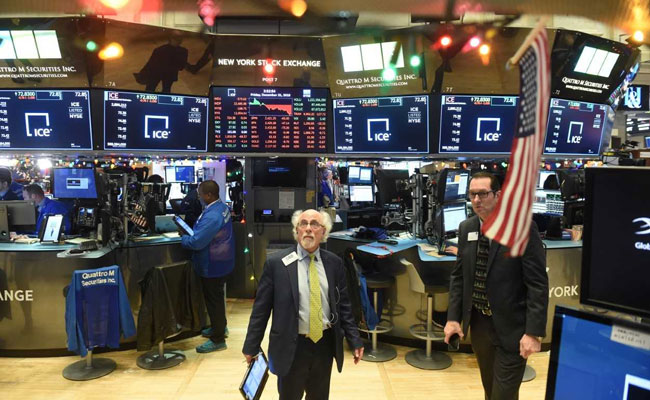
Wall Street ended its worst week in a decade with more bruising losses Friday, and with the tech-rich Nasdaq entering a bear market amid worries about trade wars and a possible US government shutdown.
The Nasdaq and Dow suffered their worst weeks since the start of the global financial crisis as the US-China trade dispute returning to the forefront, and amid continued concerns about the Federal Reserve's plans for interest rate increases.
"It has been a remarkably terrible trading week for financial markets amid concerns over rising US interest rates, decelerating global growth, Brexit uncertainty and chaos in Washington," said Lukman Otunuga, a research analyst at FXTM.
The Dow Jones Industrial Average finished the week with a loss of nearly seven per cent, after losing 1.8 per cent or more than 400 points Friday, to close at 22,445.37.
Markets elsewhere were mixed, with European bourses flat or rising slightly, while Tokyo slid.
The Wall Street decline came as Washington teetered towards a likely government shutdown as US President Donald Trump dug in on threats to close if congressional Democrats continue to refuse his demand for funds to build a wall on the border of Mexico.
Thousands of US government employees could be furloughed without a paycheck right before the end-of-year holidays if Trump and congressional Democrats fail to strike a deal by midnight (0500 GMT Saturday).
With that deadline looming, investors received another jolt in the final hour of trading when White House advisor Peter Navarro delivered hardline comments on the ongoing trade talks with China.
"China is basically trying to steal the future of Japan, the US and Europe, by going after our technology," Navarro, a longtime China hawk, told the Japan's Nikkei news agency in an interview conducted Thursday but published Friday.
And he said China must address all US concerns about its trade policies, saying there are "no half-measures."
Investors also have been anxious over the surprise resignation of Defence Secretary Jim Mattis, who laid out significant policy disagreements with the US president in his letter to Trump which he made public.
"We are in a fragile environment," said Gregori Volokhine of Meeschaert Financial Services.
"The extremist position is winning in the Trump administration, not just on trade but on everything."
Investors have been unnerved by the Federal Reserve's decision to raise interest rates this week, and projecting it would continue to raise next year.
New York Federal Reserve Bank President John Williams on Friday tried to tamp down market concerns, opening the door to a more benign monetary policy in 2019, saying the Fed was listening to the fears about the risks and will "be ready to reassess and re-evaluate our views and our policy stance."
Stocks briefly rallied on Williams remarks, but fell quickly back into the red.

-
Where You Live Shapes How You Get To Work | The Reason Why

Two-wheelers are the most popular way to get to work in India, accounting for nearly 43% of workplace commutes.
-
High US Salaries, No Green Card Certainty: The Financial Calculation Facing Indian H-1B Families
The suspension of PERM processing at eight technology employers does not cancel existing H-1B visas. What it does is force a question many Indian families have been avoiding: is the US salary worth tying your career and family plans to one employer?
-
Unhedged Position: Can India See An Indonesia-Style Time Correction?
The Nifty is trading below levels it first clocked in 2024. Is there, then, as I have suggested in the headline, potential that the current time correction drags on painfully for the next three-five, even ten years?
-
Navigating Friction And Energy Realities: An Analysis Of Marco Rubio's October Visit To India
Occurring at a critical juncture marked by stalled trade negotiations and escalating geopolitical pressures over global energy supplies, the visit offers a profound window into modern US-India relations.
-
India Exports Capital. Why Not Export Trusteeship?
The big question, then, is whether India can build an institution that global borrowers, investors, banks, and lawyers can trust, even without an Indian connection.
-
France's Economy & Politics Are In Crisis | The Reason Why
Let's look at how the French economy and politics evolved under Nicolas Sarkozy, Franois Hollande and Emmanuel Macron.
-
You May Inherit The Business. You Must Earn Its Credibility.
Succession tests the founder's ability to share authority as much as it tests the next generation's readiness to assume it.
-
Signing Deals Is One Thing; Making Them Work Is Another | The Week In Whys
Sometimes, things don't turn out as planned. Indian companies have lost some bids to rivals, some projects won't produce until 2030.
-
FOMC Wall, PERM Suspension, Hospital Stocks | Talking Points This Week
A PERM suspension would directly affect green-card sponsorship rather than H-1B visas, so the near-term earnings impact could remain relatively limited. The key question is whether this marks a new phase in US scrutiny of Indian IT.
-
Everything, Everywhere, All At Once: Dalal Street's Week To Forget | Joining The Dots
Visa curbs, a Starlink spat and cancer drug caps: what connects this week's shocks for Indian markets









