US Stocks Extend Losses As New Covid Variant Threatens Economic Recovery

U.S. stocks slid as a post-Thanksgiving selloff spread across global markets amid fears a new coronavirus variant identified in South Africa could spark fresh outbreaks and scuttle a fragile economic recovery. Haven assets surged.
Equity benchmarks dropped across the board, with cyclicals and small-caps taking the brunt of the selling. The S&P 500 Index declined 1.9 per cent while the Dow Jones Industrial Average and Russell 2000 sank at least 2.5 per cent. Travel and leisure stocks tumbled, while stay-at-home shares gained. That helped ease losses in the Nasdaq 100, which was still down 1.5 per cent.
Treasuries jumped, sending the 10-year yield down 13 basis points, while traders pushed back expectations for rate increases. The Japanese yen emerged as the main haven currency of the day, with the dollar falling. Oil tumbled toward $70 a barrel in New York and gold climbed.
The World Health Organization and scientists in South Africa were said to be working “at lightning speed” to ascertain how quickly the B.1.1.529 variant can spread and whether it's resistant to vaccines. The new threat adds to the wall of worry investors are already contending with in the form of elevated inflation, monetary tightening and slowing growth.
“It's terrible news,” Ipek Ozkardeskaya, a senior analyst at Swissquote, said in emailed comments. “The new Covid variant could hit the economic recovery, but this time, the central banks won't have enough margin to act. They can't fight inflation and boost growth at the same time. They have to choose.”
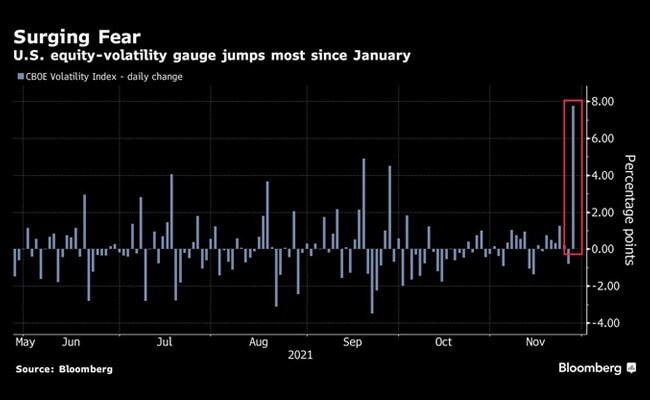
Photo Credit: Bloomberg
Carnival Corp. and Royal Caribbean Cruises Ltd. lost at least nine per cent each while United Airlines Holdings Inc. dropped 10 per cent. Zoom Video Communications Inc. and Peloton Interactive Inc. were up at least five per cent.
“This is a big shock for people waking up (and) seeing the news,” said Carl Dooley, the head of trading for Europe, the Middle East and Africa at Cowen. “Uncertainty and fear will remain high and maybe we aren't going back to new highs straight away.”
The selloff comes after global markets adopted a Jekyll-and-Hyde posture for months, with equities rallying to newer records even as concerns intensified over a toxic combination of high inflation and slower growth. Investors poured almost $900 billion into equity exchange-traded and long-only funds in 2021 -- exceeding the combined total from the past 19 years.
“At these valuations any sort of headline is going to cause this pullback,” Brian Vendig, MJP Wealth Advisors Pdresident, said in an interview with Bloomberg TV. “You definitely don't want to be 100% in risk assets -- whether its interest rate risk, inflation risk, policy risk and now another cue for the health-care crisis letting us all know we're not out of the pandemic.”
Traders pushed back the expected timing of a first 25-basis-point rate increase by the Federal Reserve to September from June, while briefly pricing out any more hikes unit 2023.
They also bet on less than a 10-basis-point hike by the Bank of England next month, compared with 35 basis points projected a month ago. They called for seven basis points of tightening by the European Central Bank by December 2022 as against nine basis points seen Thursday.
The yen and Swiss franc found bids from safety-conscious traders, while the dollar posted a modest loss. A gain for the euro, the biggest component of the Bloomberg Dollar Spot Index, also curbed the greenback.
MSCI Inc.'s Asia-Pacific equity gauge slid to the lowest since early October, with Japan and Hong Kong gauges dropping at least two per cent each.
Some of the worst-hit assets were in emerging markets. The currency of South Africa, where the virus strain was identified, lost one per cent and the Turkish lira dropped 2.4 per cent. The MSCI EM Currency Index fell to a six-week low.
While the selling continued unabated, some investors said it's important not to get carried away by short-term jitters.
“Markets have had a very strong run over the last 12 months and so it is no surprise to see a reaction like this,” said Dan Boardman-Weston, chief investment officer at BRI Wealth Management. “If this is going to take the world backward from a Covid perspective, then it's likely that inflation will abate and monetary policy will stay looser for a long time which is likely to be a positive for markets in the medium term.”
(Except for the headline, this story has not been edited by NDTV staff and is published from a syndicated feed.)

-
Midterm Rally Lasted A Day. The Hard Reality Of A Divided US May Last Two Years | Opinion

Between a contested AI boom, a debt ceiling that arrives in 2027 and a president with every incentive to act alone, the next two years may prove more volatile than the first day's rally suggests.
-
Blue Wave Will Derail the AI Trade but Won't Dismantle the AI Era | Unhedged Position
The Democrats' sweep of the US Congress will see politics collide with economic forces both over the long and short term.
-
It's Time To Take The GST Council's Bet On Trust Global
Payment records can prove India's services exports, and clear, proportionate rules can bring foreign digital sellers into the tax net.
-
Opinion | India at 38: From Innovation Overperformer to Innovation Powerhouse
India now has 453 VC-backed deep science startups, 18 of them late-stage, after 117 percent growth since 2020. Laurus Labs, at USD 9.3 billion, is the most valuable deep science company in any middle-income economy outside China.
-
Navigating Energy Crossroads: S Jaishankar's Call For Diversified Supply Chains At G20 Ministerial Meeting
As geopolitical fault lines continue to test maritime trade routes and commodity flows, Jaishankar's message remains pertinent: true economic resilience requires open markets, protected transit lines, and a genuine commitment to multilateral cooperation rather than coercion.
-
Indians Are Travelling, But Not Every Journey Is A Holiday | The Week In Whys
Pilgrims, patients and working women are the real travellers, and the system hasn't quite caught up with them.
-
Getting To Work Costs Women More | The Reason Why
It is not just about women paying more than men. It is about women paying much more in cities than in villages.
-
AI Bias In Investing Cannot Be Eliminated, But It Can Be Governed
Framing is a particularly important example as identical financial information presented in terms of gains rather than losses can lead an LLM to reach a different assessment.
-
Joining The Dots | Dark Skies, Steady Diya: Why Hope Holds This Diwali
With war, a weak rupee and foreign outflows weighing on sentiment, policymakers at the NDTV World Summit and market veterans at NDTV Profit Ignite: Diwali Edition offered the same advice: stay invested and filter out the noise.









