U.S. Manufacturing Nears Stagnation, Price Gauge At Two-Year Low

(Bloomberg) -- US manufacturing neared stagnation in October as orders contracted for the fourth time in five months, while an index of prices paid fell to a more than two-year low.
The Institute for Supply Management's gauge of factory activity retreated 0.7 point to 50.2, the lowest since May 2020, according to data released Tuesday. The median projection in a Bloomberg survey of economists called for a drop to 50, the reading that separates expansion and contraction.
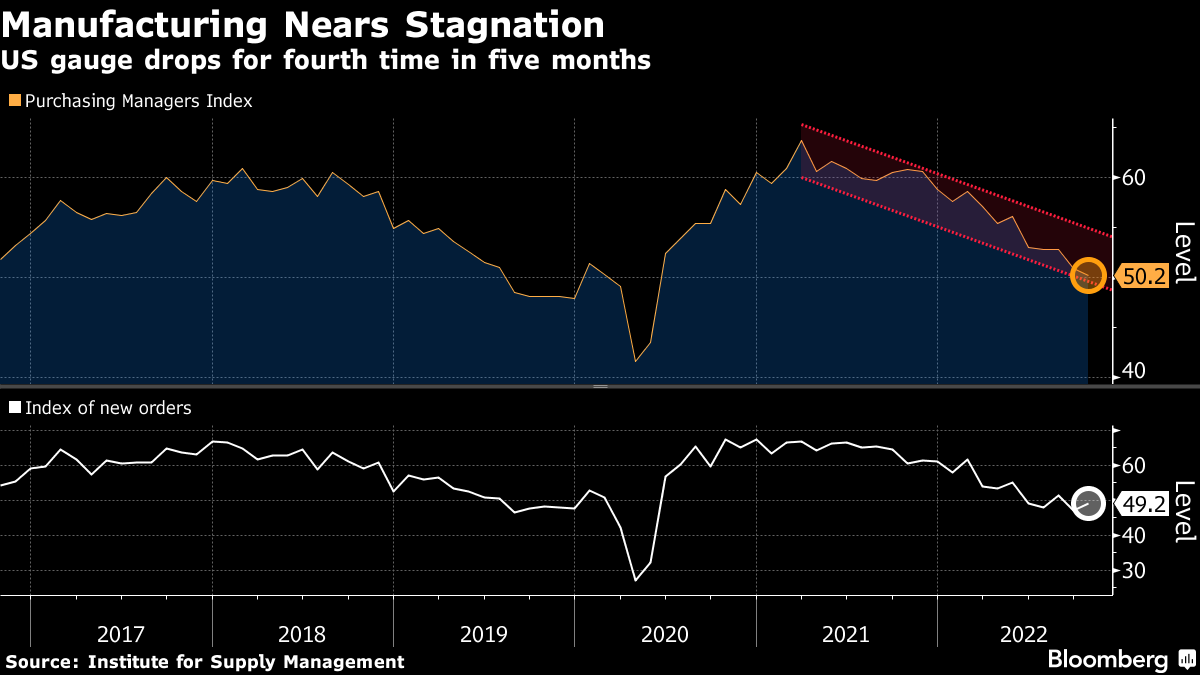
The overall manufacturing index has fallen in four of the last five months, and several of the report's demand metrics showed outright contraction in October. New bookings shrank, a measure of backlogs hit the lowest since mid-2020 and export orders contracted for a third month.
“The October index reading reflects companies' preparing for potential future lower demand,” Timothy Fiore, chair of ISM's Manufacturing Business Survey Committee, said in a statement.
The report adds to evidence of growing global recession concerns as central banks, including the Federal Reserve, step up the fight to get inflation under control. Fed policy makers are projected to increase their benchmark rate by another 75 basis points on Wednesday.
Ten manufacturing industries reported a contraction in October, led by furniture, wood products, paper products and textiles. Eight industries expanded, including apparel and machinery and transportation equipment.
In recent months, manufacturers have seen a decline in the prices for oil, metals and other commodities used for production. The group's measure of prices paid for raw materials fell in October for a seventh-straight month to the lowest level since May 2020, the last time costs contracted.
Select Industry Comments
“Flat business activity; continued electronics market challenges.” - Computers & Electronics
“Customers are canceling some orders. Inventories of finished goods increasing.” - Chemicals
“Challenges with labor and parts delivery are easing. Order levels are slowing down after pent-up demand in the previous month.” - Transportation Equipment
“Growing threat of recession is making many customers slow orders substantially. Additionally, global uncertainty about the Russia-Ukraine (war) is influencing global commodity markets.” - Food, Beverage & Tobacco
“We have seen a general pullback in available capital budgets from our customers, and that is having a significant impact on our sales in the fourth quarter.” - Machinery
“Customer demand has been slower for two months. Production is decreasing our inventory and (we are) implementing forecasts carefully. The headwind seems to be very strong, so we need to be prepared for that.” - Fabricated Metals
“International conditions loom large and seem very foreboding. Overall, we still think 2023 will be a positive year, with at least some moderate growth.” - Nonmetallic Minerals
“Lead times are improving. Plastic prices are coming down.” -Plastics
The ISM data are consistent with the weakness seen across recent regional Fed bank manufacturing surveys. An index of New York state factory activity contracted for a third straight month in October. Manufacturing also shrank in Texas and in areas covered by the Fed banks of Kansas City and Richmond.
The ISM's employment gauge edged up to the breakeven reading of 50 after shrinking in September, suggesting manufacturers are either limiting hiring, having trouble finding skilled labor or a combination of the two.
Meanwhile, softer demand has allowed manufacturers to clear some of their backlogs and improve delivery times. The ISM's supplier deliveries index fell to 46.8, the lowest reading since March 2009 and indicating faster delivery times.
Inventories continued to grow in October, but at the slowest pace since April.
--With assistance from .
(Adds industry comments)
More stories like this are available on bloomberg.com
©2022 Bloomberg L.P.

-
It's Time To Take The GST Council's Bet On Trust Global

Payment records can prove India's services exports, and clear, proportionate rules can bring foreign digital sellers into the tax net.
-
Opinion | India at 38: From Innovation Overperformer to Innovation Powerhouse
India now has 453 VC-backed deep science startups, 18 of them late-stage, after 117 percent growth since 2020. Laurus Labs, at USD 9.3 billion, is the most valuable deep science company in any middle-income economy outside China.
-
Navigating Energy Crossroads: S Jaishankar's Call For Diversified Supply Chains At G20 Ministerial Meeting
As geopolitical fault lines continue to test maritime trade routes and commodity flows, Jaishankar's message remains pertinent: true economic resilience requires open markets, protected transit lines, and a genuine commitment to multilateral cooperation rather than coercion.
-
Indians Are Travelling, But Not Every Journey Is A Holiday | The Week In Whys
Pilgrims, patients and working women are the real travellers, and the system hasn't quite caught up with them.
-
Getting To Work Costs Women More | The Reason Why
It is not just about women paying more than men. It is about women paying much more in cities than in villages.
-
AI Bias In Investing Cannot Be Eliminated, But It Can Be Governed
Framing is a particularly important example as identical financial information presented in terms of gains rather than losses can lead an LLM to reach a different assessment.
-
Joining The Dots | Dark Skies, Steady Diya: Why Hope Holds This Diwali
With war, a weak rupee and foreign outflows weighing on sentiment, policymakers at the NDTV World Summit and market veterans at NDTV Profit Ignite: Diwali Edition offered the same advice: stay invested and filter out the noise.
-
The Curious Case of Equitas Small Finance Bank And A CEO Who Quit For Stock
PN Vasudevan believes persistent investor concerns over a perceived conflict of interest had become a governance overhang on Equitas Small Finance Bank's stock, even as the lender improved profitability and asset quality.
-
Talking Points This Week: AI Cash Burn, A Tiger Comeback And An India That Still Finds Its Own Path
India is not immune to higher oil or tighter global liquidity, yet its earnings base is broader, its domestic policy levers are still available.










