U.S. Manufacturing Downshifts As Orders Shrink, ISM Data Show

(Bloomberg) -- A gauge of US manufacturing stumbled in September to a more than two-year low, moving closer to outright stagnation as orders contracted for the third time in four months.
The Institute for Supply Management's gauge of factory activity dropped nearly 2 points to 50.9, the lowest since May 2020, according to data released Monday. A reading of 50 separates expansion and contraction, and the September result was weaker than the median projection of 52 in a Bloomberg survey of economists.
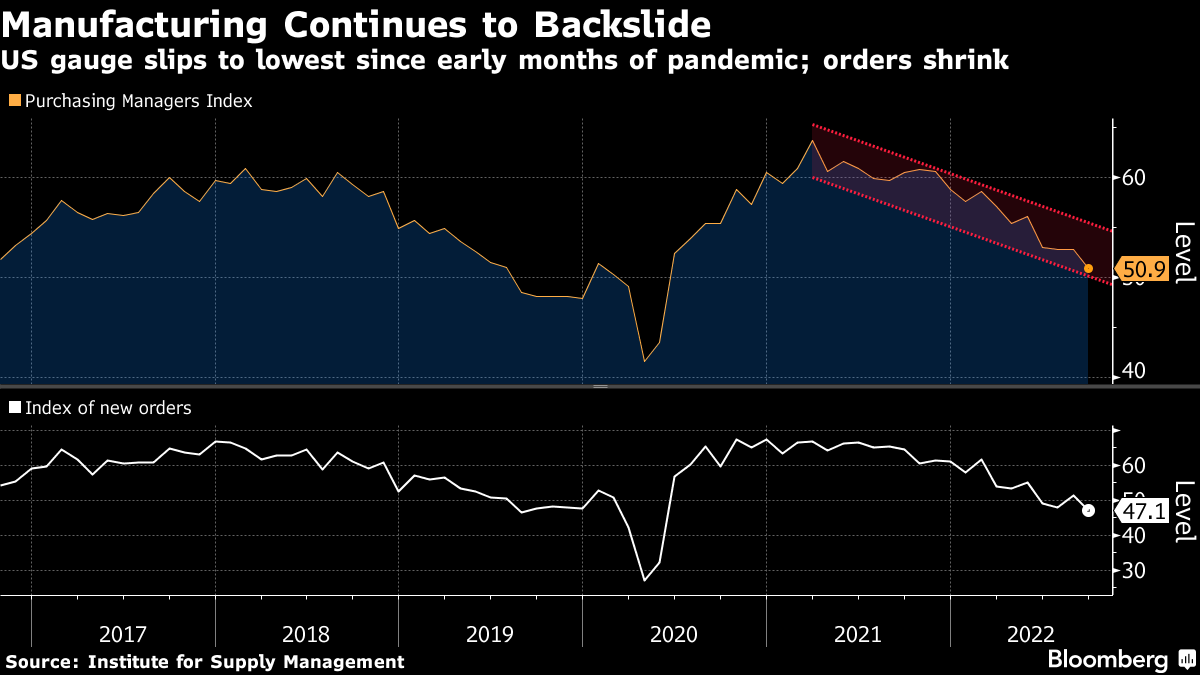
The purchasing managers group's measure of new orders declined more than 4 points to 47.1, also the lowest level since the early months of the pandemic and an indication that demand is softening. Consumer spending on merchandise is settling back and while business investment in equipment has held up, economic growth concerns are mounting as the Federal Reserve raises interest rates to combat inflation.
“Following four straight months of panelists' companies reporting softening new orders rates, the September index reading reflects companies adjusting to potential future lower demand,” Timothy Fiore, chair of ISM's Manufacturing Business Survey Committee, said in a statement.
Nine manufacturing industries reported growth in September, led by mineral products, machinery and plastics. Seven industries reported contraction, including furniture, textiles and wood.
Meantime, a measure of prices paid for materials used in the production process retreated for a sixth-straight month. At 51.7, the price index is the lowest since June 2020, likely reflecting pullbacks in prices for oil, metals and other commodities on global recession worries. The ISM index of export orders contracted by the most in more than two years.
In addition to the falloff in orders, the ISM's composite gauge was driven down by declines in gauges of factory employment and supplier deliveries. The weakening in employment, which showed contraction for the fourth time in five months, may be the combined result of still-tight labor markets and the moderation in demand.
Select Industry Comments
“Concerns of global economic slowdown are growing, and (we are) experiencing some customers pulling back orders.” -- Chemical Products
“Production is steady, allowing reduction of backlog amidst slightly softened demand.” -- Transportation Equipment
“Almost all suppliers are experiencing lead times growth. It seems no one wants to keep inventory on hand anymore.” -- Food, Beverage & Tobacco Products
“Business is flat to down due to inflation and interest rates. Hard to find and keep employees due to wage increases by competitors.” -- Fabricated Metal Products
“Supply chain constraints on many items are still an issue; staffing on the production side continues to be a significant problem. In contrast, we have more stock than needed on some key items — specifically imports.” -- Machinery
“Business continues to be strong. Some commodities within the supply chain are starting to stabilize, while others are still causing disruption for production... (We) cannot run as consistently as we would like.” -- Electrical Equipment, Appliances & Components
“Business is still strong; raw materials are becoming more available, and some raw materials prices are falling.” -- Plastics & Rubber Products
With consumers shifting more of their discretionary income toward services and away from goods, manufacturers are finding the wherewithal to catch up on order backlogs. The ISM backlogs measure fell to the lowest since 2020.
That's easing stress on supply chains, evidenced by a decline in the ISM index of supplier deliveries. Shipment times lengthened, but at the slowest pace since December 2019 -- before the pandemic.
(Adds graphic and industry comments)
More stories like this are available on bloomberg.com
©2022 Bloomberg L.P.

-
Love, Sex Aur Dhokha: The Audacious Plot To Spy On Jensen Huang

A Taipei dinner, a Singapore chip buyer and a suspected Chinese asset: inside the alleged spy operation that got close to NVIDIA's Jensen Huang.
-
Ten Things I Learnt This Samvat
Patience can be a trap. Cheap stocks can stay cheap. Leverage can wipe you out. What did Samvat 2082 teach us? Niraj Shah writes on 10 lessons from the year gone by.
-
Talking Points This Week: Tech Nerves, FII Buying, And A Faraway Banking Shock
The global markets are not shining this Diwali. The exception in the large markets is, India.
-
Midterm Rally Lasted A Day. The Hard Reality Of A Divided US May Last Two Years | Opinion
Between a contested AI boom, a debt ceiling that arrives in 2027 and a president with every incentive to act alone, the next two years may prove more volatile than the first day's rally suggests.
-
Blue Wave Will Derail the AI Trade but Won't Dismantle the AI Era | Unhedged Position
The Democrats' sweep of the US Congress will see politics collide with economic forces both over the long and short term.
-
It's Time To Take The GST Council's Bet On Trust Global
Payment records can prove India's services exports, and clear, proportionate rules can bring foreign digital sellers into the tax net.
-
Opinion | India at 38: From Innovation Overperformer to Innovation Powerhouse
India now has 453 VC-backed deep science startups, 18 of them late-stage, after 117 percent growth since 2020. Laurus Labs, at USD 9.3 billion, is the most valuable deep science company in any middle-income economy outside China.
-
Navigating Energy Crossroads: S Jaishankar's Call For Diversified Supply Chains At G20 Ministerial Meeting
As geopolitical fault lines continue to test maritime trade routes and commodity flows, Jaishankar's message remains pertinent: true economic resilience requires open markets, protected transit lines, and a genuine commitment to multilateral cooperation rather than coercion.
-
Indians Are Travelling, But Not Every Journey Is A Holiday | The Week In Whys
Pilgrims, patients and working women are the real travellers, and the system hasn't quite caught up with them.









