US Lawmakers Seek Restrictions on Russian-Origin Diamonds' Trade
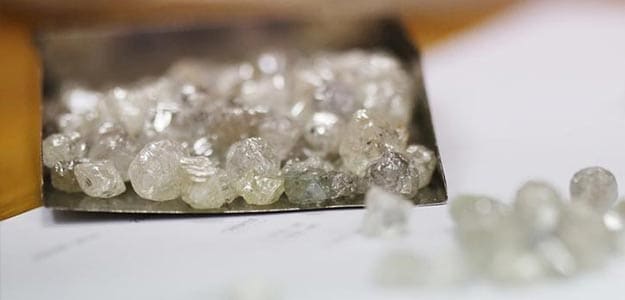
A bipartisan group of American lawmakers has sought the help of the Biden administration in restricting the international trade and sale of Russian-origin diamonds, in view of the massive sanctions that the US and its European allies have imposed on Moscow.
In a letter to Secretary of State Tony Blinken and Treasury Secretary Janet Yellen, the lawmakers expressed concern that the sanctions issued by the Treasury Department to target Russia's diamond industry will have a minimal impact on Alrosa and its CEO Sergei Ivanov's ability to freely operate globally.
Alrosa is the world's largest diamond mining company.
The company, which reported sales worth $4.2 billion last year, is responsible for 90 per cent of Russia's diamond mining capacity, which accounts for 28 per cent globally.
It is owned one-third by the Russian government, and until recently, had an office in New York City.
Mr Ivanov is the son of one of Mr Putin's closest allies, Sergei Borisovich Ivanov, who previously served as the Chief of Staff of the Presidential Executive Office, the Deputy Prime Minister and the Defence Minister of Russia and remains a permanent member of the Security Council of the Russian Federation, the letter said.
According to the Congressmen, the February 24 sanctions that listed Alrosa only blocked debt and equity transactions, making a small dent in Russia's oversized stake in the global diamond trade.
Although an important initial step, along with the designation of Alrosa's CEO, these have yet to impede trade and revenues that eventually reach the Kremlin.
The administration also announced an import ban on March 11 which would ban “products of Russian Federation origin", including non-industrial diamonds, from entering the United States.
“Experts note a “major loophole” remains in the sanctions regime that allows for importation of diamonds manufactured in India or elsewhere because of the interpretation provided in the Office of Foreign Assets Control's frequently-asked questions,” they wrote.
Namely, the term “Russian Federation origin” excludes goods “substantially transformed in a third country,” and it has long been the view of Customs and Border Protection that the cutting or polishing of diamonds in a third country would qualify as a substantial transformation.
“A recent report on the diamond industry indicated approximately 95 per cent of the world's diamonds are cut and polished in India. Thus, as it stands at this time, a diamond can be mined by an Alrosa subsidiary, polished or cut in India or another country, and sold to the United States without any prohibition, making a profit for the Russian government,” wrote the Congressmen.
The lawmakers asked that the Treasury Department reconsider the interpretation of origin that allows for the importation of diamonds from countries that may cut or polish Alrosa's diamonds.
“Second, the United States should work with its Indian counterparts, as well as those in trading centers such as Dubai, to ensure they are not being used to line the pockets of those closest to Vladimir Putin,” they said.
Finally, the State and the Treasury Departments should provide guidance to Customs and Border Protection (CBP) and the Department of Homeland Security (DHS) to ensure they prohibit the importation of Russian diamonds into the United States.
The lawmakers said that Putin's unprovoked and brazen invasion of the sovereign territory of Ukraine should be met with a forceful response from the United States and its partners.
“Luxury goods, especially items like diamonds that are used mainly for export to wealthy nations, should be among the first that Treasury and State Departments consider future action.
“We ask for your consideration of additional actions that would constrain the Kremlin's capacity to access revenue from their diamond industry which could fund the invasion of democratic and sovereign Ukraine,” the letter added.

-
Unhedged Position: Can India See An Indonesia-Style Time Correction?

The Nifty is trading below levels it first clocked in 2024. Is there, then, as I have suggested in the headline, potential that the current time correction drags on painfully for the next three-five, even ten years?
-
Navigating Friction And Energy Realities: An Analysis Of Marco Rubio's October Visit To India
Occurring at a critical juncture marked by stalled trade negotiations and escalating geopolitical pressures over global energy supplies, the visit offers a profound window into modern US-India relations.
-
India Exports Capital. Why Not Export Trusteeship?
The big question, then, is whether India can build an institution that global borrowers, investors, banks, and lawyers can trust, even without an Indian connection.
-
France's Economy & Politics Are In Crisis | The Reason Why
Let's look at how the French economy and politics evolved under Nicolas Sarkozy, Franois Hollande and Emmanuel Macron.
-
You May Inherit The Business. You Must Earn Its Credibility.
Succession tests the founder's ability to share authority as much as it tests the next generation's readiness to assume it.
-
Signing Deals Is One Thing; Making Them Work Is Another | The Week In Whys
Sometimes, things don't turn out as planned. Indian companies have lost some bids to rivals, some projects won't produce until 2030.
-
FOMC Wall, PERM Suspension, Hospital Stocks | Talking Points This Week
A PERM suspension would directly affect green-card sponsorship rather than H-1B visas, so the near-term earnings impact could remain relatively limited. The key question is whether this marks a new phase in US scrutiny of Indian IT.
-
Everything, Everywhere, All At Once: Dalal Street's Week To Forget | Joining The Dots
Visa curbs, a Starlink spat and cancer drug caps: what connects this week's shocks for Indian markets
-
India Is Going Abroad For Critical Minerals. But It May Take Years To Pay Off | The Reason Why
Although India's steps are in the right direction, they remain modest compared with India's growing dependence.
-
When Everyone Has AI, What Gives You An Edge?
India's young workforce is entering an uncertain world of work where powerful AI tools are becoming widely accessible. The advantage will belong to those who combine deep expertise with digital fluency, and the distinctly human capabilities that technology cannot manufacture.









