U.S. Job Openings Drop To 10.1 Million, Lowest Since June 2021

(Bloomberg) -- US job openings plummeted in August by the most since early in the pandemic, likely a welcome sign for Federal Reserve officials as they seek to cool demand for workers without triggering a spike in unemployment.
The number of available positions decreased to about 10.1 million in the month from 11.2 million in July, the Labor Department's Job Openings and Labor Turnover Survey, or JOLTS, showed Tuesday. The August level was lower than all estimates in a Bloomberg survey of economists.
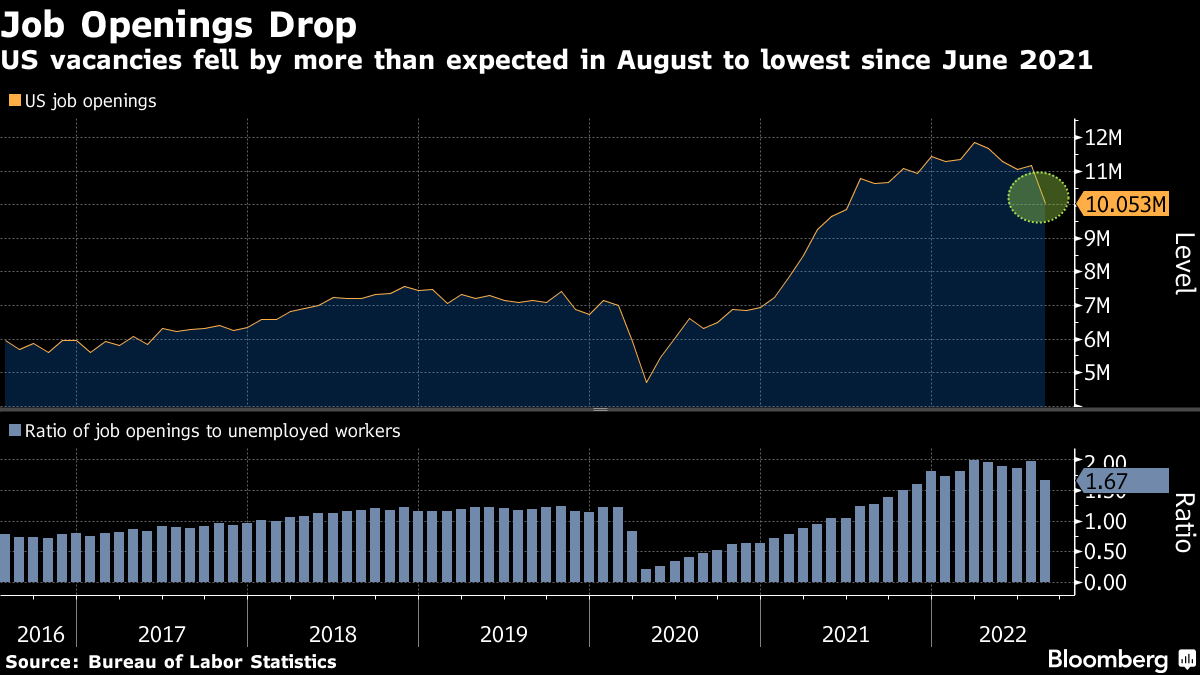
The 1.1 million decline in vacancies was the biggest since April 2020 and is consistent with moderating labor demand, reflective of shifting consumption patterns, rapidly rising interest rates and a darkening economic outlook.
Stocks jumped while Treasuries advanced after the report, as traders grew optimistic the Fed may not have to be as aggressive with its interest-rate hikes given some signs that demand for workers is cooling.
While the number of vacancies remains extremely high, the ratio of openings to unemployed persons retreated in August. There are some 1.7 jobs for every unemployed person, down from about 2 in July and the smallest ratio since November of last year.
Fed policy makers have pointed to the elevated number of job openings as a way to cool the labor market without an ensuing jump in unemployment. The decline in vacancies may help temper wage pressures that central bankers are trying to tame in an effort to extinguish rapid inflation.
What Bloomberg Economics Says...
“The ratio of job vacancies to unemployed persons fell sharply in August -- such a large drop usually implies a recession -- bolstering the case for the Fed to hike by 50 basis points rather than 75 at the November FOMC meeting. If this pace of decline continues, the labor market will be in a much cooler state by early next year, giving the Fed space to end its current tightening cycle.”
-- Eliza Winger, economist
To read the full note, click here
Hires that were little changed during the month suggest some of the decline in vacancies reflected employers withdrawing job postings rather than filling them. The largest decreases in job openings were in health care and social assistance, other services and retail trade.
Some 4.2 million Americans quit their jobs in August, a slight increase from a month earlier. The quits rate, a measure of voluntary job leavers as a share of total employment, held at 2.7%.
Layoffs increased to the highest level since March 2021, though they remain historically low.
The JOLTS data precede Friday's monthly jobs report, which is currently forecast to show US employers added 265,000 to payrolls in September. Economists are expecting the unemployment rate to hold at 3.7%, just above a five-decade low, and for average hourly earnings to post another firm advance.
(Adds Bloomberg Economics comment. A previous version of this story corrected the change in openings.)
More stories like this are available on bloomberg.com
©2022 Bloomberg L.P.

-
Love, Sex Aur Dhokha: The Audacious Plot To Spy On Jensen Huang

A Taipei dinner, a Singapore chip buyer and a suspected Chinese asset: inside the alleged spy operation that got close to NVIDIA's Jensen Huang.
-
Ten Things I Learnt This Samvat
Patience can be a trap. Cheap stocks can stay cheap. Leverage can wipe you out. What did Samvat 2082 teach us? Niraj Shah writes on 10 lessons from the year gone by.
-
Talking Points This Week: Tech Nerves, FII Buying, And A Faraway Banking Shock
The global markets are not shining this Diwali. The exception in the large markets is, India.
-
Midterm Rally Lasted A Day. The Hard Reality Of A Divided US May Last Two Years | Opinion
Between a contested AI boom, a debt ceiling that arrives in 2027 and a president with every incentive to act alone, the next two years may prove more volatile than the first day's rally suggests.
-
Blue Wave Will Derail the AI Trade but Won't Dismantle the AI Era | Unhedged Position
The Democrats' sweep of the US Congress will see politics collide with economic forces both over the long and short term.
-
It's Time To Take The GST Council's Bet On Trust Global
Payment records can prove India's services exports, and clear, proportionate rules can bring foreign digital sellers into the tax net.
-
Opinion | India at 38: From Innovation Overperformer to Innovation Powerhouse
India now has 453 VC-backed deep science startups, 18 of them late-stage, after 117 percent growth since 2020. Laurus Labs, at USD 9.3 billion, is the most valuable deep science company in any middle-income economy outside China.
-
Navigating Energy Crossroads: S Jaishankar's Call For Diversified Supply Chains At G20 Ministerial Meeting
As geopolitical fault lines continue to test maritime trade routes and commodity flows, Jaishankar's message remains pertinent: true economic resilience requires open markets, protected transit lines, and a genuine commitment to multilateral cooperation rather than coercion.
-
Indians Are Travelling, But Not Every Journey Is A Holiday | The Week In Whys
Pilgrims, patients and working women are the real travellers, and the system hasn't quite caught up with them.









