U.S. Consumer Spending Cools In Sign Of Economy On Weaker Footing
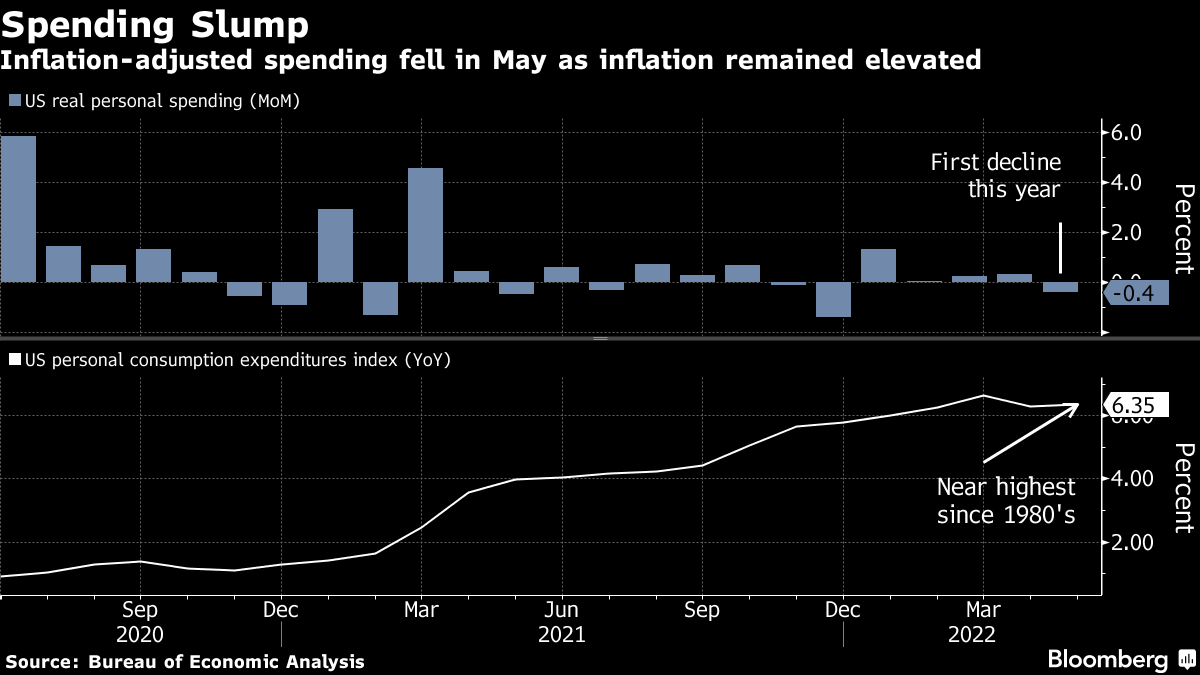
(Bloomberg) -- US consumer spending fell in May for the first time this year and prior months were revised lower, suggesting an economy on somewhat weaker footing than previously thought amid rapid inflation and Federal Reserve interest-rate hikes.
Purchases of goods and services, adjusted for changes in prices, decreased 0.4% after a downwardly revised 0.3% gain a month earlier, Commerce Department data showed Thursday. Spending on services advanced while outlays for goods declined.
The personal consumption expenditures price index, which the Federal Reserve uses for its inflation target, rose 0.6% from a month earlier and was up 6.3% since May 2021. The core PCE price index increased 0.3%, less than expected. It was up 4.7% from a year ago, the smallest gain since November.
The median forecasts in a Bloomberg survey of economists called for a 0.3% decline in inflation-adjusted spending from the prior month and for the overall price index to be up 6.4% from a year earlier. Stocks opened lower and Treasury yields eased after the data.
Unadjusted for inflation, spending rose 0.2% from the prior month, while personal income increased 0.5%.
While spending disappointed expectations, it also showed demand isn't collapsing. Demand for services proved resilient, underscoring a long-anticipated shift in consumer preferences from goods to services. Spending on international travel strengthened in May.
Even so, the slowdown in consumer spending -- the main driver of the US economy -- adds to growing concerns about the economic outlook. Household sentiment is at a record low, recession fears are growing, and the labor market, while still robust, is showing some early signs of softening.
“Today's details on monthly spending figures shows a much weaker profile for spending in the first five months of the year and sets us up for weaker growth in the second quarter than the data would have suggested just 48 hours ago,” Wells Fargo & Co. economists Tim Quinlan and Shannon Seery said in a note after the report.
Inflation, while showing signs of stabilizing, is still eroding Americans' pay. Households are facing rising prices across the economy, including near-record costs for gasoline. The Fed, which earlier this month raised interest rates by the most since 1994, will take the latest figures into account at their July meeting when deciding whether to once again hike rates by 75 basis points, or opt for a 50 basis-point increase.
What Bloomberg Economics Says...
“The drop in real personal spending in May -- coupled with downward revisions to the data from January to April -- means less momentum for consumption and the overall economy going into the second half of the year. The data indicate weaker growth in services amid a general pullback in goods spending, with inflation weighing on purchasing power and sentiment at record lows.”
-- Yelena Shulyatyeva and Andrew Husby, economists
For the full note, click here.
On Wednesday, Fed Chair Jerome Powell said he and his colleagues “hope that growth will remain positive,” noting that the economy is “well positioned to withstand tighter monetary policy.” But he also acknowledged the task of avoiding a recession has become more challenging in recent months.
Saving Rate
The saving rate rose slightly in May to 5.4%, a three-month high, but was still near its lowest since 2009. High inflation has prompted Americans to draw down their savings since the end of last year.
The consumer price index, which typically runs hotter than the PCE price index, unexpectedly jumped to a fresh 40-year high in May.
Inflation-adjusted spending on goods dropped 1.6% in May, the biggest drop this year, while services increased 0.3%. Spending on motor vehicles led the decline in goods outlays, according to the Commerce Department.
Services were boosted by housing and utilities, as well as health care.
Wages and salaries increased 0.5% last month. When adjusted for inflation, however, disposable personal income declined 0.1%, the third decrease this year.
Separate figures Thursday showed applications for jobless benefits fell slightly last week, though remained near the highest level since January.
(Adds economists' comment)
More stories like this are available on bloomberg.com
©2022 Bloomberg L.P.

-
Navigating Friction And Energy Realities: An Analysis Of Marco Rubio's October Visit To India

Occurring at a critical juncture marked by stalled trade negotiations and escalating geopolitical pressures over global energy supplies, the visit offers a profound window into modern US-India relations.
-
India Exports Capital. Why Not Export Trusteeship?
The big question, then, is whether India can build an institution that global borrowers, investors, banks, and lawyers can trust, even without an Indian connection.
-
France's Economy & Politics Are In Crisis | The Reason Why
Let's look at how the French economy and politics evolved under Nicolas Sarkozy, Franois Hollande and Emmanuel Macron.
-
You May Inherit The Business. You Must Earn Its Credibility.
Succession tests the founder's ability to share authority as much as it tests the next generation's readiness to assume it.
-
Signing Deals Is One Thing; Making Them Work Is Another | The Week In Whys
Sometimes, things don't turn out as planned. Indian companies have lost some bids to rivals, some projects won't produce until 2030.
-
FOMC Wall, PERM Suspension, Hospital Stocks | Talking Points This Week
A PERM suspension would directly affect green-card sponsorship rather than H-1B visas, so the near-term earnings impact could remain relatively limited. The key question is whether this marks a new phase in US scrutiny of Indian IT.
-
Everything, Everywhere, All At Once: Dalal Street's Week To Forget | Joining The Dots
Visa curbs, a Starlink spat and cancer drug caps: what connects this week's shocks for Indian markets
-
India Is Going Abroad For Critical Minerals. But It May Take Years To Pay Off | The Reason Why
Although India's steps are in the right direction, they remain modest compared with India's growing dependence.
-
When Everyone Has AI, What Gives You An Edge?
India's young workforce is entering an uncertain world of work where powerful AI tools are becoming widely accessible. The advantage will belong to those who combine deep expertise with digital fluency, and the distinctly human capabilities that technology cannot manufacture.
-
Wrong Labels, High Pesticide Residues Holding Back Agri Exports | The Reason Why
India needs stronger domestic food-safety and labelling standards, with best practices becoming part of everyday business for farmers, traders and food companies.










