U.S. Hiring To Slow Again Amid Writers Strike, Yellow Bankruptcy

(Bloomberg) -- A monthly report on US employment due Friday is set to show net hiring slowed again to a fresh post-2020 low of 182,000 in August, according to Bloomberg Economics.
Two high-profile events in particular — the Hollywood writers' strike and the bankruptcy of trucking company Yellow Corp. — probably weighed on the numbers, Bloomberg economists Anna Wong, Stuart Paul and Eliza Winger wrote Thursday in a preview of the report. Wage growth probably also slowed, they said.
“The two main drags on August's private payrolls are the Writers Guild of America strike, and layoffs following the bankruptcy of trucking company Yellow,” Wong, Paul and Winger said.
“We think the cracks in the labor market will widen in coming months, with a potential strike by the United Auto Workers and a possible government shutdown turning payrolls negative in the fall.”
Read More: US PREVIEW: A ‘Swift' Summer Papers Over Cracks in Job Market
Hiring has been slowing throughout the year as employers have completed the process of restaffing positions that were lost in the initial stage of the pandemic. In June and July, hiring rates finally returned to pre-pandemic levels, at just under 200,000 per month.
That leaves the US labor market at a critical juncture, with forecasters wondering whether the slowdown will continue — raising recession risks — or whether job creation can settle into a new normal, more in line with the pre-pandemic pace.
Several economists — including those at the Federal Reserve, Bank of America and JPMorgan Chase & Co. — have in recent weeks rescinded their predictions for a recession as data on economic growth have surprised to the upside, inflation has cooled and labor-market indicators have remained resilient.
Bloomberg Economics, though, is among those sticking by their recession calls, despite the broader shift in sentiment.
Paul, Wong and Winger pointed to signs typically seen early on in recessions, such as employers cutting hours, workers seeking multiple jobs to make ends meet, bankrupt firms laying off workers, and wages softening. “Once these dynamics start asserting themselves, they're hard to stop,” they wrote.
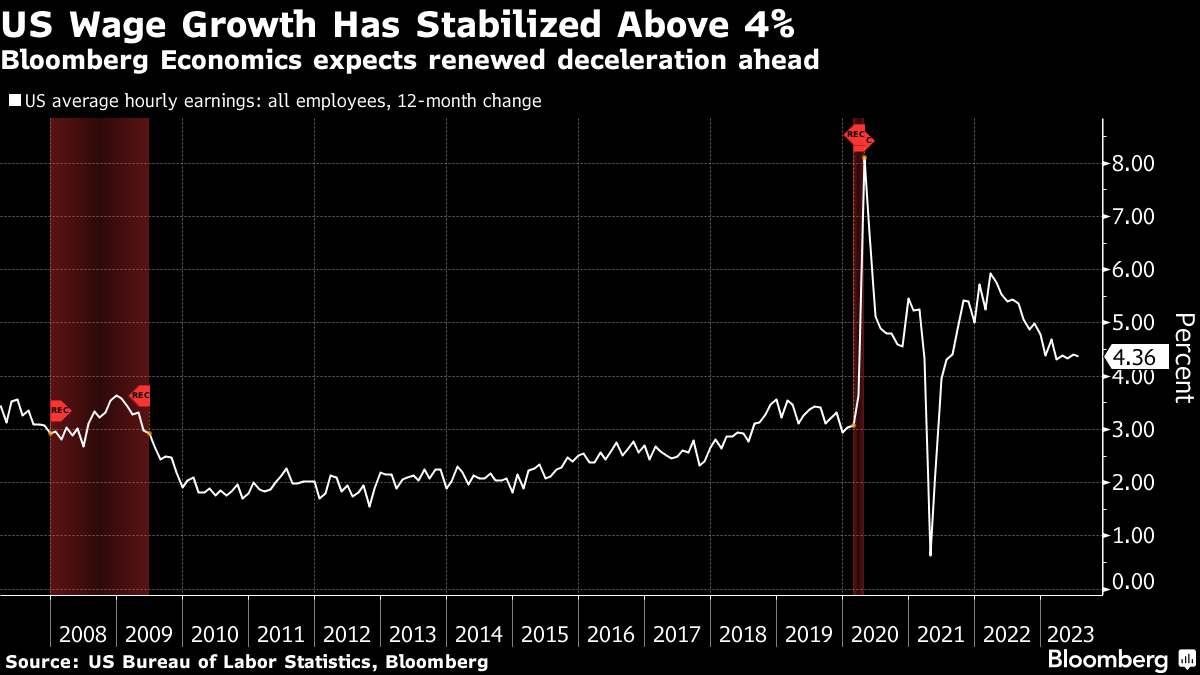
Another key indicator to watch in the report is average hourly earnings. Wage growth has slowed this year, though in recent months it's shown signs of stabilizing at rates above levels the Fed views as compatible with its 2% inflation target.
Average hourly earnings rose 4.4% over the last 12 months. In comparison, the fastest rate of wage growth achieved in the pre-pandemic economic expansion was 3.6%.
“With private-sector demand for labor softening, we expect month-on-month wage growth slowed to 0.2% in August” after advancing 0.4% in July, the Bloomberg economists said. “Annualized, that monthly pace would be consistent with the Fed's 2% inflation objective.”
Wong, Paul and Winger expect the report will show the unemployment rate ticked up to 3.6% last month, while labor force participation remained unchanged at 62.6%. Their predictions are broadly in line with consensus estimates in a Bloomberg survey of outside forecasters.
More stories like this are available on bloomberg.com
©2023 Bloomberg L.P.

-
Navigating Energy Crossroads: S Jaishankar's Call For Diversified Supply Chains At G20 Ministerial Meeting

As geopolitical fault lines continue to test maritime trade routes and commodity flows, Jaishankar's message remains pertinent: true economic resilience requires open markets, protected transit lines, and a genuine commitment to multilateral cooperation rather than coercion.
-
Indians Are Travelling, But Not Every Journey Is A Holiday | The Week In Whys
Pilgrims, patients and working women are the real travellers, and the system hasn't quite caught up with them.
-
Getting To Work Costs Women More | The Reason Why
It is not just about women paying more than men. It is about women paying much more in cities than in villages.
-
AI Bias In Investing Cannot Be Eliminated, But It Can Be Governed
Framing is a particularly important example as identical financial information presented in terms of gains rather than losses can lead an LLM to reach a different assessment.
-
Joining The Dots | Dark Skies, Steady Diya: Why Hope Holds This Diwali
With war, a weak rupee and foreign outflows weighing on sentiment, policymakers at the NDTV World Summit and market veterans at NDTV Profit Ignite: Diwali Edition offered the same advice: stay invested and filter out the noise.
-
The Curious Case of Equitas Small Finance Bank And A CEO Who Quit For Stock
PN Vasudevan believes persistent investor concerns over a perceived conflict of interest had become a governance overhang on Equitas Small Finance Bank's stock, even as the lender improved profitability and asset quality.
-
Talking Points This Week: AI Cash Burn, A Tiger Comeback And An India That Still Finds Its Own Path
India is not immune to higher oil or tighter global liquidity, yet its earnings base is broader, its domestic policy levers are still available.
-
Foreign Investors Own Half Of HDFC Bank and ICICI Bank. An LTCG Cut Could Matter Most Here
Foreign portfolio investors have US$115 billion parked in HDFC Bank, ICICI Bank. If the government cuts long-term capital gains tax, Jefferies says returning foreign money could land here first.
-
'Never Seen This Level Of Negativity': Sandeep Tandon Says The Next Rally May Be Closer Than You Think
Veteran investor Sandeep Tandon says foreign selling is easing, large-caps are due a comeback and mid-caps are crowded, while he turns positive on gold, power and pharma this Diwali.
-
Indians Stay With Family, Not In Hotels | The Reason Why
India still lacks enough clean, reliable and affordable hotels for budget-conscious travellers.










