Fed Set To Double Its Economic Growth Forecast After Strong US Data
(Bloomberg) -- The US economy has been looking so solid lately that Federal Reserve officials will probably need to double their projection for growth in 2023 when they publish an updated outlook later this month.
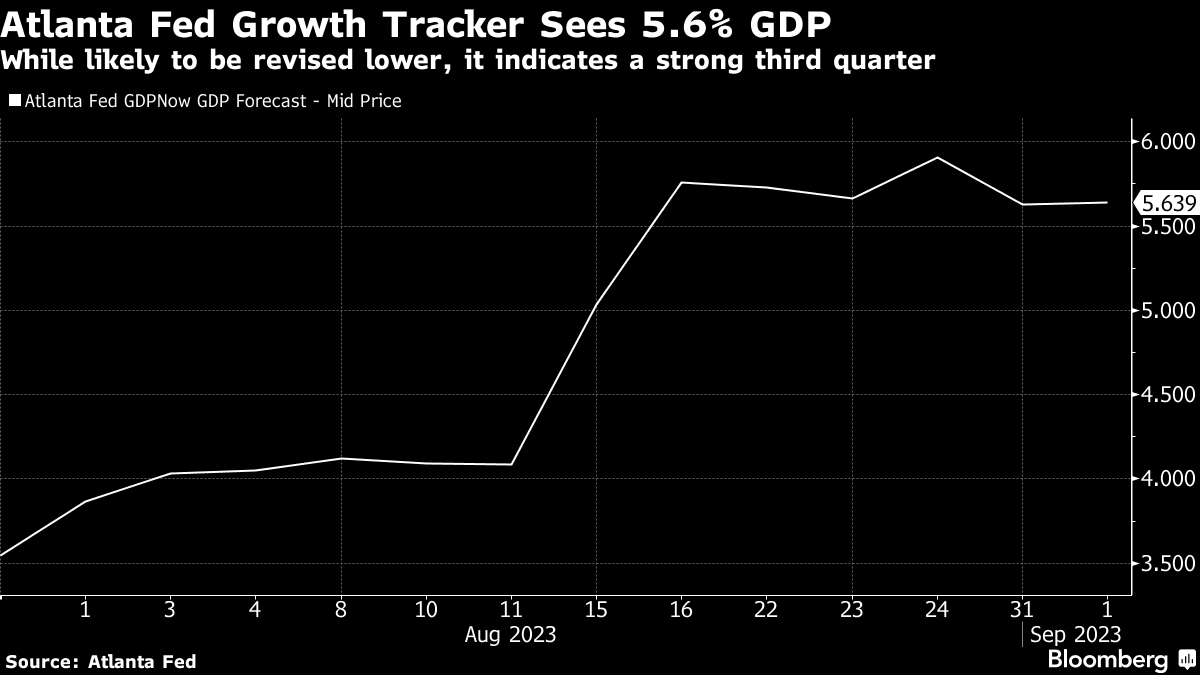
Following a string of stronger-than-expected reports on everything from consumer spending to residential investment, economists have been boosting their forecasts for gross domestic product. One widely-followed, unofficial estimate produced by the Atlanta Fed even has it expanding 5.6% on an annualized basis in the third quarter.

That marks a sharp turnaround from three months ago — the last time policymakers updated their own numbers — when the consensus view was that the economy would stall in the current quarter. And it may be enough to prompt Fed officials to scale back their estimates for interest-rate cuts in 2024.
“Consumer spending was robust in June and July, so the third quarter is virtually baked in the cake at this point,” said Stephen Stanley, the chief economist at Santander Capital Markets US who is projecting 3.7% growth in the July-to-September period. “5% seems too high, but not impossible.”
Any read on GDP growth above 3.2% would mark the strongest quarter since 2021, when the US was experiencing a rapid recovery from the initial shock of the pandemic. The acceleration is in stark contrast with the outlook for China, which has been downgraded in recent weeks amid a mounting property crisis.
When Fed officials last updated their own projections for the US in mid-June, they showed the median policymaker thought GDP would expand just 1% in 2023. At the time, that marked an upgrade over the previous projection round in March, which implied a recession this year.
That number will probably go up to 1.8% or 2% in the new projections set to be released at the conclusion of the central bank's Sept. 19-20 policy meeting, and the outlook for the unemployment rate could be revised lower, according to Omair Sharif, president of Inflation Insights LLC.
The growth upgrade may also lead Fed officials to scale back the easing they had projected for next year to 75 basis points of rate cuts instead of 100, Sharif said.
Widespread Upswing
The Atlanta Fed tracker — which is separate from policymakers' quarterly projections — is volatile and will probably be revised down some before the government publishes its first official read on current-quarter growth at the end of October.
But it underscores the widespread upswing in sentiment over the past few months. Better-than-expected numbers in a monthly Institute for Supply Management report on the US services sector published Wednesday bolstered the theme.
Read More: Goldman Cuts US Recession Chances to 15% on Improved Inflation
Despite the rising optimism, the central bank has signaled it will probably leave its benchmark interest rate unchanged at the September meeting.
A rate hike in July brought it into a range of 5.25% to 5.5% — the highest level in 22 years — and Fed Governor Christopher Waller said Tuesday that policymakers can now afford to “proceed carefully” given recent data showing inflation continues to ease. On Wednesday, Boston Fed President Susan Collins cautioned further tightening could yet be warranted.
“The economy accelerated over the summer, but the Fed is willing to wait out September,” said Diane Swonk, the chief economist at KPMG LLP in Chicago. “A soft or ‘softish' landing is now the most likely scenario.”
Even if the odds of a recession have come down, forecasters are largely sticking to predictions that growth will slow in the fourth quarter. Looming headwinds include rising gasoline prices, a resumption of student-loan payments and the possibility of a government shutdown.
What Bloomberg Economics Says...
“We don't see the likely strength in 3Q GDP as indicative of increased probability of soft landing; to the contrary, in our view that actually increases the chance of a negative GDP print in 4Q. ... With no comparable forces in the horizon in 4Q, student loan payments resuming, consumer loan delinquency rising and the labor market softening, consumption will likely be weak in 4Q.”
— Anna Wong, chief US economist
Many also believe the impact of aggressive rate hikes over the past year-and-a-half, and tighter credit conditions in the wake of bank failures earlier this year, will soon begin to show.
“The end of the three-year student forbearance program is likely to exert some drag on consumer spending as over 27 million borrowers will need to start making monthly loan repayments,” said Thomas Feltmate, a senior economist at TD Bank Group.
“I suspect we'll also see some of the air on business investment come out over the coming quarters — particularly with rates having turned higher in recent months — and credit conditions remain quite tight.”
(Updates with ISM report in tenth paragraph, Susan Collins comments in 12th paragraph.)
More stories like this are available on bloomberg.com
©2023 Bloomberg L.P.

-
Navigating Energy Crossroads: S Jaishankar's Call For Diversified Supply Chains At G20 Ministerial Meeting

As geopolitical fault lines continue to test maritime trade routes and commodity flows, Jaishankar's message remains pertinent: true economic resilience requires open markets, protected transit lines, and a genuine commitment to multilateral cooperation rather than coercion.
-
Indians Are Travelling, But Not Every Journey Is A Holiday | The Week In Whys
Pilgrims, patients and working women are the real travellers, and the system hasn't quite caught up with them.
-
Getting To Work Costs Women More | The Reason Why
It is not just about women paying more than men. It is about women paying much more in cities than in villages.
-
AI Bias In Investing Cannot Be Eliminated, But It Can Be Governed
Framing is a particularly important example as identical financial information presented in terms of gains rather than losses can lead an LLM to reach a different assessment.
-
Joining The Dots | Dark Skies, Steady Diya: Why Hope Holds This Diwali
With war, a weak rupee and foreign outflows weighing on sentiment, policymakers at the NDTV World Summit and market veterans at NDTV Profit Ignite: Diwali Edition offered the same advice: stay invested and filter out the noise.
-
The Curious Case of Equitas Small Finance Bank And A CEO Who Quit For Stock
PN Vasudevan believes persistent investor concerns over a perceived conflict of interest had become a governance overhang on Equitas Small Finance Bank's stock, even as the lender improved profitability and asset quality.
-
Talking Points This Week: AI Cash Burn, A Tiger Comeback And An India That Still Finds Its Own Path
India is not immune to higher oil or tighter global liquidity, yet its earnings base is broader, its domestic policy levers are still available.
-
Foreign Investors Own Half Of HDFC Bank and ICICI Bank. An LTCG Cut Could Matter Most Here
Foreign portfolio investors have US$115 billion parked in HDFC Bank, ICICI Bank. If the government cuts long-term capital gains tax, Jefferies says returning foreign money could land here first.
-
'Never Seen This Level Of Negativity': Sandeep Tandon Says The Next Rally May Be Closer Than You Think
Veteran investor Sandeep Tandon says foreign selling is easing, large-caps are due a comeback and mid-caps are crowded, while he turns positive on gold, power and pharma this Diwali.
-
Indians Stay With Family, Not In Hotels | The Reason Why
India still lacks enough clean, reliable and affordable hotels for budget-conscious travellers.










