US Adds Eight Chinese Firms To Trade Blacklist
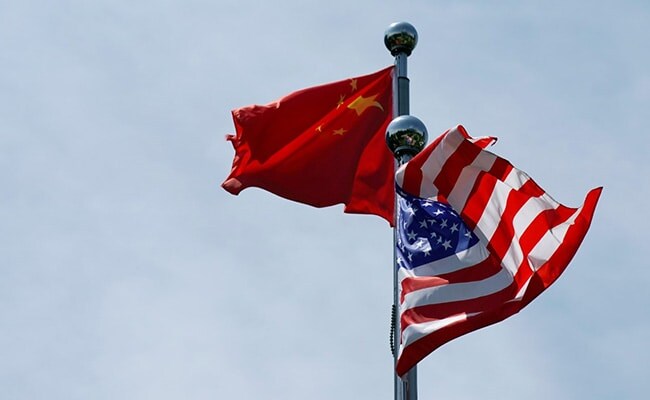
The US government expanded its trade blacklist on Monday to include some of China's top artificial intelligence (AI) startups over Beijing's treatment of Muslim minorities.
Below are details of major companies placed on the blacklist, which effectively bans them from buying components from US companies. The move is likely to impact not just them but also their suppliers, customers and financial backers.
HIKVISION
Formally known as Hangzhou Hikvision Digital Technology, the firm is the world's largest purveyor of video surveillance systems.
It is also a vendor to police agencies in Xinjiang, where a sweeping crackdown on Uighurs has drawn international condemnation.
Hikvision has not been allowed to sell to US federal government agencies since mid-August thanks to a law that blocked five Chinese firms as possible security threats because their products could allow access to sensitive systems.
The company, which has a market value of about $42 billion, is 42 per cent owned by Chinese state investors and its two key founders. It pulls nearly 30 per cent of its 50 billion yuan ($7 billion) in annual revenue from overseas.
Hikvision does not disclose suppliers, but Japan's video interface firm Techpoint Inc said in a regulatory filing in March that Hikvision accounted for 62 per cent of its annual revenue in 2018.
Losing business with Hikvision could have a material and adverse effect on its business, the Japanese firm said.
John Honovich, founder of surveillance video research company IPVM, said Hikvision and Dahua both use Intel Corp, Nvidia Corp, Ambarella Inc, Western Digital and Seagate Technology as suppliers.
The impact of the blacklisting on the Chinese companies would be "devastating", he said.
SENSETIME GROUP
Incorporated in 2014 after receiving investment from IDG Capital, SenseTime is one of the fastest growing AI startups in China.
Dual-based in Beijing and Hong Kong, SenseTime develops applications for facial recognition, video analysis and other areas including autonomous driving.
Its technology employs AI to identify individuals and analyse those identities using cameras, and has been used by Chinese authorities to track and capture suspects in public spaces such as airports and festivals.
Its $620 million fundraising in May last year valued the firm at more than $4.5 billion. Fidelity International, Hopu Capital, Silver Lake, and Tiger Global led the financing.
The firm has also received funding from e-commerce firms Alibaba and Suning.Com Co, Singapore state fund Temasek Holding, state-backed fund Sailing Capital and US chipmaker Qualcomm Inc.
SenseTime counts China's Ministry of Public Security and local heavyweights such as China Mobile, HNA Group and Huawei Technologies as its major clients.
Its facial recognition unlocking and related technologies are offered to smartphone brands OPPO and Vivo.
The firm said in February it will create an alliance with the Massachusetts Institute of Technology (MIT) to advance research into AI.
MEGVII TECHNOLOGY
Founded in 2011 by Chief Executive Yin Qi and two friends from Tsinghua University, the company is preparing an initial public offering (IPO) in Hong Kong to raise at least $500 million.
Widely known for facial recognition platform Face++, Megvii will become the first Chinese AI firm to go public if the deal goes ahead.
The company provides facial recognition and other AI technology to governments and companies including Alibaba, Ant Financial, Lenovo Group Ltd and Huawei.
Its $750 million fundraising in May 2018 valued the firm at slightly over $4 billion.
It raised funds from Alibaba, Ant Financial, Foxconn Technology, Bank of China Group Investment (BOCGI), the state bank's private equity arm, Macquarie Group, and ICBC Asset Management (Global) Co.
The Abu Dhabi Investment Authority, one of the world's biggest sovereign wealth funds, also took part in a fund raising.
IFLYTEK CO
Founded in 1999, the speech recognition firm is a national champion in voice-related AI.
State-owned China Mobile is iFlytek's largest shareholder with a 12.85 per cent stake, according to its 2018 annual report.
The MIT last year announced a five-year agreement with IFlytek under which the Chinese firm would help underwrite three research projects at the university's renowned Computer Science and Artificial Intelligence Laboratory (CSAIL).
The projects relate to AI in health care, speech recognition, and what CSAIL described in its announcement as creating "more human-like AI".
A 2016 government procurement announcement named an iFlytek subsidiary as the sole supplier of 25 "voiceprint" collection systems to police in Kashgar, a city in Xinjiang, Reuters reported earlier.
Another iFlytek unit signed a deal with Xinjiang's prison administration bureau.
ZHEJIANG DAHUA TECHNOLOGY
The video surveillance equipment maker went public in 2008 and is among five firms which had been barred from selling to US government agencies, along with Hikvision.
The company, which claims to be the world's second largest surveillance provider, says its products and services are applied over 180 countries and regions.
Its products have been used in events such as the Rio Olympics, the G20 Hangzhou Summit, and a subway project in Brazil.
XIAMEN MEIYA PICO INFORMATION
Established in 1999, the company is a data recovery expert and says it provides products and services for law enforcement and government agencies all over the world.
Its digital forensics services include extracting evidence from digital media such as computers, mobile phones and data storage cards.
The company says it provided security support for events such as the Beijing Olympic Games, Guangzhou Asian Games and Shanghai World Expo.
YITU TECHNOLOGY
The facial recognition technology firm was founded in 2012 and raised funds from investors including Sequoia Capital, Jack Ma's private equity fund Yunfeng Capital, and Hillhouse Capital Group.
The company claims its facial recognition platform is capable of identifying over 1 billion faces within one second.
It said in 2015 its technology is used at China Merchants Bank's 1,500 outlets. It worked with Alibaba Cloud to build a cloud platform for smart transportation management.

-
Opinion | India at 38: From Innovation Overperformer to Innovation Powerhouse

India now has 453 VC-backed deep science startups, 18 of them late-stage, after 117 percent growth since 2020. Laurus Labs, at USD 9.3 billion, is the most valuable deep science company in any middle-income economy outside China.
-
Navigating Energy Crossroads: S Jaishankar's Call For Diversified Supply Chains At G20 Ministerial Meeting
As geopolitical fault lines continue to test maritime trade routes and commodity flows, Jaishankar's message remains pertinent: true economic resilience requires open markets, protected transit lines, and a genuine commitment to multilateral cooperation rather than coercion.
-
Indians Are Travelling, But Not Every Journey Is A Holiday | The Week In Whys
Pilgrims, patients and working women are the real travellers, and the system hasn't quite caught up with them.
-
Getting To Work Costs Women More | The Reason Why
It is not just about women paying more than men. It is about women paying much more in cities than in villages.
-
AI Bias In Investing Cannot Be Eliminated, But It Can Be Governed
Framing is a particularly important example as identical financial information presented in terms of gains rather than losses can lead an LLM to reach a different assessment.
-
Joining The Dots | Dark Skies, Steady Diya: Why Hope Holds This Diwali
With war, a weak rupee and foreign outflows weighing on sentiment, policymakers at the NDTV World Summit and market veterans at NDTV Profit Ignite: Diwali Edition offered the same advice: stay invested and filter out the noise.
-
The Curious Case of Equitas Small Finance Bank And A CEO Who Quit For Stock
PN Vasudevan believes persistent investor concerns over a perceived conflict of interest had become a governance overhang on Equitas Small Finance Bank's stock, even as the lender improved profitability and asset quality.
-
Talking Points This Week: AI Cash Burn, A Tiger Comeback And An India That Still Finds Its Own Path
India is not immune to higher oil or tighter global liquidity, yet its earnings base is broader, its domestic policy levers are still available.
-
Foreign Investors Own Half Of HDFC Bank and ICICI Bank. An LTCG Cut Could Matter Most Here
Foreign portfolio investors have US$115 billion parked in HDFC Bank, ICICI Bank. If the government cuts long-term capital gains tax, Jefferies says returning foreign money could land here first.










