Urjit Patel: The Five-Year Twist

Five years ago, in January 2012, a 40-page research paper was published by the Brookings Institution on inflation in India and the role of the Reserve Bank of India in taming it. The authors of that paper, in a scathing introductory paragraph, said disquieting and obvious questions need to be raised on public policy grounds… The central bank head is pleading hopelessness or a form of muddled eclecticism and concluded by lamenting that “answers have been scarce”. The paper waxed eloquent about the need for rigorous analysis of causes of inflation in India, employing scientific tools to carefully analyse the inflation problem and arriving at well thought-out solutions to address them.
The paper was brilliant and received an overwhelmingly positive response. The larger point that the paper made was that policy issues need to be grounded in rigour, costs and benefits weighed carefully and only then specific policy interventions have to be devised. It also rightly articulated the need for the central bank head to be open to suggestions and provide answers to questions raised.
Purportedly, on November 7, 2016, the Government of India sent a letter to the RBI where it said “to mitigate the triple problems of counterfeiting, terrorist financing and black money, the Central Board of the Reserve Bank may consider withdrawal of the legal tender status of the notes in high denominations of Rs 500 and Rs 1,000”. The government's letter to the RBI further elaborated that “in the last five years, there has been a significant increase in circulation of Rs 500 and Rs 1,000 notes.” Upon receiving this “advisory” from the government, what would Urjit Patel of the 2012 vintage have done?
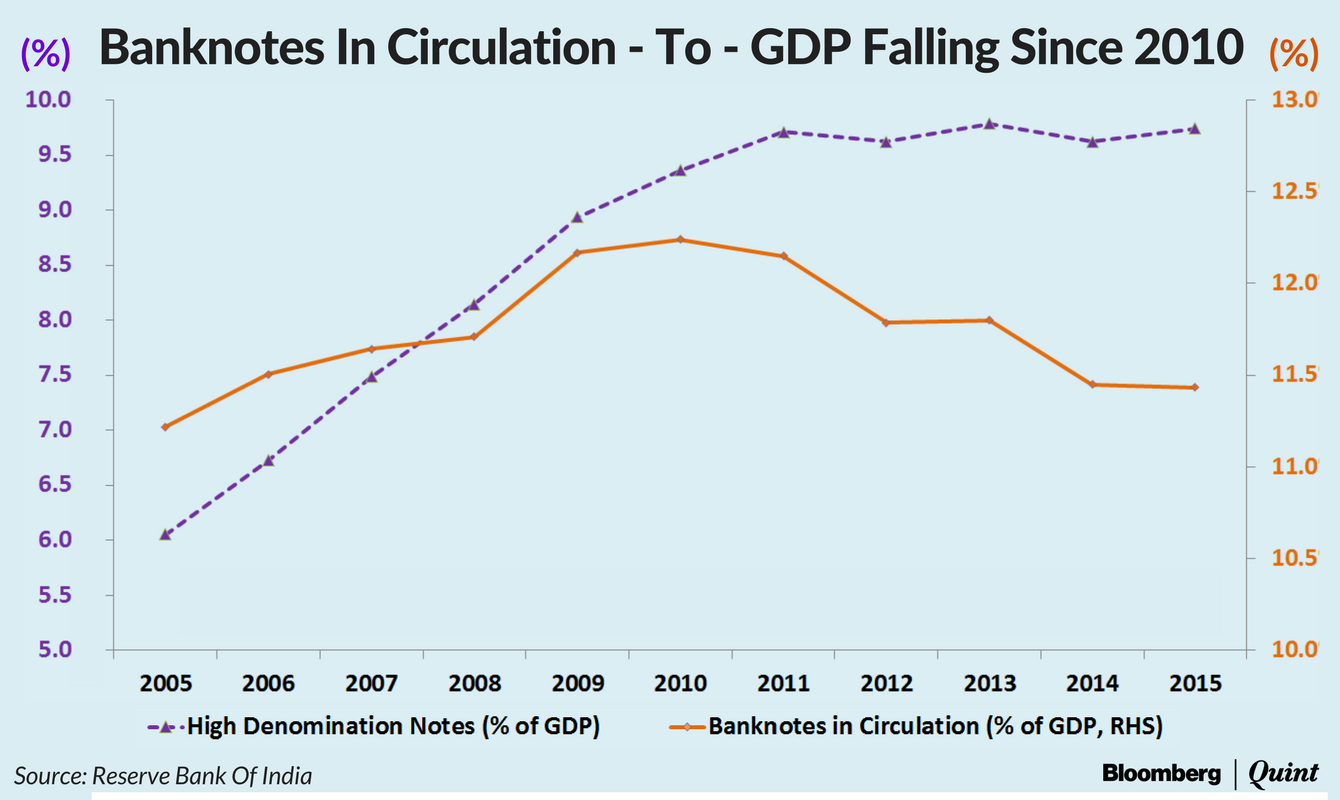
He would have first analysed the government's statement rigorously to validate their claims using data and empirical evidence. He would have collated data to check if there was indeed a sudden increase in circulation of Rs 500 and Rs 1,000 notes in the last five years. He would have immediately realized that any increase in circulation of currency has to first be normalized against increase in economic output and activity, as measured by GDP.
Urjit Patel would have tested if banknotes and high-denomination notes in circulation measured as a percentage of GDP were rising disproportionately.
Upon testing this, he would have found that contrary to the government's claims, the percentage of high denomination notes in circulation has actually been constant at roughly 9.7 percent from 2011 to 2015. He would have also realized that the Rs 1,000 note was only introduced in the year 2000 which would explain an initial adoption effect. Further, to his utter surprise, he would have realized that the total value of all banknotes in circulation as a percentage of GDP has come down from 12.2 percent to 11.4 percent in the last five years and did not rise, as the government claimed. With these results, he may have hypothesised that there is perhaps a shift to higher denomination notes from smaller denomination notes as India continued to grow richer.
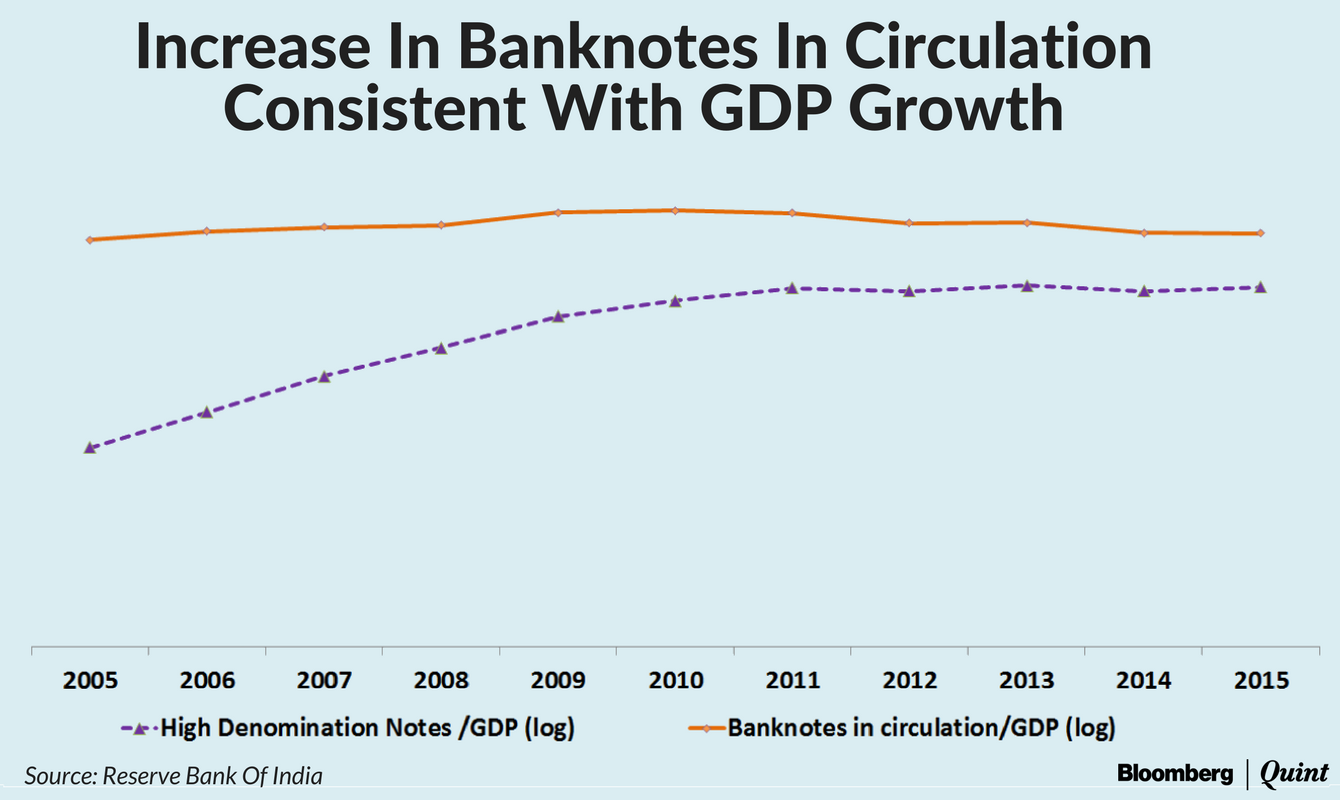
To test that hypothesis, Urjit Patel may have further done a logarithmic growth analysis of GDP, banknotes and high-denomination notes in circulation to test if there was a disproportionate growth in high-denomination notes relative to GDP growth. Again, he would have found nothing alarming or extraordinary in the growth of such high-denomination notes over the last five years, as the government claimed. Over the past decade, the banknotes in circulation have been remarkably consistent with growth in GDP, refuting the government's theory that there is a worrying rise in currency in circulation. He would have surmised that since overall banknotes in circulation have been consistent with GDP growth, any small increase in high-denomination notes is merely a substitution effect from smaller denomination notes.
If there was no disproportionate increase in high-denomination banknotes, then claims of a growing “black economy” solely due to increase in currency is also suspect.
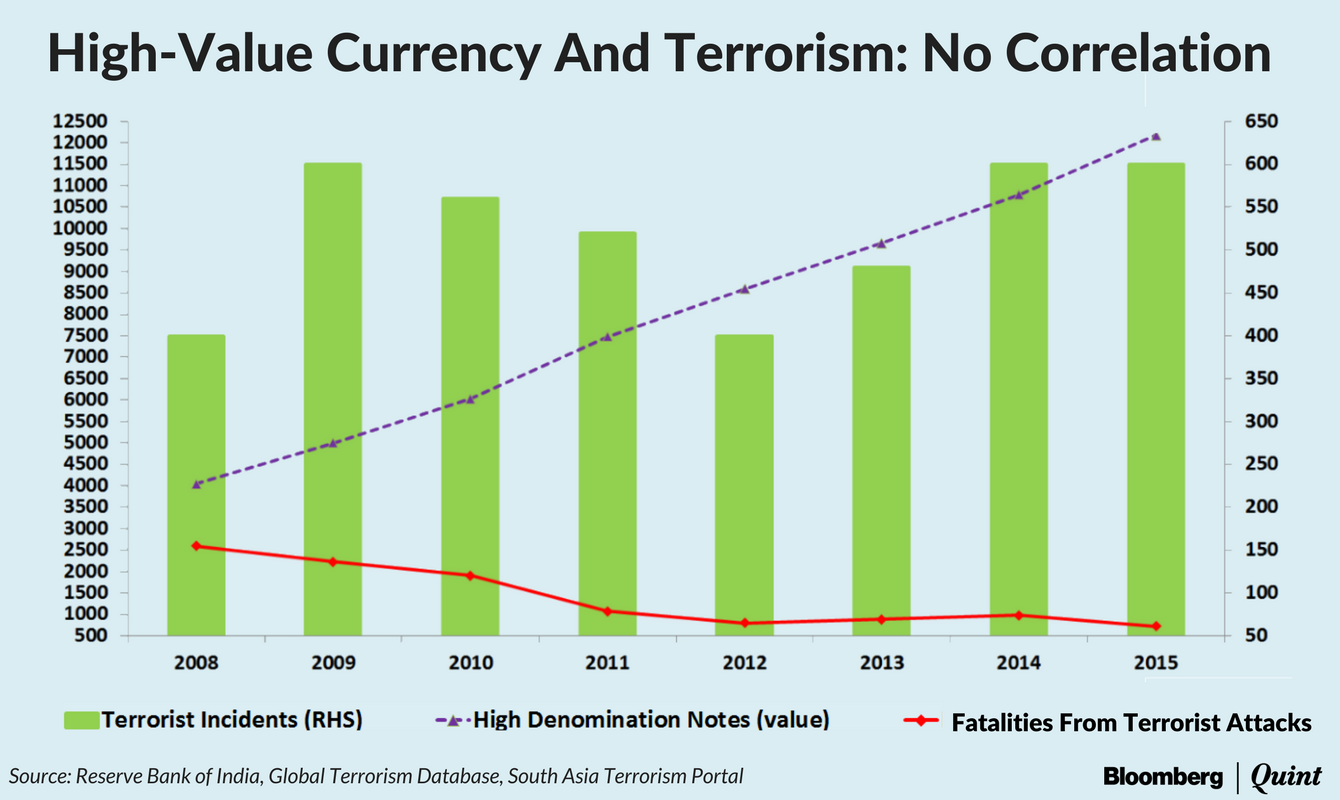
Further, Urjit Patel may have pondered if an increase in absolute levels of banknotes and high-denomination notes aided terror financing, as the government claimed.
Again, he would have sought empirical evidence to test this claim and collated data on terrorist strikes and fatalities from the Global Terrorism database and the South Asian Terrorism portal.
To be sure, he would have also agreed that even a single terror attack and a single fatality on Indian soil is condemnable and needs to be stopped. However, using this dataset, he would have realized that it is very difficult to establish a causal relationship between the number of terrorist strikes on Indian soil and the absolute levels of currency in circulation. Urjit Patel may have thus been perplexed at the government's claim that there is a sudden increase in terror financing due to an increase in high-denomination notes in circulation.
With all of these analyses and findings, Urjit Patel may have perhaps been unconvinced regarding the government's advice to the RBI to invalidate Rs 500 and Rs 1,000 banknotes as a specific solution to stem the problems of terror financing and black money. Counterfeiting is a perennial and global problem that central banks have addressed through periodic changes in designs of banknotes. Despite all this, Urjit Patel, the liberal economist, may have also opined that should the democratically elected government still decide to retire Rs 500 and Rs 1,000 notes, the RBI will certainly support it but will need sufficient time to prepare and be ready to minimize economic disruption.
Urjit Patel in 2012 also felt very strongly about the need for the RBI Governor to provide answers to questions raised in the larger public policy interest, be open to suggestions and not be dogmatic in approach.
So, going by those standards, Urjit Patel of the 2012 vintage, would not have waited for two weeks to release detailed numbers of currency deposits in banks, explained the basis for radical policy decisions such as rationing currency in the nation in the absence of a financial emergency and would have been very transparent about the decision-making process of the RBI about one of the most significant central bank decisions taken globally in recent history.
Urjit Patel's co-author of that 2012 Brookings paper was my good friend, Gangadhar Darbha, who sadly passed away last year. Gangadhar would have agreed with me - What a difference five years can make!
Praveen Chakravarty is a Senior Fellow at IDFC Institute, a Mumbai-based think/do tank. His work focuses on financial sector legislation & political economy. Noise to Signal will bring you insights from that.
The views expressed here are those of the author's and do not necessarily represent the views of BloombergQuint or its editorial team.

-
Navigating Energy Crossroads: S Jaishankar's Call For Diversified Supply Chains At G20 Ministerial Meeting

As geopolitical fault lines continue to test maritime trade routes and commodity flows, Jaishankar's message remains pertinent: true economic resilience requires open markets, protected transit lines, and a genuine commitment to multilateral cooperation rather than coercion.
-
Indians Are Travelling, But Not Every Journey Is A Holiday | The Week In Whys
Pilgrims, patients and working women are the real travellers, and the system hasn't quite caught up with them.
-
Getting To Work Costs Women More | The Reason Why
It is not just about women paying more than men. It is about women paying much more in cities than in villages.
-
AI Bias In Investing Cannot Be Eliminated, But It Can Be Governed
Framing is a particularly important example as identical financial information presented in terms of gains rather than losses can lead an LLM to reach a different assessment.
-
Joining The Dots | Dark Skies, Steady Diya: Why Hope Holds This Diwali
With war, a weak rupee and foreign outflows weighing on sentiment, policymakers at the NDTV World Summit and market veterans at NDTV Profit Ignite: Diwali Edition offered the same advice: stay invested and filter out the noise.
-
The Curious Case of Equitas Small Finance Bank And A CEO Who Quit For Stock
PN Vasudevan believes persistent investor concerns over a perceived conflict of interest had become a governance overhang on Equitas Small Finance Bank's stock, even as the lender improved profitability and asset quality.
-
Talking Points This Week: AI Cash Burn, A Tiger Comeback And An India That Still Finds Its Own Path
India is not immune to higher oil or tighter global liquidity, yet its earnings base is broader, its domestic policy levers are still available.
-
Foreign Investors Own Half Of HDFC Bank and ICICI Bank. An LTCG Cut Could Matter Most Here
Foreign portfolio investors have US$115 billion parked in HDFC Bank, ICICI Bank. If the government cuts long-term capital gains tax, Jefferies says returning foreign money could land here first.
-
'Never Seen This Level Of Negativity': Sandeep Tandon Says The Next Rally May Be Closer Than You Think
Veteran investor Sandeep Tandon says foreign selling is easing, large-caps are due a comeback and mid-caps are crowded, while he turns positive on gold, power and pharma this Diwali.
-
Indians Stay With Family, Not In Hotels | The Reason Why
India still lacks enough clean, reliable and affordable hotels for budget-conscious travellers.










