Urjit Patel Met PM Modi Amid Face-Off Over RBI Autonomy: Report
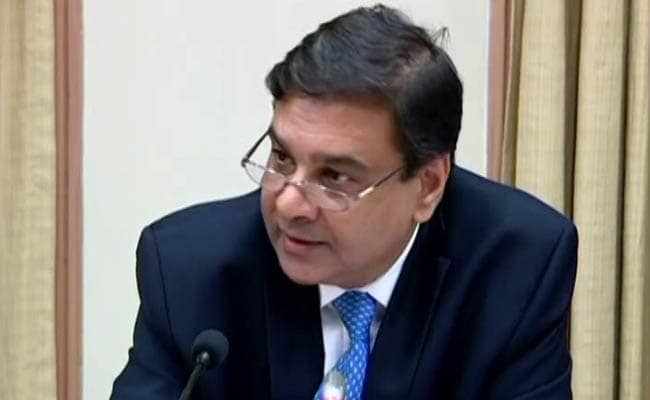
NEW DELHI: RBI Governor Urjit Patel is believed to have met Prime Minister Narendra Modi last week in a bid to work out a solution on contentious issues that have been flash point between the central bank and the government during the last few weeks. Sources said Patel was in the national capital on Friday and met senior officials in the Prime Minister's Office (PMO). The meetings, which some said also included with the Prime Minister, came amid a face-off between the central bank and the finance ministry over issues ranging from appropriate size of reserves that RBI must maintain to ease lending norms to step up growth in an election year.
Sources said there are indications that the RBI may create a special dispensation for lending to small and medium enterprises, but it was not immediately clear if an agreement has been worked out to ease liquidity situation for non-banking finance companies (NBFCs) and the RBI parting with its substantial part of its surplus.
Tensions between the RBI and the government have escalated recently, with the Finance Ministry initiating discussion under the never-used-before Section 7 of the RBI Act which empowers the government to issue directions to the RBI Governor.
RBI Deputy Governor Viral Acharya had in a speech last month talked about the independence of the central bank, arguing that any compromise could be "potentially catastrophic" for the economy.
Last week, Economic Affairs Secretary Subhash Chandra Garg had said the government was not in any dire need of funds and that there was no proposal to ask the RBI to transfer Rs 3.6 lakh crore.
He further said the only proposal "under discussion is to fix appropriate economic capital framework of RBI".
Economic capital framework refers to the risk capital required by the central bank while taking into account different risks.
The Reserve Bank of India (RBI) has a massive Rs 9.59 lakh crore reserves.
Patel's meetings at the PMO came days before the RBI's crucial board meeting on November 19 during which contentious issues are likely to come up for discussion.
Sources said the government nominee directors and a few independent directors could raise the issue of interim dividend along with the capital framework of RBI.
However, any change in the central bank's economic capital framework can be carried out only after making amendments to the RBI Act, 1934.
Other issues which could be raised include alignment of capital adequacy norms with those in advanced countries and some relaxation in the Prompt Corrective Action framework, sources said, adding more measures to enhance lending to MSMEs and NBFCs may also be discussed.
(Except for the headline, this story has not been edited by NDTV staff and is published from a syndicated feed.)

-
High US Salaries, No Green Card Certainty: The Financial Calculation Facing Indian H-1B Families

The suspension of PERM processing at eight technology employers does not cancel existing H-1B visas. What it does is force a question many Indian families have been avoiding: is the US salary worth tying your career and family plans to one employer?
-
Unhedged Position: Can India See An Indonesia-Style Time Correction?
The Nifty is trading below levels it first clocked in 2024. Is there, then, as I have suggested in the headline, potential that the current time correction drags on painfully for the next three-five, even ten years?
-
Navigating Friction And Energy Realities: An Analysis Of Marco Rubio's October Visit To India
Occurring at a critical juncture marked by stalled trade negotiations and escalating geopolitical pressures over global energy supplies, the visit offers a profound window into modern US-India relations.
-
India Exports Capital. Why Not Export Trusteeship?
The big question, then, is whether India can build an institution that global borrowers, investors, banks, and lawyers can trust, even without an Indian connection.
-
France's Economy & Politics Are In Crisis | The Reason Why
Let's look at how the French economy and politics evolved under Nicolas Sarkozy, Franois Hollande and Emmanuel Macron.
-
You May Inherit The Business. You Must Earn Its Credibility.
Succession tests the founder's ability to share authority as much as it tests the next generation's readiness to assume it.
-
Signing Deals Is One Thing; Making Them Work Is Another | The Week In Whys
Sometimes, things don't turn out as planned. Indian companies have lost some bids to rivals, some projects won't produce until 2030.
-
FOMC Wall, PERM Suspension, Hospital Stocks | Talking Points This Week
A PERM suspension would directly affect green-card sponsorship rather than H-1B visas, so the near-term earnings impact could remain relatively limited. The key question is whether this marks a new phase in US scrutiny of Indian IT.
-
Everything, Everywhere, All At Once: Dalal Street's Week To Forget | Joining The Dots
Visa curbs, a Starlink spat and cancer drug caps: what connects this week's shocks for Indian markets
-
India Is Going Abroad For Critical Minerals. But It May Take Years To Pay Off | The Reason Why
Although India's steps are in the right direction, they remain modest compared with India's growing dependence.









