UPSC Topper Tina Dabi’s Success is NOT Scripted by ‘Bonus Marks’
To set the record straight, Tina Dabi, the 2015 UPSC topper, did not receive any “affirmative”, bonus or extra marks for being a Dalit. She was declared Rank #1 through a merit list released by the UPSC.
If you're wondering what this is about, let us help you.
A blog post titled ‘Tina Dabi and Reservation Controversy' went viral a few days ago. The blog alleges she cleared the exam by “claiming reservation” while the comments section is replete with claims (yet again) that reservation “kills” merit.
The Bare Facts – “Reserved” Equals “Undeserving”?
Yes, Dabi is the first Dalit woman to top the UPSC exam. But her success isn't sitting easy. She's been facing incessant online trolling for using the ‘Dalit' card, in a brash and very public display of systematic caste-based hatred.
Which led us wondering how being a Dalit helped her score in the UPSC.
So again, here are the facts:
- The UPSC exam is conducted in three stages – the preliminary exam, the main exam and an interview round.
- The cut-off for the prelims in 2015 was 107.34 for the general category and 94 for the SC category.
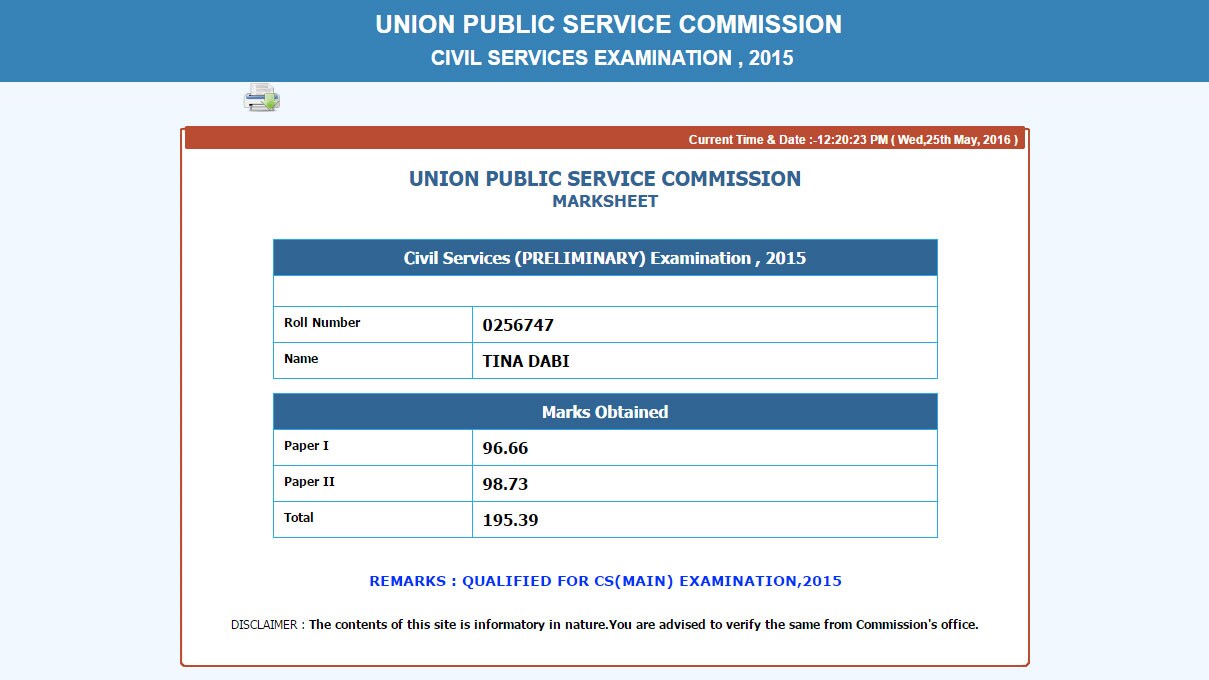
- Dabi secured a 96.66 in paper 1 of the prelims, which made her clear the above mentioned cut-off of 94.
- The fact that she made the prelims cut-off indicates that she applied through the SC category.
- Paper 2 was a qualifying exam, in which anybody who scored 66 or above would clear the mark. Dabi scored 98.73.
 UPSC website) ">
Yes, Dabi cleared the prelims cut-off through the SC category. However, the final merit list was based on the score in her mains and interview round. The prelims, being a qualifier, did not affect the final merit list.
Her application through the SC category being used as a plank to negate her success is thus, both ill-informed and casteist.
Which brings us to the next question.
Reservation is a legitimate constitutional right, not a favour. Why then is she not entitled to use the same?
The anti-reservation stance being used to legitimise online campaigns that malign her as “undeserving” is a display of nauseating hypocrisy.
Virulent Attacks Indicative of Casteist Hatred
Personal attacks abound. The blog mentions an Ankit Srivastava, who failed to qualify in this year's exam and went on a tirade against Dabi. Another, who could not clear the cut-off two years ago, has been comparing his marks with Dabi's to assert that she is undeserving.
UPSC's discretion of choosing a cut-off varies every year. So where does the validity of comparing scores across different years lie?
And if that wasn't enough, Dabi was also greeted with over 35 fake Facebook profiles.
One of the posts written in her name praises Modi and critiques reservations as a weapon of vote bank politics.
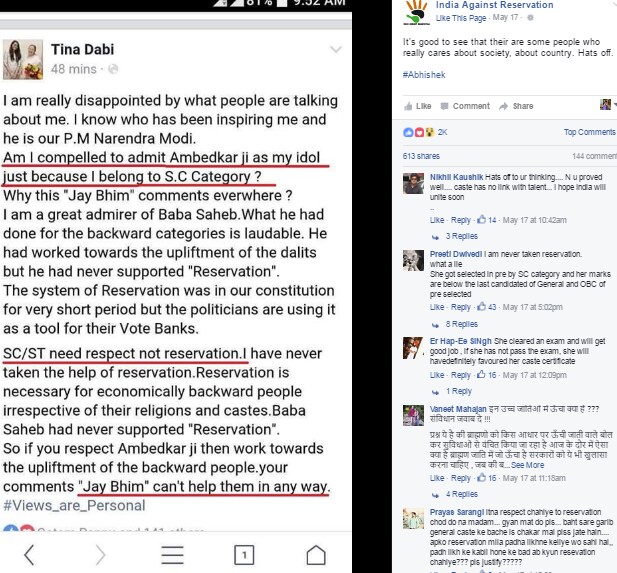
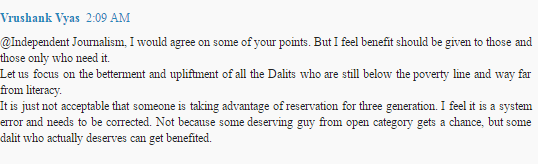
One says that because she belongs to the “creamy layer” and not deserve to use the quota.
 Blog) ">
Here's why the creamy layer argument is problematic. Reservation or affirmative action was supposed to lend a hand to the historically marginalised and excluded. It wasn't meant to be a poverty alleviation scheme, but a way to ensure better representation and undo (or at least make an attempt to) centuries of caste-based oppression.
Those who use ‘merit' as a qualifier against reservations, need to understand that Dabi is still an exception.
In fact, statistics show that despite reservation, by 2012, out of 149 secretary-level officers, there were no SCs and only 4 STs.
But then again, there are other factors that need assessment.
First, how many generations would it take before we can do away with the requirement of reserved quotas?
Second, how does one decide who “needs” reservations? There are several groups who are economically backward, but are outside the fence of “reserved” populations.
Similarly, many backward individuals, who can avail of reservations are in fact financially better off than others.
Therefore, with all the criticism Dabi seems to be getting, there is a need to, well, analyse the idea of “needs” in the discourse on reservation, instead of simply bashing her for belonging to an economically stable family.
Intensifying the Reservation Debate
Would we have even cared to bother about all this had she not been a rank one holder? Maybe not.
And if you thought reservation is unique to India, well, it's not.
Affirmative action, or the policy of favouring members of a historically disadvantaged group, is practised in Ivy League schools too.
A political hot potato, the issue has escalated after Asian-American organisations have drafted complaints alleging that these schools including Yale University use racial quotas to maintain “ideal racial balances.” Last year, Princeton researchers concluded that African Americans received 230 “bonus” points, and Hispanics received 185 points to get admissions.
Tina, however, did not get any “bonus” points (reiteration required).
That said, the narrative built around her “dalit” status and our collective musings over the same reiterate why, and how much, caste still matters in India.

-
Blue Wave Will Derail the AI Trade but Won't Dismantle the AI Era | Unhedged Position

The Democrats' sweep of the US Congress will see politics collide with economic forces both over the long and short term.
-
It's Time To Take The GST Council's Bet On Trust Global
Payment records can prove India's services exports, and clear, proportionate rules can bring foreign digital sellers into the tax net.
-
Opinion | India at 38: From Innovation Overperformer to Innovation Powerhouse
India now has 453 VC-backed deep science startups, 18 of them late-stage, after 117 percent growth since 2020. Laurus Labs, at USD 9.3 billion, is the most valuable deep science company in any middle-income economy outside China.
-
Navigating Energy Crossroads: S Jaishankar's Call For Diversified Supply Chains At G20 Ministerial Meeting
As geopolitical fault lines continue to test maritime trade routes and commodity flows, Jaishankar's message remains pertinent: true economic resilience requires open markets, protected transit lines, and a genuine commitment to multilateral cooperation rather than coercion.
-
Indians Are Travelling, But Not Every Journey Is A Holiday | The Week In Whys
Pilgrims, patients and working women are the real travellers, and the system hasn't quite caught up with them.
-
Getting To Work Costs Women More | The Reason Why
It is not just about women paying more than men. It is about women paying much more in cities than in villages.
-
AI Bias In Investing Cannot Be Eliminated, But It Can Be Governed
Framing is a particularly important example as identical financial information presented in terms of gains rather than losses can lead an LLM to reach a different assessment.
-
Joining The Dots | Dark Skies, Steady Diya: Why Hope Holds This Diwali
With war, a weak rupee and foreign outflows weighing on sentiment, policymakers at the NDTV World Summit and market veterans at NDTV Profit Ignite: Diwali Edition offered the same advice: stay invested and filter out the noise.
-
The Curious Case of Equitas Small Finance Bank And A CEO Who Quit For Stock
PN Vasudevan believes persistent investor concerns over a perceived conflict of interest had become a governance overhang on Equitas Small Finance Bank's stock, even as the lender improved profitability and asset quality.










