The Airline Industry’s Biggest Climate Challenge: A Lack Of Clean Fuel

(Bloomberg) -- In a glimmer of progress for the daunting task of reducing air travel's climate impact, a newly built plant in rural Georgia is expected to begin pumping out the world's first commercial quantities of a new type of cleaner jet fuel this month.
The $200 million plant from LanzaJet Inc. will be the first to turn ethanol into a fuel compatible with jet engines. The facility is one of many efforts around the globe attempting to crack one of the biggest problems facing greener air travel: finding and developing cleaner feedstocks that can generate enormous quantities of fuel without triggering ripple effects that end up worsening the climate and biodiversity crises.
Progress thus far has been very limited. Efforts to produce new types of cleaner fuels require hundreds of millions of dollars. But investors have remained wary with would-be plants routinely suffering lengthy delays and struggling to become operational.
“We need to scale-up by 1,000-fold,” says Hemant Mistry, director of net zero transition for the International Air Transport Association, which has pledged that the aviation industry will erase its carbon emissions by 2050, mostly by using huge quantities of cleaner jet fuel.
At its new facility dubbed Freedom Pines Fuels, LanzaJet plans to produce 9 million gallons of sustainable aviation fuel (SAF) per year. In one sense, that's just a tiny step forward: It would take 100 of these plants to fulfill just 1% of the ravenous appetite of the world's commercial air carriers, which consumed 90 billion gallons of jet fuel last year.
But it provides a glimpse of one direction the clean fuel industry wants to go. Most SAF today is derived from animal fats and waste oils, which are relatively scarce. Used cooking oil is already widely collected for road transportation with only modest room for growth, while a robust market has long converted animal fats into ingredients for pet food and detergents. Strong demand from aviation could push these other industries to switch to climate-harming ingredients, like palm oil, warn environmental groups.
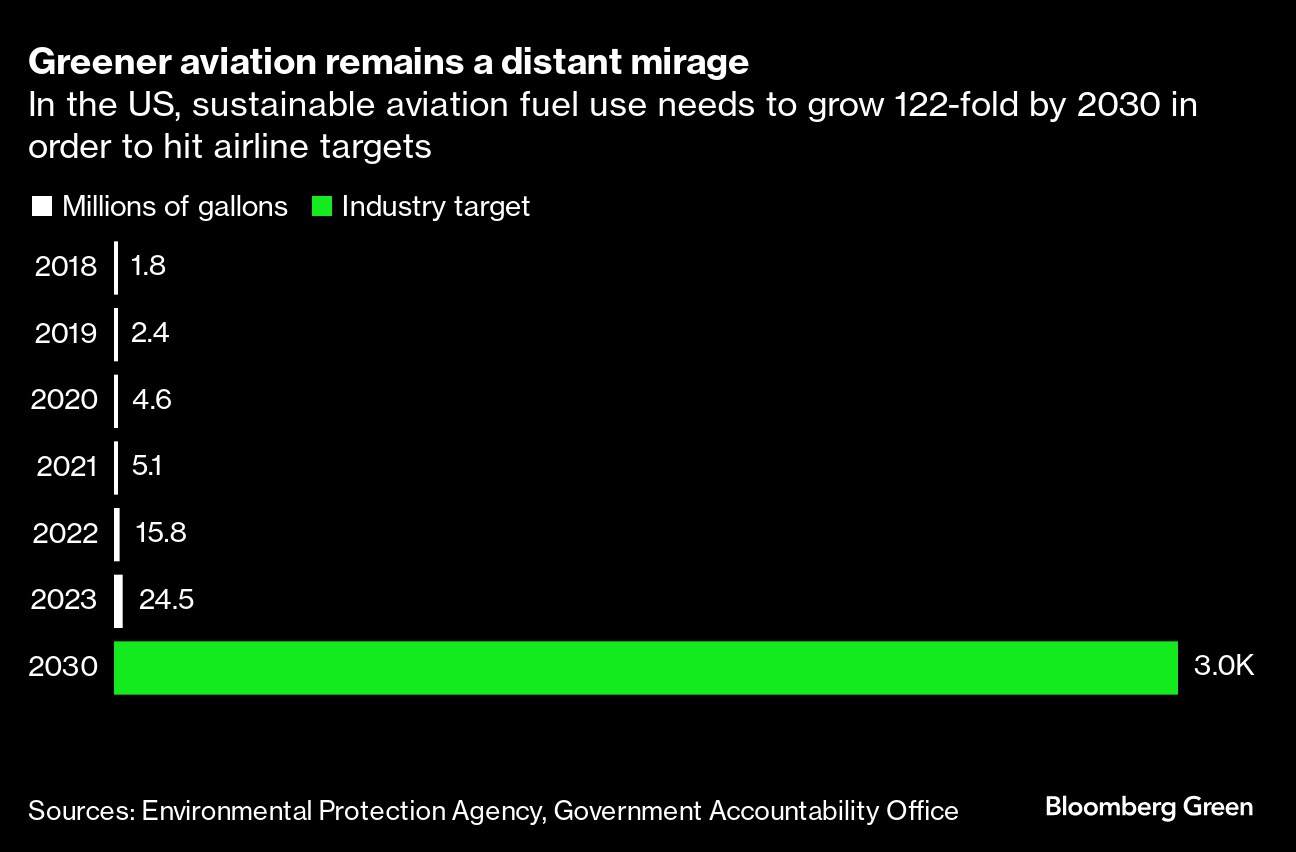
This has left aviation giants scouring the world for alternatives to meet their climate commitments. IAG SA, the parent company of British Airways, has pledged to up its SAF usage to 10% by 2030. Last year, it gobbled up 17.6 million gallons, or 0.66%, of its total fuel. While that's a tiny amount, it eclipses US airlines. United Airlines Holdings Inc. has led US carriers, but got less than 0.1% of its fuel from clean sources last year. All of IAG's cleaner fuel last year came from traditional feedstocks like waste oils, according to Aaron Robinson, the company's vice president for sustainable aviation fuel in the US.
But that could soon change. Three years ago, British Airways partnered with LanzaJet, investing in Freedom Pines' construction and teaming up on a clean fuels facility in the UK, which they hope will come online by 2028. Both plants will deploy technology known as alcohol-to-jet, which uses chemical reactions to upgrade ethanol into a potent fuel capable of powering jet turbines. IAG hopes to consume its first SAF from the Georgia plant later this year.
“Diversification matters,” says IAG's Robinson. “That's why alcohol-to-jet is an area that is quite attractive to us.”
It could sidestep a thorny issue facing some of the industry's other clean fuel efforts. In the US, airlines are advocating for rules that could allow corn ethanol to qualify for SAF tax credits. It's contentious because renewable fuels policies enacted in the US nearly two decades ago have led to about 40% of the country's crop being turned into fuel.
This spiked demand for corn and other crops, spurring land-use changes not just in the US but globally. Those changes included clearing carbon-rich grasslands and forests to plant more crops, which negated most of the climate benefits of corn-based ethanol. Airlines are convinced this can be done with far fewer climate impacts, but doubters abound.
“This industry needs an absolutely huge amount of fuel,” says Alethea Warrington, a senior campaigner at Possible, a UK-based climate charity that is skeptical of SAF and encourages less air travel. “Wherever you try to get this from, it throws up huge systemic problems.”
Freedom Pines will initially deliver scant climate benefits because it will use corn ethanol from the US Midwest to “work the kinks out,” says Jimmy Samartzis, chief executive officer of LanzaJet. As it becomes operational over three to six months, it will transition to using sugarcane ethanol from Brazil, which has fewer land-use impacts. Doing so would reduce heat-trapping emissions by at least half compared to fossil jet fuel, according to the US Environmental Protection Agency.
Samartzis says they'll also soon use ethanol derived from waste products, like corn stalks and other agricultural residues. That should deliver even bigger carbon savings because they do little to spur land-use changes that could harm the climate.
L.E.K. Consulting, in a report on the SAF market last year, predicted alcohol-to-jet will surpass today's clean fuels to become the world's biggest source of SAF by the middle of next decade. “It's a proven technology and there are abundant agricultural and forestry residues, which work very well with it,” says John Goddard, L.E.K.'s senior partner and vice chair of sustainability.
It's not the only path forward, though. Several outfits, like Nuseed and CoverCress Inc., which is majority-owned by Bayer AG, are beginning to enlist farmers to plant between their normal rotations of corn and soybeans. This includes carinata and pennycress, which can be converted into biofuels and animal feed. Because these are planted as cover crops when fields would otherwise lay fallow, they don't trigger land-use changes. But these businesses face a range of hurdles from reluctant farmers to regulatory approvals.
“It's not for the faint of heart to introduce a new crop,” says Mike DeCamp, chief executive officer of CoverCress, who adds that it could be a decade before the company reaches its full scale. His firm was named a BloombergNEF Pioneer this week owing to the promise of its technology to breed and edit the genes of pennycress to make growing the crop more profitable.

By the 2040s, Goddard and other experts believe a nascent technology called power-to-liquids or e-kerosene will likely eclipse the rest of the market and reduce the risk of land-use change altogether. That fuel is produced by combining a stream of captured CO2 with hydrogen molecules using vast quantities of renewable energy. The output is a liquid fuel with almost no climate footprint.
But the barriers are immense. Capturing CO2 is extremely difficult, and there is little extra renewable energy as governments around the world race to decarbonize. All told, power-to-liquids would cost nearly seven times more than traditional jet fuel, according to L.E.K.
The difficulties are showcased by Transport & Environment, a nonprofit in Brussels, which has tracked proposed power-to-liquids plants across much of Europe. Although the number of announced facilities climbed to 45 as of January — part of a “largely positive” trend, it noted — all of the major projects remain “hypothetical” as they've yet to clear the crucial final investment decision, where money begins to flow and the construction truly commences.
Governments have been throwing a mishmash of requirements and incentives at the industry in an attempt to build momentum. The EU has been at the forefront, with lawmakers there mandating that airlines use SAF in increasing quantities through 2050, when it should account for at least 70% of all fuel. This includes a sub-mandate for pricey e-kerosene, which must go from 1.2% of fuels in 2030 to 35% by 2050.
SAF requirements in the US have gained little traction amid forceful opposition from the airlines. Instead, the Inflation Reduction Act created an incentive for SAF worth up to $1.75 per gallon. That expires in 2027, though, well before most proposed plants will be operating.
“That's not long enough to get projects built and constructed,” says LanzaJet's Samartzis.
In the case of Freedom Pines, it took a little help to get it over the finish line. Breakthrough Energy supplied a $50 million grant in 2022 to help keep the project on track.
But if Freedom Pines can ramp up successfully and churn out millions of gallons of SAF, it could do a lot to rev up investor appetite, according to Susan van Dyk, a biofuels consultant and researcher at the University of British Columbia.
Nonetheless, she adds, the industry has a long way to go to catch up to its SAF promises, which requires a 50- or 100-fold increase in production by the end of this decade. “I can't see that happening by 2030,” says van Dyk. “We just need more of these technologies to be commercial and ramping up.”
©2024 Bloomberg L.P.

-
Where You Live Shapes How You Get To Work | The Reason Why

Two-wheelers are the most popular way to get to work in India, accounting for nearly 43% of workplace commutes.
-
High US Salaries, No Green Card Certainty: The Financial Calculation Facing Indian H-1B Families
The suspension of PERM processing at eight technology employers does not cancel existing H-1B visas. What it does is force a question many Indian families have been avoiding: is the US salary worth tying your career and family plans to one employer?
-
Unhedged Position: Can India See An Indonesia-Style Time Correction?
The Nifty is trading below levels it first clocked in 2024. Is there, then, as I have suggested in the headline, potential that the current time correction drags on painfully for the next three-five, even ten years?
-
Navigating Friction And Energy Realities: An Analysis Of Marco Rubio's October Visit To India
Occurring at a critical juncture marked by stalled trade negotiations and escalating geopolitical pressures over global energy supplies, the visit offers a profound window into modern US-India relations.
-
India Exports Capital. Why Not Export Trusteeship?
The big question, then, is whether India can build an institution that global borrowers, investors, banks, and lawyers can trust, even without an Indian connection.
-
France's Economy & Politics Are In Crisis | The Reason Why
Let's look at how the French economy and politics evolved under Nicolas Sarkozy, Franois Hollande and Emmanuel Macron.
-
You May Inherit The Business. You Must Earn Its Credibility.
Succession tests the founder's ability to share authority as much as it tests the next generation's readiness to assume it.
-
Signing Deals Is One Thing; Making Them Work Is Another | The Week In Whys
Sometimes, things don't turn out as planned. Indian companies have lost some bids to rivals, some projects won't produce until 2030.
-
FOMC Wall, PERM Suspension, Hospital Stocks | Talking Points This Week
A PERM suspension would directly affect green-card sponsorship rather than H-1B visas, so the near-term earnings impact could remain relatively limited. The key question is whether this marks a new phase in US scrutiny of Indian IT.
-
Everything, Everywhere, All At Once: Dalal Street's Week To Forget | Joining The Dots
Visa curbs, a Starlink spat and cancer drug caps: what connects this week's shocks for Indian markets