PM Modi's Big Chance Today To Woo Voters Before Polls
Prime Minister Narendra Modi has a last-ditch attempt to win voters with possible populist spending measures in today's budget, risking his debt targets in the process.
PM Modi is feeling the heat after his ruling Bharatiya Janata Party lost control of three key states in regional elections last month, setting the stage for a contentious national vote that's due by May. He's coming under pressure from a resurgent opposition, which is going all out to lure voters with debt waivers for farmers and pledges of welfare grants for the poor.
Speculation is swirling that the PM's fiscal plan includes a cash transfer program for farmers entailing an additional spending of 70,000 crore rupees ($9.8 billion), support for small businesses and some reprieve for taxpayers. For investors, that translates into another breach in the budget deficit target of 3.3 per cent of gross domestic product this year and possible record borrowing in the coming year.
"In the event of the incumbent government staying in power or the Congress-led coalition taking over, fiscal policy will likely remain overly loose, with the deficit likely to remain well above the 3 per cent comfort level," said Prakash Sakpal, an economist at ING Groep NV in Singapore.
Deficit economists in a Bloomberg survey expect the government to widen its target for FY19 to 3.5 per cent of GDP from 3.3 per cent.
Fiscal deficit is forecast to widen to 3.5 per cent of the gross domestic product in the year to March, and reach 3.3 per cent in the next financial year, according to the median estimate in a Bloomberg survey of economists.
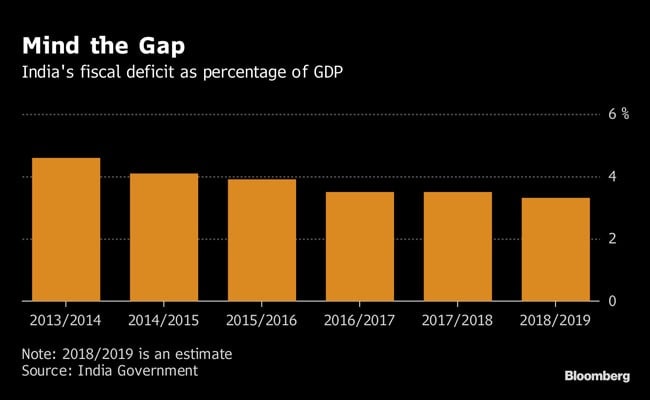
"The fiscal deficit is already at 114.8 per cent of its budgeted target, implying expenditure cuts will have to be substantial if the government is to stick to its budgeted fiscal deficit target of 3.3 per cent in FY19," said Madhavi Arora, an economist at Edelweiss Securities Pvt.
When including spending and revenue from the various states, country's deficit shoots up to 6.3 per cent of GDP, according to estimates from Moody's Investors Service. That's one of the highest in Asia, and among the reasons the nation's credit rating remains constrained.
Bond yields have risen in four of the past five weeks, with the yield on the most-traded 2028 security increasing 15 basis points to 7.54 per cent in the past month.
Rate Cuts?
To help make up the revenue shortfall and keep the budget deficit in check, the government may pressure the Reserve Bank of India to pay an early dividend. Some reports suggest new Governor Shaktikanta Das may be asked to stump up as much as 40,000 crore rupees to boost the state's coffers.
Mr Das is also in a position to give support to the economy through interest rate cuts, providing an extra boost to PM Modi's government. With inflation at an 18-month low, consumer demand weakening and global risks mounting, economists are betting the RBI will lower rates this year, possibly as early as next week.
What Our Economists Say...
"If the government surprises by abandoning its fiscal targets, yields could rise further. This could make it harder for the Reserve Bank of India to adopt an accommodative stance."-- Abhishek Gupta, Bloomberg Economics.
A pre-election budget usually covers the period until a new government takes office, and isn't typically used to make major announcements, such as tax changes that would carry over into the next administration. But there's no law that prevents PM Modi from making significant announcements this week.
"They will announce some doles for the rural economy," said Jay Shankar, a Delhi-based independent economist. "The bigger questions are: Can we afford it now? Will these measures help the sector and the overall economy? Will it convert into more votes. The answer, to my mind, is in the negative."

-
Navigating Friction And Energy Realities: An Analysis Of Marco Rubio's October Visit To India

Occurring at a critical juncture marked by stalled trade negotiations and escalating geopolitical pressures over global energy supplies, the visit offers a profound window into modern US-India relations.
-
India Exports Capital. Why Not Export Trusteeship?
The big question, then, is whether India can build an institution that global borrowers, investors, banks, and lawyers can trust, even without an Indian connection.
-
France's Economy & Politics Are In Crisis | The Reason Why
Let's look at how the French economy and politics evolved under Nicolas Sarkozy, Franois Hollande and Emmanuel Macron.
-
You May Inherit The Business. You Must Earn Its Credibility.
Succession tests the founder's ability to share authority as much as it tests the next generation's readiness to assume it.
-
Signing Deals Is One Thing; Making Them Work Is Another | The Week In Whys
Sometimes, things don't turn out as planned. Indian companies have lost some bids to rivals, some projects won't produce until 2030.
-
FOMC Wall, PERM Suspension, Hospital Stocks | Talking Points This Week
A PERM suspension would directly affect green-card sponsorship rather than H-1B visas, so the near-term earnings impact could remain relatively limited. The key question is whether this marks a new phase in US scrutiny of Indian IT.
-
Everything, Everywhere, All At Once: Dalal Street's Week To Forget | Joining The Dots
Visa curbs, a Starlink spat and cancer drug caps: what connects this week's shocks for Indian markets
-
India Is Going Abroad For Critical Minerals. But It May Take Years To Pay Off | The Reason Why
Although India's steps are in the right direction, they remain modest compared with India's growing dependence.
-
When Everyone Has AI, What Gives You An Edge?
India's young workforce is entering an uncertain world of work where powerful AI tools are becoming widely accessible. The advantage will belong to those who combine deep expertise with digital fluency, and the distinctly human capabilities that technology cannot manufacture.
-
Wrong Labels, High Pesticide Residues Holding Back Agri Exports | The Reason Why
India needs stronger domestic food-safety and labelling standards, with best practices becoming part of everyday business for farmers, traders and food companies.










