Government's Interim Budget: Here Are The Winners And Losers
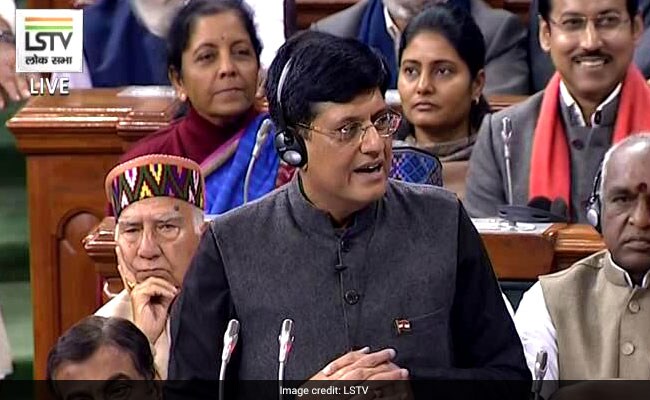
Prime Minister Narendra Modi has delivered an interim budget likely to boost the government's popularity ahead of polls that are now just months away.
The budget includes big announcements such as a major income support scheme for farmers and a new pension program for workers. It also includes a number of smaller measures that could prove popular, including tax relief for the lower middle class.
Delivered by Finance Minister Piyush Goyal because Arun Jaitley is in the US for medical treatment, the budget speech was heavy on praise for the government's programs over the last four-and-a-half years -- sometimes prompting boos from the opposition.
Farmers, as well as companies with exposure to rural India and middle class taxpayers, seem to be the clear winners here at the expense of the country's fiscal deficit.
Winners
Farmers
As expected, PM Modi's administration has come out with a massive spending plan for the country's farmers: A Rs 75,000-crore ($10.5 billion) farm income support program. Farmers with less than two hectares of land will receive Rs 6,000 ($84) each year. That's likely to assist about 120 million small and marginal farmers, the government said. Agriculture-focused companies such as Shakti Pumps India, Jain Irrigation Systems, KSB, Kirloskar Brothers, Avanti Feeds, Waterbase, JK Agri Genetics, PI Industries could benefit.
Tax payers
Income tax payers earning up to Rs 5,00,000 will get a full tax rebate, while those earning up to Rs 6,50,000 will not need to pay tax if they invest in the country's provident funds and prescribed equities. Mr Goyal said this could benefit as many as 30 million middle class taxpayers. Anyone earning more will be taxed at the prevailing rates.
Rural India
Increased spending on the animal husbandry and fisheries sectors and an interest subvention plan for small-and-medium-sized businesses could benefit companies with exposure to rural India. That includes motorcycle companies and others with interests in the country's heartland including Mahindra & Mahindra and Larsen & Toubro.
Workers
A second big announcement in the budget was for a "mega" pension program for India's informal sector workers with income below Rs 15,000. The vast majority of the country's workers are employed in small enterprises, often with little job security and no social security benefits.
Real Estate
The Bombay Stock Exchange's real estate index climbed as the government reiterated its push for affordable housing and announced new measures that could boost home-buying. Mr Goyal promised a home for every person in India, a country of 1.3 billion people, and proposed to allow investments of as much as Rs 2 crore from capital gains for buying two residential houses, compared with only one at present. He also proposed waiving tax on the notional rent payable on a second self-occupied house. Companies that could benefit include Oberoi Realty, Prestige Estates Projects and DLF.
Auto-makers
The S&P BSE Auto Index jumped as much as 5.3 per cent, its biggest intraday advance since May 2014, as Goyal delivered his speech. Maruti Suzuki India, Hero MotoCorp and Bajaj Auto gave the biggest boost to the benchmark S&P BSE Sensex.
PM Modi
In his government's budget, two major initiatives -- a farmer income support plan and a pension plan -- bear the name of the prime minister's office. Although the farmers' plan was expected, the pension announcement was not. And both could go some way to boosting Modi's popularity ahead of elections.
Losers
Bond holders
PM Modi's government will breach its fiscal deficit target for a second year, with the budget gap estimated at 3.4 per cent. Bond holders could get hit if Moody's or S&P downgrade the country's credit rating. Moody's has already said the government's budget includes no new policies to increase revenues.
"Ongoing slippage from the government's budgeted fiscal deficit targets over the past two years, and our expectation that the government will face challenges meeting its target again this coming fiscal year (ending March 2020) does not bode well for medium term fiscal consolidation,'' said Gene Fang, an associate managing director at Moody's Investors Service's sovereign risk group.
Sovereign bonds slid after the government detailed higher-than-expected borrowing numbers for fiscal 2019-20. The yield on the most traded 2028 bond was up 14 basis points to 7.63 per cent as of 2:43 pm in Mumbai.
Opposition parties
PM Modi's administration has unleashed an interim budget full of populist goodies for farmers, the middle class and small-and-medium-sized businesses. Regardless of whether the government implements any of this with the election due by May, the announcements could still hurt opposition parties as they head out on the campaign trail with only manifesto promises to offer voters.
Farm labourers
Rural labourers who toil on farms but don't actually own any land will not benefit from the government's big spending plan for farmers. These workers are often already desperately poor, while most state-initiated plans to boost prosperity in the countryside tend to focus on land-owning farmers.
''It tends to ignore the landless farmers who will not be entitled to the annual support of Rs 6,000,'' said Jaijit Bhattacharya, president of the Centre for Digital Economy Policy Research in New Delhi.
Defense
In dollar terms, the country's defense spending is less than it was last year because of depreciation. This year's budget allocates about Rs 3.05 lakh crore ($43 billion) for defense spending, most of which is eaten up by recurring costs that squeezes the money available for new arms purchases.
Last year, the government allocated about Rs 2.85 lakh crore ($40 billion). But the rupee has depreciated over the past year and on February 1, 2018, Rs 2.85 lakh crore amounted to roughly $44.5 billion. That stagnation matters, because India is one of the world's largest weapons importers. Effectively, the government is compensating for depreciation and inflation, and will likely still sell this as an increase in defense spending.

-
Blue Wave Will Derail the AI Trade but Won't Dismantle the AI Era | Unhedged Position

The Democrats' sweep of the US Congress will see politics collide with economic forces both over the long and short term.
-
It's Time To Take The GST Council's Bet On Trust Global
Payment records can prove India's services exports, and clear, proportionate rules can bring foreign digital sellers into the tax net.
-
Opinion | India at 38: From Innovation Overperformer to Innovation Powerhouse
India now has 453 VC-backed deep science startups, 18 of them late-stage, after 117 percent growth since 2020. Laurus Labs, at USD 9.3 billion, is the most valuable deep science company in any middle-income economy outside China.
-
Navigating Energy Crossroads: S Jaishankar's Call For Diversified Supply Chains At G20 Ministerial Meeting
As geopolitical fault lines continue to test maritime trade routes and commodity flows, Jaishankar's message remains pertinent: true economic resilience requires open markets, protected transit lines, and a genuine commitment to multilateral cooperation rather than coercion.
-
Indians Are Travelling, But Not Every Journey Is A Holiday | The Week In Whys
Pilgrims, patients and working women are the real travellers, and the system hasn't quite caught up with them.
-
Getting To Work Costs Women More | The Reason Why
It is not just about women paying more than men. It is about women paying much more in cities than in villages.
-
AI Bias In Investing Cannot Be Eliminated, But It Can Be Governed
Framing is a particularly important example as identical financial information presented in terms of gains rather than losses can lead an LLM to reach a different assessment.
-
Joining The Dots | Dark Skies, Steady Diya: Why Hope Holds This Diwali
With war, a weak rupee and foreign outflows weighing on sentiment, policymakers at the NDTV World Summit and market veterans at NDTV Profit Ignite: Diwali Edition offered the same advice: stay invested and filter out the noise.
-
The Curious Case of Equitas Small Finance Bank And A CEO Who Quit For Stock
PN Vasudevan believes persistent investor concerns over a perceived conflict of interest had become a governance overhang on Equitas Small Finance Bank's stock, even as the lender improved profitability and asset quality.










