Defence Budget Increased By 6.87% To Rs 3.18 Lakh Crore
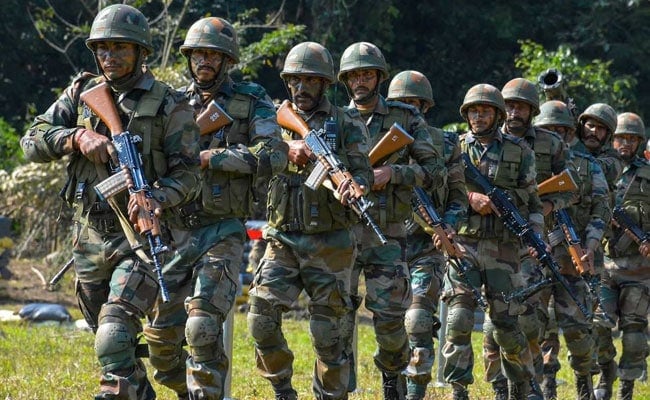
The defence budget was increased by 6.87 per cent to Rs 3.18 lakh crore against last year's allocation of Rs 2.98 lakh crore, notwithstanding expectations of a major hike when China and Pakistan were bolstering their military capabilities.
Out of the total allocation, Rs 1,08,248 crore has been set aside for capital outlay for the year 2019-2020 to purchase new weapons, aircraft, warships and other military hardware. Last year, the government allocated Rs 93,982 crore as capital outlay.
The defence ministry said the total allocation of Rs 3,18,931 crore in defence budget is an increase of 6.87 per cent over revised estimate of Rs 2,98,418 crore for 2018-19. The total outlay does not include Rs 1,12,079 crore set aside for payment of pensions.
"The allocation for capital expenditure is totally inadequate given the kind of modernisation our armed forces are envisaging," said Dr Laxman Behera of Institute of Defence Studies and Analysis. Behera said the defence budget is around 1.44 per cent of the GDP which, he called as "insufficient" considering the evolving security situation in India's neighbourhood. Presenting the interim budget for 2019-20 in Parliament, Union Minister for Finance and Corporate Affairs Piyush Goyal said additional funds, if necessary, would be provided to secure India's borders and maintain its defence preparedness.
"Our defence budget will be crossing Rs 3,00,000 crore for the first time in 2019-20. For securing our borders and to maintain preparedness of the highest order, if necessary, additional funds would be provided," he said.
Under capital outlay, the Army was granted Rs 29,447 crore, the Navy was given Rs 23,156 crore and the Indian Air Force got an allocation of Rs 39,302 crore.
The revenue expenditure which includes expenses on payment of salaries and maintenance of establishments has been pegged at Rs 2,10,682 crore as against Rs 1,88,118 crore for 2018-19. Experts said Goyal's budget was an interim budget and the allocation for defence forces may change when a full-fledged budget is presented by the new government after the Lok Sabha polls.
The defence ministry said the capital outlay for armed forces is 32.19 per cent of the government's total capital expenditure of Rs 3,36,293 crore. It said the total defence allocation including for funds for pensions accounted for 15.48 per cent of the total central government expenditure.
Earlier the Press Information Bureau pegged the defence budget at Rs 3,05,296 crore. But later, the defence ministry put the total allocation at Rs 3,18,931 crore. Officials said the final amount of defence budget included funds set aside for Border Roads Organisation, Coast Guards and allocation made for payment of salaries and allowances to civil staff of the defence ministry.
In his budget speech, Goyal also referred to government's efforts to strengthen defence and national security and said due care will be taken of the soldiers who protect India's borders in tough conditions. He said the issue of One Rank One Pension (OROP) which was pending for the last 40 years has been resolved.
"The previous governments announced it in three budgets but sanctioned a mere Rs 500 crore in 2014-15 interim budget. In contrast we have already disbursed over Rs 35,000 crore after implementing the scheme in its true spirit," he said.
He said the government also announced substantial hike in the Military Service Pay (MSP) of all service personnel and special allowances were given to naval and air force.

-
Navigating Energy Crossroads: S Jaishankar's Call For Diversified Supply Chains At G20 Ministerial Meeting

As geopolitical fault lines continue to test maritime trade routes and commodity flows, Jaishankar's message remains pertinent: true economic resilience requires open markets, protected transit lines, and a genuine commitment to multilateral cooperation rather than coercion.
-
Indians Are Travelling, But Not Every Journey Is A Holiday | The Week In Whys
Pilgrims, patients and working women are the real travellers, and the system hasn't quite caught up with them.
-
Getting To Work Costs Women More | The Reason Why
It is not just about women paying more than men. It is about women paying much more in cities than in villages.
-
AI Bias In Investing Cannot Be Eliminated, But It Can Be Governed
Framing is a particularly important example as identical financial information presented in terms of gains rather than losses can lead an LLM to reach a different assessment.
-
Joining The Dots | Dark Skies, Steady Diya: Why Hope Holds This Diwali
With war, a weak rupee and foreign outflows weighing on sentiment, policymakers at the NDTV World Summit and market veterans at NDTV Profit Ignite: Diwali Edition offered the same advice: stay invested and filter out the noise.
-
The Curious Case of Equitas Small Finance Bank And A CEO Who Quit For Stock
PN Vasudevan believes persistent investor concerns over a perceived conflict of interest had become a governance overhang on Equitas Small Finance Bank's stock, even as the lender improved profitability and asset quality.
-
Talking Points This Week: AI Cash Burn, A Tiger Comeback And An India That Still Finds Its Own Path
India is not immune to higher oil or tighter global liquidity, yet its earnings base is broader, its domestic policy levers are still available.
-
Foreign Investors Own Half Of HDFC Bank and ICICI Bank. An LTCG Cut Could Matter Most Here
Foreign portfolio investors have US$115 billion parked in HDFC Bank, ICICI Bank. If the government cuts long-term capital gains tax, Jefferies says returning foreign money could land here first.
-
'Never Seen This Level Of Negativity': Sandeep Tandon Says The Next Rally May Be Closer Than You Think
Veteran investor Sandeep Tandon says foreign selling is easing, large-caps are due a comeback and mid-caps are crowded, while he turns positive on gold, power and pharma this Diwali.
-
Indians Stay With Family, Not In Hotels | The Reason Why
India still lacks enough clean, reliable and affordable hotels for budget-conscious travellers.










