Under New Bankruptcy Law, Firms Clear Rs 830 Billion In Dues: Official
India's new bankruptcy law has instilled fear among delinquent borrowers and prompted several reluctant founders to repay outstanding debt due to the risk of losing their company, according to its insolvency regulator.
"There is a perceptible difference in the behavior of borrowers and lenders," M.S. Sahoo, chairman of the Insolvency and Bankruptcy Board of India, said, referring to the period since the introduction of Insolvency and Bankruptcy Code in 2016. "The stakeholders know that the firm goes into liquidation if they fail to arrive at a resolution plan within the specified time."
Companies facing bankruptcy petitions have reportedly cleared dues of as much as 830 billion rupees ($12 billion) with creditors, Sahoo said in an interview at his New Delhi office last week. This will support growth by improving capacity utilization and rescuing failed businesses, he said.
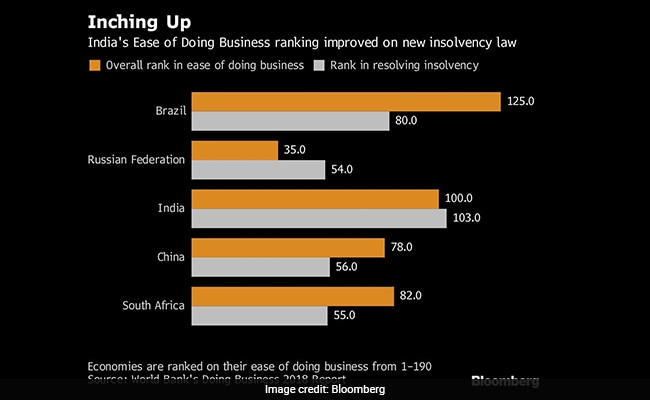
The insolvency code replaced a web of archaic laws, some dating back a 100 years, and helped India jump 30 points to make it to the top 100 countries in World Bank's ease of doing business rankings. The new law is key for Prime Minister Narendra Modi to wipe out bad loans and boost growth in Asia's third-largest economy.
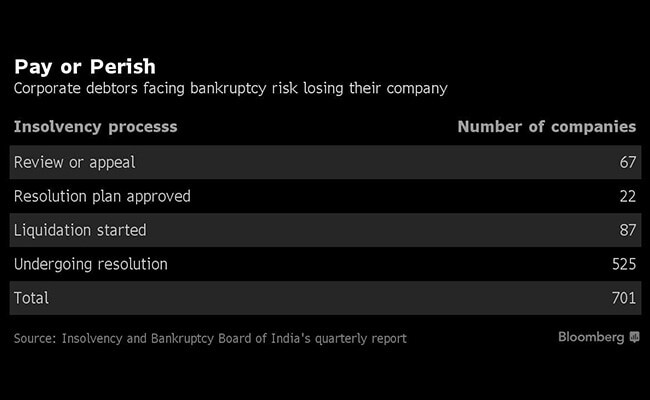
The law empowers lenders to drag companies that have defaulted for 90 days on debt exceeding 100,000 rupees to the bankruptcy court which then places it under an administrator to examine a revival or an outright sale. If a plan is not worked out within three quarters, then the company's assets get liquidated. The objective was to bring debt-laden companies back on their feet and help banks free up $210 billion of stressed assets for lending.
A report by the Reserve Bank of India estimates that gross bad-loan ratio may increase to 12.2 percent by March 2019 from 11.6 percent in the previous year, limiting bank's ability to lend to businesses.
Next Phase
The government is also working to put in place, as early as next month, new rules to hold accountable individuals, who stood guarantee for loans to a company, in case of a default. The scope of the regulation would later be expanded to include individual businessmen and eventually every private citizen.
India is also planning regulations on cross-border insolvency to pursue foreign assets of a defaulting company. It is working on the model cross-border insolvency law adopted by the United Nations Commission on International Trade Law to harmonize cooperation between countries.
Work on that front has already begun, Sahoo said, adding the government would need to amend the law to incorporate the proposed changes.
Even as the government tries to widen the scope of bankruptcy law, bitter court battles have bogged down efforts to clean up bad loans through the new code and companies are missing the 270-day deadline for resolution. The government is running against time to fix the legal and operational issues that keep cropping up and has tweaked the norms several times.
"If you are flying an aircraft at 30,000 feet and it has developed a snag, you don't have the luxury to come down to the ground and repair it." Sahoo said. "Laws need to be made as and when the market needs it. If you do not respond promptly the loss is much more."

-
Where You Live Shapes How You Get To Work | The Reason Why

Two-wheelers are the most popular way to get to work in India, accounting for nearly 43% of workplace commutes.
-
High US Salaries, No Green Card Certainty: The Financial Calculation Facing Indian H-1B Families
The suspension of PERM processing at eight technology employers does not cancel existing H-1B visas. What it does is force a question many Indian families have been avoiding: is the US salary worth tying your career and family plans to one employer?
-
Unhedged Position: Can India See An Indonesia-Style Time Correction?
The Nifty is trading below levels it first clocked in 2024. Is there, then, as I have suggested in the headline, potential that the current time correction drags on painfully for the next three-five, even ten years?
-
Navigating Friction And Energy Realities: An Analysis Of Marco Rubio's October Visit To India
Occurring at a critical juncture marked by stalled trade negotiations and escalating geopolitical pressures over global energy supplies, the visit offers a profound window into modern US-India relations.
-
India Exports Capital. Why Not Export Trusteeship?
The big question, then, is whether India can build an institution that global borrowers, investors, banks, and lawyers can trust, even without an Indian connection.
-
France's Economy & Politics Are In Crisis | The Reason Why
Let's look at how the French economy and politics evolved under Nicolas Sarkozy, Franois Hollande and Emmanuel Macron.
-
You May Inherit The Business. You Must Earn Its Credibility.
Succession tests the founder's ability to share authority as much as it tests the next generation's readiness to assume it.
-
Signing Deals Is One Thing; Making Them Work Is Another | The Week In Whys
Sometimes, things don't turn out as planned. Indian companies have lost some bids to rivals, some projects won't produce until 2030.
-
FOMC Wall, PERM Suspension, Hospital Stocks | Talking Points This Week
A PERM suspension would directly affect green-card sponsorship rather than H-1B visas, so the near-term earnings impact could remain relatively limited. The key question is whether this marks a new phase in US scrutiny of Indian IT.
-
Everything, Everywhere, All At Once: Dalal Street's Week To Forget | Joining The Dots
Visa curbs, a Starlink spat and cancer drug caps: what connects this week's shocks for Indian markets