Ukraine Considering Debt-Restructuring Options As Payments Loom

(Bloomberg) -- Ukrainian officials are exploring the possibility of debt restructuring as the war-ravaged country's funding options are at risk of running out, according to three people familiar with the discussions.
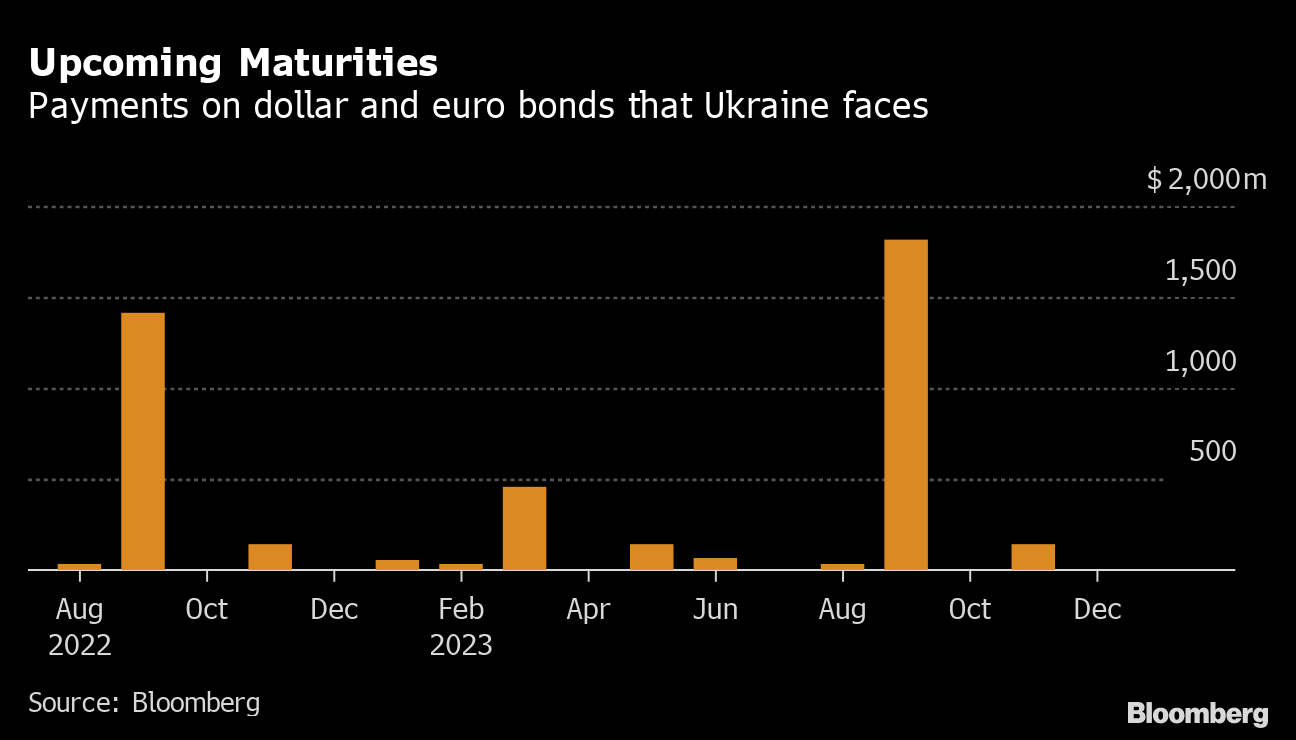
Multiple scenarios are being considered and no decision is expected until later in the summer, according to two of the people, all of whom asked not to be identified because the talks are private. Ukraine has time until at least Sept. 1, when it faces a $1.4 billion redemption and interest payments, according to Bloomberg calculations.
Policy makers in Kyiv are struggling to keep the budget running as the country's military fends off Russia's invasion, which has destroyed cities, brought the nation's key grain exports to a standstill, and displaced more than 10 million people.
The International Monetary Fund is offering advice and analysis about Ukraine's financial and debt situation, according to two of the people.
A fund spokesman declined to comment on the possibility of debt restructuring. IMF staff have been engaging with the Ukrainian authorities since the invasion began in late February and continue to do so, the spokesman said.
The Finance Ministry in Kyiv declined to comment.
One of the options that Ukraine is considering involves a so-called consent solicitation, a request from the issuer for bondholder approval to amend the terms of the securities issued, according to the people. Another includes using Russia's frozen assets as collateral, though the legal viability of such an idea is unclear, they said.
The IMF in early March approved a $1.4 billion emergency loan for Ukraine, canceling the nation's existing stand-by arrangement with the fund, which had $2.2 billion remaining to pay out from an original $5 billion authorized in 2020.
Financing Woes
The negotiations underscore the Ukrainian government's aim to remain on good terms with global investors, particularly to be in position to fund the country's reconstruction after the war. For issuers, missing payments on international bonds would risk losing access to global debt markets for years.
Restructuring Ukraine's bonds as a way of lowering its debt burden would help ensure that financing from major allies on defense and humanitarian aid aren't channeled to repay bondholders.
Ukraine's dollar and euro bonds trade below levels indicating distress and restructuring risk. The bonds due in September trade with more than 40% of discount to their face value, according to data compiled by Bloomberg.
Still, the Ukrainian government has said it is committed to servicing its foreign-debt obligations.
More than four months after Russia invaded Ukraine, spurring massive fighting that has left thousands of dead and a quarter of Ukraine's population displaced from their homes, the country's budget is coming under strain as its main funder -- Ukraine's central bank -- raises the alarm about the limits of its ability to buy sovereign debt. The economic fallout has brought funding for everything from pensions to military operations under strain.
The central bank estimates Ukraine's economy may shrink at least 30% this year, with the hryvnia being under increasing pressure. The monetary authority hiked its key interest rate to 25% from 10% at its last meeting on June 3 to support the currency.
More stories like this are available on bloomberg.com
©2022 Bloomberg L.P.

-
A New Samvat Wishlist: Inclusive Prosperity And Human Development

India has strengthened its economic foundations through infrastructure, digital access and enterprise. Its next growth chapter must deepen productivity, create better livelihoods and widen participation in prosperity.
-
Love, Sex Aur Dhokha: The Audacious Plot To Spy On Jensen Huang
A Taipei dinner, a Singapore chip buyer and a suspected Chinese asset: inside the alleged spy operation that got close to NVIDIA's Jensen Huang.
-
Ten Things I Learnt This Samvat
Patience can be a trap. Cheap stocks can stay cheap. Leverage can wipe you out. What did Samvat 2082 teach us? Niraj Shah writes on 10 lessons from the year gone by.
-
Talking Points This Week: Tech Nerves, FII Buying, And A Faraway Banking Shock
The global markets are not shining this Diwali. The exception in the large markets is, India.
-
Midterm Rally Lasted A Day. The Hard Reality Of A Divided US May Last Two Years | Opinion
Between a contested AI boom, a debt ceiling that arrives in 2027 and a president with every incentive to act alone, the next two years may prove more volatile than the first day's rally suggests.
-
Blue Wave Will Derail the AI Trade but Won't Dismantle the AI Era | Unhedged Position
The Democrats' sweep of the US Congress will see politics collide with economic forces both over the long and short term.
-
It's Time To Take The GST Council's Bet On Trust Global
Payment records can prove India's services exports, and clear, proportionate rules can bring foreign digital sellers into the tax net.
-
Opinion | India at 38: From Innovation Overperformer to Innovation Powerhouse
India now has 453 VC-backed deep science startups, 18 of them late-stage, after 117 percent growth since 2020. Laurus Labs, at USD 9.3 billion, is the most valuable deep science company in any middle-income economy outside China.
-
Navigating Energy Crossroads: S Jaishankar's Call For Diversified Supply Chains At G20 Ministerial Meeting
As geopolitical fault lines continue to test maritime trade routes and commodity flows, Jaishankar's message remains pertinent: true economic resilience requires open markets, protected transit lines, and a genuine commitment to multilateral cooperation rather than coercion.









