Uday Kotak Wants India To Regulate International Proxy Advisers
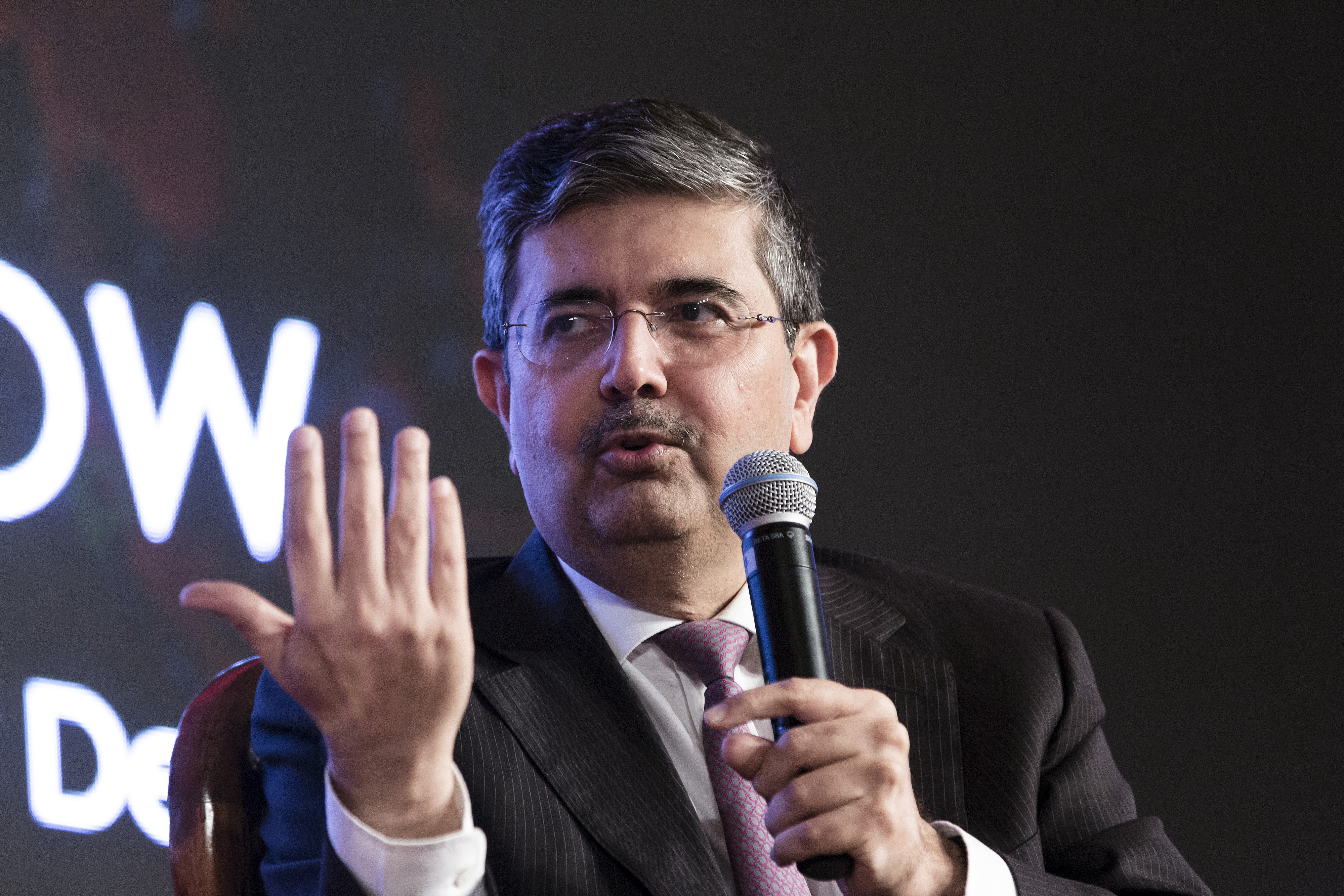
Veteran banker Uday Kotak has sought regulation of international proxy advisers after two such firms asked investors to vote against reappointment of Deepak Parekh on the board of HDFC Ltd., India's largest mortgage lender.
“We have seen the concentration of voting through global proxy advisory services, leading to concentration of voting power in the hands of a few global agencies,” Kotak, managing director and chief executive officer at Kotak Mahindra Bank Ltd., said on the sidelines of the listing ceremony of HDFC Asset Management Company Ltd. “This questions the very basis of well-run, widely held companies and diversified ownerships.”
Kotak Investment Banking was the lead manager for the initial public offering of HDFC AMC, which listed at a premium of 65 percent on stock exchanges.
Two U.S. proxy advisories—Glass Lewis & Co and Institutional Shareholder Services—had asked investors to vote against Parekh and two other board members—former Reserve Bank of India Governor Bimal Jalan and well-known accountant Bansi Mehta—citing the number of directorships they hold, lack of attendance and overall independence of HDFC's board.
While Parekh, with 33 years on the HDFC board, narrowly survived the votes against him, Jalan and Mehta quit a day before the shareholder vote.
It also bothers me that some of the most reputed names in India get questioned and actually have to take a tough call, between being voted out or resigning. And these are outstanding Indian names who had to face this.Uday Kotak, Managing Director & CEO, Kotak Mahindra Bank
Kotak recently led a committee constituted by regulator Securities and Exchange Board of India to review corporate governance norms applying to listed entities. It is on the recommendations of this committee that SEBI's regulations now require that any director above the age of 75 seeking reappointment must do so via a special resolution. In company law, a special resolution requires 75 percent of the votes cast in favour of the resolution.
Hence Parekh, who was up for reappointment as director on the HDFC board required a high number of votes in his favour. He won by less than 0.2 percent.
The Proxy Firms' Recommendations
ISS recommended investors vote against Parekh and Mehta as they were each on more than six public company boards.
ISS' proxy voting guidelines make clear that it will generally vote for the election of directors unless certain conditions are not met, one of them being—the director should not be on the board of more than six public company boards.
Glass Lewis recommended voting against Parekh and Mehta as in its assessment the HDFC board is not independent enough.
Jalan, who has been on the board of HDFC since 2008, had attended three of six board meetings thus not meeting the minimum 75 percent threshold that both proxy advisory company expect directors to meet.
Both proxy advisory firms apply self-styled higher governance standards than local law requires. These standards are published and available publicly.
Kotak said the “time has come for us to ask this question that if proxy advisory services in India are regulated, what about regulation of global proxy advisory services?”
Proxy Firm Regulations
In 2014, SEBI notified regulations for research analysts and including domestic proxy advisory firms with their purview. The regulations provide for qualification, certification, capital adequacy, management of conflicts of interest, disclosure requirements and such for research analysts. The same provisions apply to proxy advisory firms as well.
Additionally, a proxy advisory firm in India also has to disclose:
- The extent of research involved in a particular recommendation.
- Policies and procedures for interacting with issuers, informing issuers about the recommendation and review of recommendations.
The proxy adviser is also required by SEBI to maintain a record of his voting recommendations.
On the face of it, both ISS and Glass Lewis would seem to be in compliance with such provisions were they needed to adhere to them. Both firms are yet to respond to BloombergQuint's emailed queries.

-
A New Samvat Wishlist: Inclusive Prosperity And Human Development

India has strengthened its economic foundations through infrastructure, digital access and enterprise. Its next growth chapter must deepen productivity, create better livelihoods and widen participation in prosperity.
-
Love, Sex Aur Dhokha: The Audacious Plot To Spy On Jensen Huang
A Taipei dinner, a Singapore chip buyer and a suspected Chinese asset: inside the alleged spy operation that got close to NVIDIA's Jensen Huang.
-
Ten Things I Learnt This Samvat
Patience can be a trap. Cheap stocks can stay cheap. Leverage can wipe you out. What did Samvat 2082 teach us? Niraj Shah writes on 10 lessons from the year gone by.
-
Talking Points This Week: Tech Nerves, FII Buying, And A Faraway Banking Shock
The global markets are not shining this Diwali. The exception in the large markets is, India.
-
Midterm Rally Lasted A Day. The Hard Reality Of A Divided US May Last Two Years | Opinion
Between a contested AI boom, a debt ceiling that arrives in 2027 and a president with every incentive to act alone, the next two years may prove more volatile than the first day's rally suggests.
-
Blue Wave Will Derail the AI Trade but Won't Dismantle the AI Era | Unhedged Position
The Democrats' sweep of the US Congress will see politics collide with economic forces both over the long and short term.
-
It's Time To Take The GST Council's Bet On Trust Global
Payment records can prove India's services exports, and clear, proportionate rules can bring foreign digital sellers into the tax net.
-
Opinion | India at 38: From Innovation Overperformer to Innovation Powerhouse
India now has 453 VC-backed deep science startups, 18 of them late-stage, after 117 percent growth since 2020. Laurus Labs, at USD 9.3 billion, is the most valuable deep science company in any middle-income economy outside China.
-
Navigating Energy Crossroads: S Jaishankar's Call For Diversified Supply Chains At G20 Ministerial Meeting
As geopolitical fault lines continue to test maritime trade routes and commodity flows, Jaishankar's message remains pertinent: true economic resilience requires open markets, protected transit lines, and a genuine commitment to multilateral cooperation rather than coercion.









