Uber Surges as Profit Beat Shows Strong Demand For Rides, Food
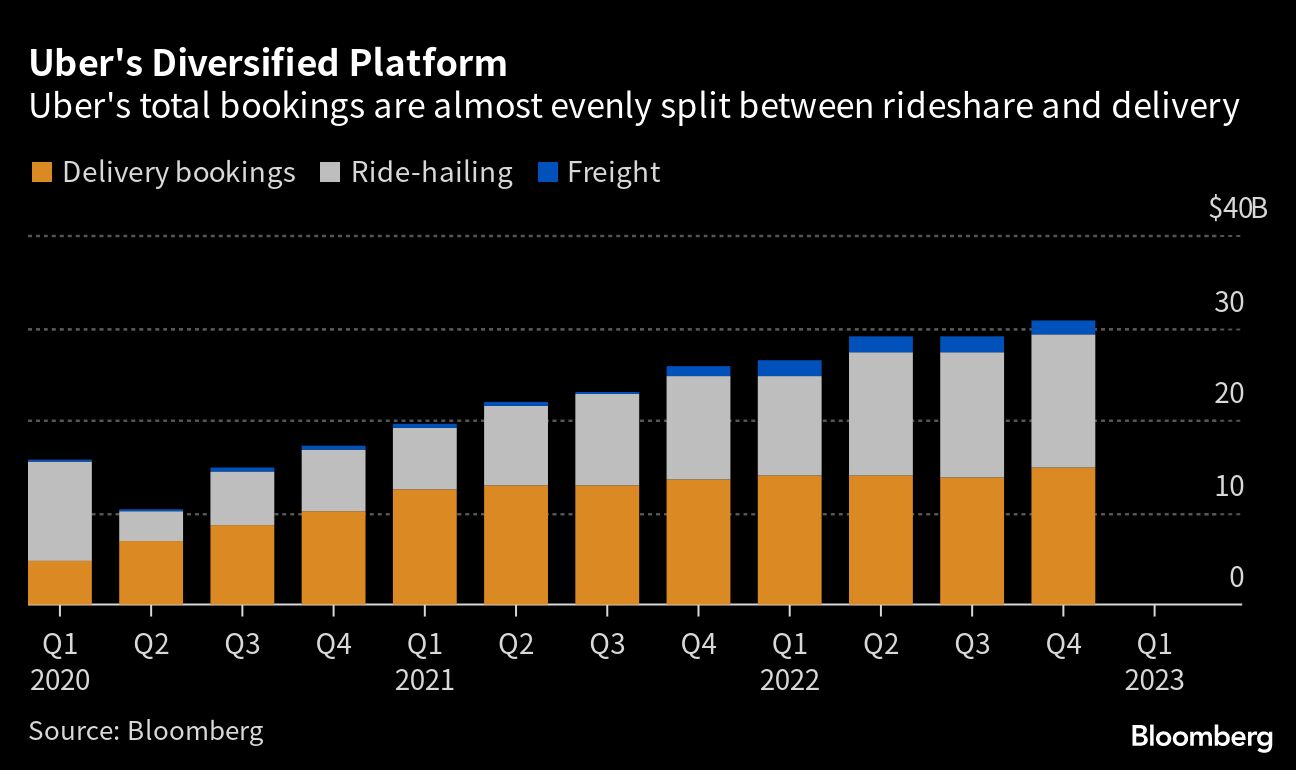
(Bloomberg) -- Uber Technologies Inc. shares surged as much as 11% after the company reported earnings that beat analysts' estimates, showing that consumers continue to spend more on rides and food takeout despite an uncertain economic outlook.
Adjusted earnings before interest, taxes, depreciation and amortization reached $761 million in the first quarter, the company said in a statement Tuesday. That beat the $678.6 million analysts were predicting, according to data compiled by Bloomberg.
“We delivered record profitability and free cash flow in Q1, and we are poised to expand profitability again in Q2,” Chief Financial Officer Nelson Chai said in the statement.
Shares jumped to as high as $36.40 in premarket trading after closing at $32.74 on Monday. The stock is up 32% so far this year.
The results signal that the San Francisco-based company is weathering slowing economic growth and rising inflation better than expected, even as spending in retail and other areas suffers. It's also been outshining rival Lyft Inc., which is overhauling operations in the face of sluggish demand and weak profits. Lyft is set to report its results later this week.
“This was a quarter Uber should frame in its HQ as it speaks to a ‘new and improved' Uber story going forward,” Dan Ives, an analyst at Wedbush Securities, wrote in a note to investors after the results.
Uber generated $31.4 billion in gross bookings, which include ride hailing, food delivery and freight. That was slightly below the $31.5 billion Wall Street had forecast as a decline in freight volumes dragged down overall bookings.

Even though the company saw fewer-than-expected monthly active users, ride-hailing bookings of $15 billion beat projections — an indication that customers are taking trips more frequently. The increased engagement was attributed in part to lower fares.
New mobility products also helped attract drivers and riders to the platform, Chief Executive Officer Dara Khosrowshahi said in prepared remarks. That's help improve profitability “even as our competitors continue to compete on incentives and price,” he said. Uber said active ride-share drivers were up 35% compared with last year, reflecting an increase of more than 1 million.
Uber was hit hard when the pandemic decimated demand for rides. Though it was able to cushion the impact with its delivery unit — Uber Eats, which grew rapidly as millions of couch-bound customers ordered takeout — the company struggled to overcome a shortage of drivers after cities began reopening. That sent wait times and fares soaring.
Lyft also had a hard time bringing the number of drivers and riders into balance. Both companies spent millions in incentives to lure workers back to their apps. But Lyft has had a harder time getting back on track. Its comeback efforts have included hiring a new CEO, David Risher, laying off thousands of workers and calling its remaining staff back to the office. But Lyft has fewer active riders than it did before the Covid-19 pandemic.
Uber commanded 76% of US ride-share sales in March, up from 66% in early 2020, according to research firm YipitData. Uber, which reduced headcount earlier in the pandemic, hasn't announced widespread cost cuts or layoffs.
Still, the company said it has lowered headcount through performance reviews during the first quarter and expects its workforce to be “flat to down” in the quarters ahead, without specifying the exact decrease in jobs. Uber Freight, its logistics unit, also cut 3% of its workforce in January.
The company reported $8.8 billion in revenue during the period ending March 31, surpassing analysts' expectations of $8.7 billion. Uber expects adjusted earnings before interest, taxes, depreciation and amortization of $800 million to $850 million in the current quarter.
More stories like this are available on bloomberg.com
©2023 Bloomberg L.P.

-
Ten Things I Learnt This Samvat

Patience can be a trap. Cheap stocks can stay cheap. Leverage can wipe you out. What did Samvat 2082 teach us? Niraj Shah writes on 10 lessons from the year gone by.
-
Talking Points This Week: Tech Nerves, FII Buying, And A Faraway Banking Shock
The global markets are not shining this Diwali. The exception in the large markets is, India.
-
Midterm Rally Lasted A Day. The Hard Reality Of A Divided US May Last Two Years | Opinion
Between a contested AI boom, a debt ceiling that arrives in 2027 and a president with every incentive to act alone, the next two years may prove more volatile than the first day's rally suggests.
-
Blue Wave Will Derail the AI Trade but Won't Dismantle the AI Era | Unhedged Position
The Democrats' sweep of the US Congress will see politics collide with economic forces both over the long and short term.
-
It's Time To Take The GST Council's Bet On Trust Global
Payment records can prove India's services exports, and clear, proportionate rules can bring foreign digital sellers into the tax net.
-
Opinion | India at 38: From Innovation Overperformer to Innovation Powerhouse
India now has 453 VC-backed deep science startups, 18 of them late-stage, after 117 percent growth since 2020. Laurus Labs, at USD 9.3 billion, is the most valuable deep science company in any middle-income economy outside China.
-
Navigating Energy Crossroads: S Jaishankar's Call For Diversified Supply Chains At G20 Ministerial Meeting
As geopolitical fault lines continue to test maritime trade routes and commodity flows, Jaishankar's message remains pertinent: true economic resilience requires open markets, protected transit lines, and a genuine commitment to multilateral cooperation rather than coercion.
-
Indians Are Travelling, But Not Every Journey Is A Holiday | The Week In Whys
Pilgrims, patients and working women are the real travellers, and the system hasn't quite caught up with them.
-
Getting To Work Costs Women More | The Reason Why
It is not just about women paying more than men. It is about women paying much more in cities than in villages.









