Tycoon Pallonji Mistry Tries To Unlock $17 Billion, In Battle With Tatas
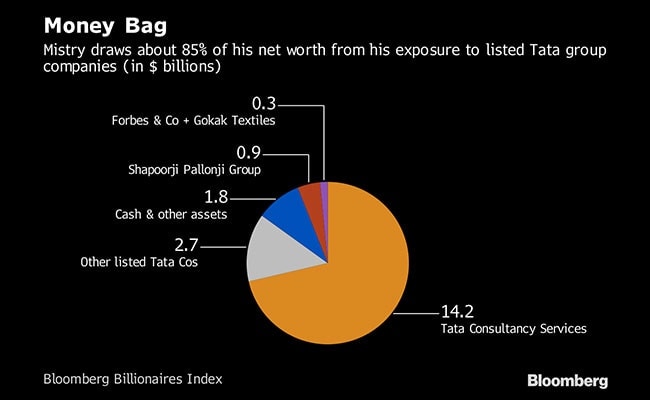
Billionaire Pallonji Mistry has about 85 percent of his estimated $19.9 billion fortune locked up in a legal battle with India's largest conglomerate.
The conflict between Mistry and the Tata Group began with a boardroom coup in 2016, when the former's son was ousted as chairman of the latter. The 89-year-old Mistry is one of the largest shareholders in Tata Sons Ltd., which controls the $100 billion conglomerate, and his family has since filed numerous lawsuits against the holding company's board, alleging suppression of minority interests and governance lapses.
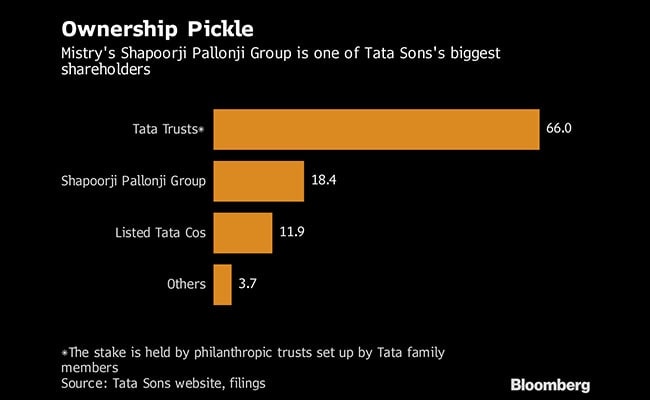
The courtroom battle has continued, most recently focused on a move by Tata Sons to restrict shareholders from freely selling their stake -- a change recognized by the government this month. Mistry, who derives an estimated $16.9 billion of his fortune from his 18.4 percent equity in Tata Sons, can no longer sell those holdings without the approval of a board his family has been fighting for two years.
Mistry's Shapoorji Pallonji group didn't reply to an email seeking comment. A Tata Sons spokesman declined to comment.
While Tata Sons has always been a closely held private entity, it was considered a public limited company due to its size under an old legal provision. That allowed investors greater flexibility in transferring their shares, according to Daizy Chawla, a New Delhi-based senior partner at law firm Singh & Associates.
The law was altered some years back, allowing Tata Sons's shareholders to approve a change to its legal status last year, overriding objections from Mistry's son.
"Being a private company there is now restriction on the free transfer of shares by its shareholder and the transfer needs to be done with the approval of the board of directors," Chawla said.
A New Delhi court last week heard arguments on a plea to put on hold government approval of Tata Sons's conversion. The dispute may eventually wend its way to India's top court since the losing party will have the right to appeal.
The discord has battered a relationship that goes back almost a century. A Mistry company had financial links with Tata Sons from as early as 1927, though the family only began acquiring equity from the 1960s onward. Over time, purchases from Tata family members and a rights issue grew their holding to the present 18.4 percent.
Mistry inherited the stake from his father, who built the Tata Group's automobile factories and steel mills. His Shapoorji Pallonji group, founded in 1865, is also responsible for some of financial capital Mumbai's most iconic structures including the Reserve Bank of India buildings and The Taj Mahal Palace hotel.
After earning a reputation for being reclusive, Mistry and his family were thrust into the spotlight in 2012, when his younger son was chosen to helm the Tata group. The bonhomie ended with his son's ouster in October 2016, which triggered one of India's worst corporate showdowns.
Still, it's the exposure to Tata companies that's helped bump up Pallonji Mistry's fortune by $2.5 billion this year as investors piled into Tata Consultancy Services Ltd., Asia's largest software services provider. Mistry ranks 44th on the Bloomberg Billionaires Index and is among the richest men living in India.
Article 75
Another point of contention that's emerged as the Tata-Mistry relationship soured is article 75 of Tata Sons's articles of association, which the board can use to force a shareholder to sell out. This provision is also being contested in court.
Combined with the decision to go private, the restriction puts Mistry in a tight spot. On the one hand, he can be forced to sell his stake while, on the other, he needs Tata Sons to sign off on a suitor he picks.
"Tata Sons can choose to preempt any stake sale by enforcing article 75 in its articles of association and forcing an existing shareholder to sell out," said Sudip Mahapatra, a partner at law firm S&R Associates. "That's what's putting the Mistry family on a weak footing."
(Except for the headline, this story has not been edited by NDTV staff and is published from a syndicated feed.)

-
Navigating Energy Crossroads: S Jaishankar's Call For Diversified Supply Chains At G20 Ministerial Meeting

As geopolitical fault lines continue to test maritime trade routes and commodity flows, Jaishankar's message remains pertinent: true economic resilience requires open markets, protected transit lines, and a genuine commitment to multilateral cooperation rather than coercion.
-
Indians Are Travelling, But Not Every Journey Is A Holiday | The Week In Whys
Pilgrims, patients and working women are the real travellers, and the system hasn't quite caught up with them.
-
Getting To Work Costs Women More | The Reason Why
It is not just about women paying more than men. It is about women paying much more in cities than in villages.
-
AI Bias In Investing Cannot Be Eliminated, But It Can Be Governed
Framing is a particularly important example as identical financial information presented in terms of gains rather than losses can lead an LLM to reach a different assessment.
-
Joining The Dots | Dark Skies, Steady Diya: Why Hope Holds This Diwali
With war, a weak rupee and foreign outflows weighing on sentiment, policymakers at the NDTV World Summit and market veterans at NDTV Profit Ignite: Diwali Edition offered the same advice: stay invested and filter out the noise.
-
The Curious Case of Equitas Small Finance Bank And A CEO Who Quit For Stock
PN Vasudevan believes persistent investor concerns over a perceived conflict of interest had become a governance overhang on Equitas Small Finance Bank's stock, even as the lender improved profitability and asset quality.
-
Talking Points This Week: AI Cash Burn, A Tiger Comeback And An India That Still Finds Its Own Path
India is not immune to higher oil or tighter global liquidity, yet its earnings base is broader, its domestic policy levers are still available.
-
Foreign Investors Own Half Of HDFC Bank and ICICI Bank. An LTCG Cut Could Matter Most Here
Foreign portfolio investors have US$115 billion parked in HDFC Bank, ICICI Bank. If the government cuts long-term capital gains tax, Jefferies says returning foreign money could land here first.
-
'Never Seen This Level Of Negativity': Sandeep Tandon Says The Next Rally May Be Closer Than You Think
Veteran investor Sandeep Tandon says foreign selling is easing, large-caps are due a comeback and mid-caps are crowded, while he turns positive on gold, power and pharma this Diwali.
-
Indians Stay With Family, Not In Hotels | The Reason Why
India still lacks enough clean, reliable and affordable hotels for budget-conscious travellers.










