Why Sun Pharma Could Face Pricing Pressure Due To Trump's Drug Cost Reductions

US President Donald Trump has announced plans to significantly reduce prescription drug prices in the country, stating on social media that prices would be cut by over 59%. While the details of the executive order are still awaited, Sun Pharmaceutical Industries Ltd.'s US exposure makes it a key company to watch.
At the heart of this proposal is the revival of the 'Most Favored Nation' pricing model, which could have implications for companies like Sun Pharmaceutical.
The MFN model, originally proposed in 2020, aimed to link Medicare Part B drug reimbursements to the lowest prices paid by OECD countries. While the earlier version was struck down in federal courts and eventually withdrawn by the Biden administration, Trump's comments suggest a renewed attempt to implement it.
The move aims to align American drug costs with those paid in other developed nations and echoes previous efforts during his first term.
Macquarie notes that a return to MFN pricing could affect companies selling branded medications within the US, particularly those with exposure to Medicare Part B. For example, Sun Pharma's product Ilumya is sold under this programme and could face downward pricing pressure. However, the impact on generic drugmakers is expected to be minimal, as generics are significantly cheaper and primarily sold under Medicare Part D, which wasn't targeted in the original MFN model.
However, according to analysts at Citi, current proposal may be less aggressive than it appears. The executive order reportedly encourages a direct-to-consumer market and asks pharmaceutical firms to negotiate pricing with the Department of Health and Human Services. If no agreement is reached within 180 days, MFN pricing may then be enforced. This indirect approach could soften the immediate impact on companies like Sun Pharma.
Citi also points out that high US drug prices stem largely from structural issues within the insurance and distribution systems, particularly the role of pharmacy benefit managers. These middlemen often favour large pharmaceutical firms offering rebates, limiting access for smaller players. Should future reforms reduce PBM influence, companies such as Sun Pharma and Biocon could benefit, especially in the specialty and biosimilars segments.
Sun Pharma Share Price Rises
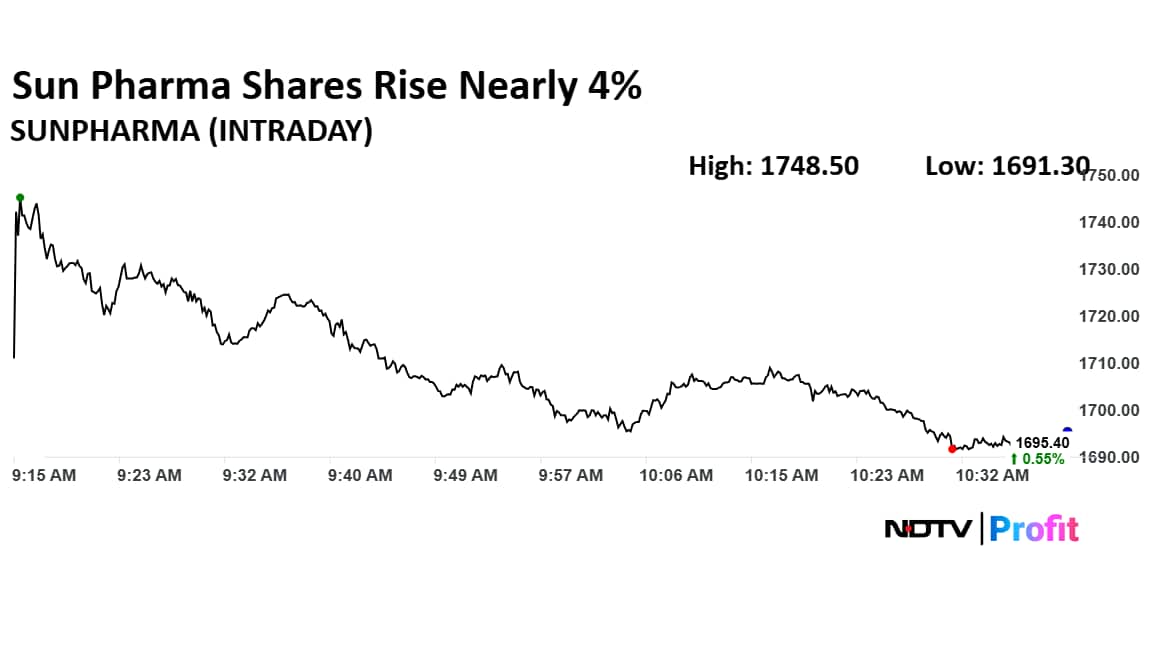
The shares of Sun Pharma rose as much as 3.69% to Rs 1,748.50 apiece, the highest level since May 9. It pared gains to trade 0.42% higher at Rs 1,693.20 apiece, as of 10:36 a.m. This compares to a 1.02% decline in the NSE Nifty 50 Index.
It has risen 11.03% in the last 12 months and fallen 10.23% year-to-date. Total traded volume so far in the day stood at 3.3 times its 30-day average. The relative strength index was at 48.80.
Out of 42 analysts tracking the company, 34 maintain a 'buy' rating, five recommend a 'hold,' and three suggest 'sell,' according to Bloomberg data. The average 12-month consensus price target implies an upside of 21.5%.

-
High US Salaries, No Green Card Certainty: The Financial Calculation Facing Indian H-1B Families

The suspension of PERM processing at eight technology employers does not cancel existing H-1B visas. What it does is force a question many Indian families have been avoiding: is the US salary worth tying your career and family plans to one employer?
-
Swiggy vs Eternal: Food Delivery's Two Rivals Are No Longer In The Same Race
Eternal is building a private AI assistant, dark.ai. Swiggy is still working out how to make Instamart pay, with an operating loss of Rs 895 crore in the July-September quarter while Blinkit stayed profitable.
-
Where You Live Shapes How You Get To Work | The Reason Why
Two-wheelers are the most popular way to get to work in India, accounting for nearly 43% of workplace commutes.
-
Unhedged Position: Can India See An Indonesia-Style Time Correction?
The Nifty is trading below levels it first clocked in 2024. Is there, then, as I have suggested in the headline, potential that the current time correction drags on painfully for the next three-five, even ten years?
-
Navigating Friction And Energy Realities: An Analysis Of Marco Rubio's October Visit To India
Occurring at a critical juncture marked by stalled trade negotiations and escalating geopolitical pressures over global energy supplies, the visit offers a profound window into modern US-India relations.
-
India Exports Capital. Why Not Export Trusteeship?
The big question, then, is whether India can build an institution that global borrowers, investors, banks, and lawyers can trust, even without an Indian connection.
-
France's Economy & Politics Are In Crisis | The Reason Why
Let's look at how the French economy and politics evolved under Nicolas Sarkozy, Franois Hollande and Emmanuel Macron.
-
You May Inherit The Business. You Must Earn Its Credibility.
Succession tests the founder's ability to share authority as much as it tests the next generation's readiness to assume it.
-
Signing Deals Is One Thing; Making Them Work Is Another | The Week In Whys
Sometimes, things don't turn out as planned. Indian companies have lost some bids to rivals, some projects won't produce until 2030.
-
FOMC Wall, PERM Suspension, Hospital Stocks | Talking Points This Week
A PERM suspension would directly affect green-card sponsorship rather than H-1B visas, so the near-term earnings impact could remain relatively limited. The key question is whether this marks a new phase in US scrutiny of Indian IT.









