Trump's Tightrope in Syria Is Getting Shakier
(Bloomberg View) -- Under President Donald Trump, the U.S. has stepped up its involvement in the Syria war on a scale not seen under Barack Obama. The Trump administration, however, is only dropping hints about it, and the official policy rhetoric has been, in some ways, less interventionist than that from the Obama White House. The U.S. is trying to conduct a foreign war without telling the public much about it.
One reason is that the U.S. escalation in Syria relies on at least tacit assent from the dominant military power there, Russia.
That's a risky game, because the U.S. rejects cooperation as a matter of policy. An accident -- or a Trump change of heart, which the president appeared to signal after the poison gas incident in Khan Sheikhun on Tuesday -- can turn a situational partnership into a conflict.
Trump's solution to the dilemma he presented during the election campaign -- a reluctance to fight foreign wars and a firm promise to wipe out the Islamic State -- is apparently to empower the U.S. generals in the region without much of a political message behind it from Washington. U.S. activity -- and the collateral damage it brings -- has increased visibly this year.
In recent months, the number of airstrikes by the U.S.-led anti-ISIS coalition, reported by the U.S. Air Force Central Command, hasn't markedly increased, though the emphasis of the campaign has shifted from Iraq to Syria. But Airwars, a collaborative project that has been collecting airstrike data from sources on the ground, has noted a growing number of reports of civilian casualties from coalition airstrikes -- more this year than from Russian bombs. These reports are hard to substantiate, but Airwars's data collection goes back far enough to make the numbers useful in discerning trends.
The U.S. is also sending hundreds of additional troops to Syria and Iraq. The numbers, a total of about 650 in March, are not large enough to signal a major escalation, but sometimes it's enough for the U.S. to plant its flag to change the actions of other militaries. That's what appeared to happen near the town of Manbij last month, when the arrival of U.S. troops signaled to Turkey that it was time to end an offensive in the area. It worked.
In February and March, the U.S. generals appeared to forge something of a tactical interaction pattern with Russian ones. In February, the chiefs of the two nations' staffs, Joe Dunford and Valery Gerasimov, met in Baku, Azerbaijan -- the first such top-level military meeting since Russia annexed Crimea in 2014. Last month, they added their Turkish counterpart Hulusi Akar for a second meeting in Antalya, Turkey. A spokesman for Dunford said “the importance of additional measures for de-conflicting operations” -- military speak for staying out of each others' way -- was emphasized during the summit.
Under Obama, even that turned out to be impossible. Last September, Russian Foreign Minister Sergei Lavrov and former Secretary of State John Kerry announced that the two countries would set up a "Joint Implementation Center" to coordinate airstrikes. The deal fell through, not least because of Pentagon objections: even for that degree of cooperation, the countries' military goals had to be aligned, at least to some extent. Finally, that seems to be possible under Trump.
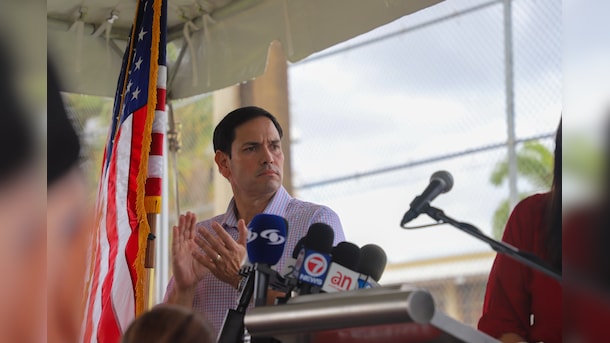
On a political level, however, such coordination is impossible to trumpet, or even cautiously announce, in the U.S. The political climate in Washington is so charged that top Trump administration officials can't afford to make even mild statements that could be construed as pro-Russian. When Secretary of State Rex Tillerson said last week that "the longer-term status of President Assad," Moscow's ally in Syria, "will be decided by the Syrian people," that was quickly used against him. Senator Marco Rubio, one of the driving forces behind investigating Russia's role in the 2016 presidential election, said on Tuesday he didn't think it was a coincidence that chemical weapons were used in Khan Sheikhum after Tillerson's statement.
Trump and his administration quickly realized they needed a change in rhetoric. On Wednesday, Tillerson urged Russians to “think carefully about their continued support of the Assad regime." Trump himself, speaking at a press conference with King Abdullah II or Jordan, said his "attitude towards Syria and Assad has changed very much."
Asked what he was going to do about his change of attitude, Trump only said, "You'll see." But the vague threat of a forceful U.S. intervention against Assad was voiced by United Nations Ambassador Nikki Haley in a speech at the U.N. Security Council: "When the United Nations consistently fails in its duty to act collectively, there are times in the life of states that we are compelled to take our own action." She also amplified her criticism of Russia, which blocked the U.N.'s response to the chemical attack, saying, “How many more children have to die before Russia cares?”
Trump has been egged on long enough to prove he is not a Putin stooge. Given his tendency to make rash decisions, this threatens the fragile balance achieved by the politically-untethered U.S. military and the Russian command. Some conservatives, for example, have long demanded the creation of no-fly zones over Syria. And it's not hard to imagine the kind of military meetings that have just begun taking place becoming politically unfeasible for the White House. That would increase the likelihood for accidents between the Russian and U.S. forces in Syria at the very least.
Despite the Khan Sheikhun chemical attack, and despite the apparent increase in coalition-inflicted civilian casualties, the quiet effort to coordinate Russian and U.S. action has been painful to ISIS, whose territory has been shrinking lately as both Russian-backed regime forces and the U.S. coalition advanced. If the interaction collapses, ISIS will be the first to celebrate -- unless the U.S. swiftly increases its military presence in Syria, openly getting into just the kind of Middle Eastern war for which Trump has shown such distaste.
This column does not necessarily reflect the opinion of the editorial board or Bloomberg LP and its owners.
Leonid Bershidsky is a Bloomberg View columnist. He was the founding editor of the Russian business daily Vedomosti and founded the opinion website Slon.ru.
To contact the author of this story: Leonid Bershidsky at lbershidsky@bloomberg.net.
To contact the editor responsible for this story: Mike Nizza at mnizza3@bloomberg.net.
For more columns from Bloomberg View, visit http://www.bloomberg.com/view.

-
Unhedged Position: Can India See An Indonesia-Style Time Correction?

The Nifty is trading below levels it first clocked in 2024. Is there, then, as I have suggested in the headline, potential that the current time correction drags on painfully for the next three-five, even ten years?
-
Navigating Friction And Energy Realities: An Analysis Of Marco Rubio's October Visit To India
Occurring at a critical juncture marked by stalled trade negotiations and escalating geopolitical pressures over global energy supplies, the visit offers a profound window into modern US-India relations.
-
India Exports Capital. Why Not Export Trusteeship?
The big question, then, is whether India can build an institution that global borrowers, investors, banks, and lawyers can trust, even without an Indian connection.
-
France's Economy & Politics Are In Crisis | The Reason Why
Let's look at how the French economy and politics evolved under Nicolas Sarkozy, Franois Hollande and Emmanuel Macron.
-
You May Inherit The Business. You Must Earn Its Credibility.
Succession tests the founder's ability to share authority as much as it tests the next generation's readiness to assume it.
-
Signing Deals Is One Thing; Making Them Work Is Another | The Week In Whys
Sometimes, things don't turn out as planned. Indian companies have lost some bids to rivals, some projects won't produce until 2030.
-
FOMC Wall, PERM Suspension, Hospital Stocks | Talking Points This Week
A PERM suspension would directly affect green-card sponsorship rather than H-1B visas, so the near-term earnings impact could remain relatively limited. The key question is whether this marks a new phase in US scrutiny of Indian IT.
-
Everything, Everywhere, All At Once: Dalal Street's Week To Forget | Joining The Dots
Visa curbs, a Starlink spat and cancer drug caps: what connects this week's shocks for Indian markets
-
India Is Going Abroad For Critical Minerals. But It May Take Years To Pay Off | The Reason Why
Although India's steps are in the right direction, they remain modest compared with India's growing dependence.
-
When Everyone Has AI, What Gives You An Edge?
India's young workforce is entering an uncertain world of work where powerful AI tools are becoming widely accessible. The advantage will belong to those who combine deep expertise with digital fluency, and the distinctly human capabilities that technology cannot manufacture.