Need A Refund Against Train Ticket Cancellation? Here Are The Latest Rules

IRCTC, the ticketing arm of Indian Railways, allows refund on a booked train ticket under certain conditions. While IRCTC allows refund through online and offline modes in case of cancellation of a regular train ticket, no refund - or money back - is permitted in case of a confirmed Tatkal ticket. Tatkal tickets, introduced by the Railways in 1997, are meant for passengers who want to travel at a short notice. In the online mode, through its portal irctc.co.in, IRCTC enables train ticket holders - or passengers holding a regular train ticket, not Tatkal - to apply for refund of money on ticket cancellations.
In online cancellation of tickets, the money is returned to the passenger through the same channel used for booking the railway ticket, according to IRCTC. In offline mode, the train ticket holder is required to visit a reservation counter. IRCTC only allows money back in case of Tatkal ticket in select conditions. IRCTC charges certain cancellation charges towards refund in case of cancellation of a train ticket (regular or Tatkal ticket) and refunds the remaining amount.
Indian Railways' rules on refund and cancellation of regular train ticket
1. The Railways levies a clerkage fee of Rs 30 per passenger for cancellation of unreserved, RAC (reservation against cancellation) and waitlisted train tickets under the unreserved (second class) category. For the tickets of second class (reserved) and other classes, a fee of Rs 60 per passenger is charged, according to Indian Railways' website - indianrail.gov.in.
2. Cancellation charge per passenger on confirmed (reserved) tickets when done 48 hours before the scheduled departure of the train costs to Rs 240 for 1st AC/executive class. For 2 AC/1st class, it costs to Rs 200. The charges for 3AC/3A economy is Rs 180 while for sleeper class, the charges are priced at Rs 120. The cancellation charges for second class are Rs 60.
3. Cancellation charge per passenger on confirmed (reserved) tickets when done in between 48 hours and 12 hours before the scheduled departure of the train costs 25 per cent subject to minimum charge mentioned above. Cancellation charge per passenger on confirmed (reserved) tickets when done in between 12 hours and 4 hours before the scheduled departure of the train costs 50 per cent, subject to minimum charge as mentioned above. No refund is given by Indian Railways after the above prescribed time limit.
4. Partially confirmed tickets can be cancelled up to half an hour before the scheduled departure of the train from the ticket counter, said Indian Railways.
5. Refund on unused RAC/WL (Waitlisted) tickets is given up to half an hour before the scheduled departure of the train subject to deduction of clerkage charge.
6. In case of cancellation of trains for online tickets, automatic refund is granted. Filing of TDR (Ticket Deposit Receipt) is not required.
The Railways provides an online facility to enable users to find the refund status of their cancelled tickets in real time. This facility can be accessed through the Indianrail website, refunds.indianrail.gov.in. If passengers have cancelled their tickets, they can key in the Passenger Name Record (PNR) numbers of the tickets to know the refund status.
(Also read: How to file a TDR to seek refund)
Refund in case of cancellation of Tatkal ticket
The Railways does not permit a refund in case of cancellation of a confirmed Tatkal ticket. However, in case of "contingent cancellation and waitlisted Tatkal ticket cancellations", refunds are allowed after deduction of charges as per the rules. "Partial cancellation of Tatkal e-tickets is allowed... If the train is marked as 'CANCELLED' due to breaches, floods, accidents etc. full refund is permissible in case the ticket is cancelled within three days of the scheduled departure of the train. In case of e-tickets, such cancellations can be done by the customer through Internet," according to the IRCTC website.
The Railways allows a full refund of fare and Tatkal charges on tickets booked under Tatkal scheme under the following conditions, according to the carrier's website:
1. If the train is delayed by more than three hours at the journey originating point of the passenger and not the boarding point if the passenger's journey originating point and boarding point are different.
2. If the train is to run on a diverted route and passenger is not willing to travel.
3. If the train is to run on diverted route and boarding station or the destination or both the stations are not on the diverted route.
4. In case of non attachment of coach in which Tatkal accommodation has been earmarked and the passenger has not been provided accommodation in the same class.
5. If the party has been accommodated in lower class and does not want to travel. In case the party travels in lower class, the passenger will be given refund of difference of fare and also the difference of Tatkal charges, if any.
How to know the status of refund against cancelled train tickets
1. The user is required to log in to the website Indianrail Refunds website - refunds.indianrail.gov.in.
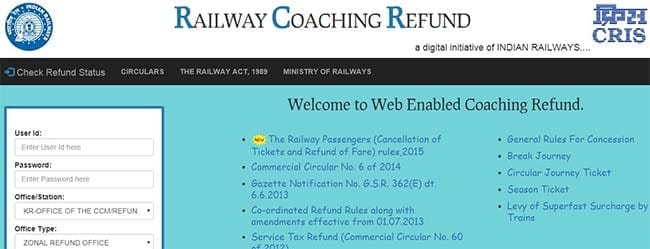
(The Railway Coaching Refund website also contains information on cancellation and refund rules)
2. The user is then required to select the 'Check Refund Status' option and enter his or her PNR details.
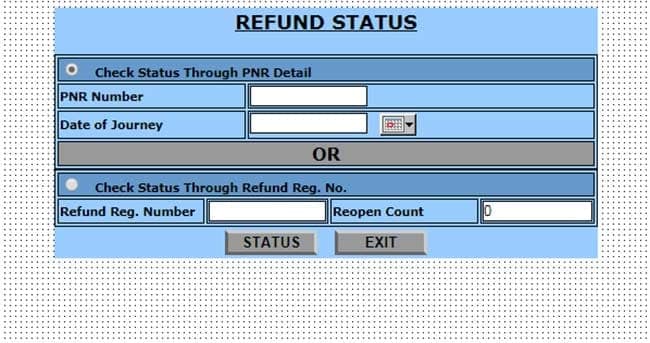
(The user is required to provide the PNR number as well as the date of train journey as given on the train ticket)
3. The website then displays the status of refund against cancellation of train tickets booked through either online or offline modes.

-
A New Samvat Wishlist: Inclusive Prosperity And Human Development

India has strengthened its economic foundations through infrastructure, digital access and enterprise. Its next growth chapter must deepen productivity, create better livelihoods and widen participation in prosperity.
-
Love, Sex Aur Dhokha: The Audacious Plot To Spy On Jensen Huang
A Taipei dinner, a Singapore chip buyer and a suspected Chinese asset: inside the alleged spy operation that got close to NVIDIA's Jensen Huang.
-
Ten Things I Learnt This Samvat
Patience can be a trap. Cheap stocks can stay cheap. Leverage can wipe you out. What did Samvat 2082 teach us? Niraj Shah writes on 10 lessons from the year gone by.
-
Talking Points This Week: Tech Nerves, FII Buying, And A Faraway Banking Shock
The global markets are not shining this Diwali. The exception in the large markets is, India.
-
Midterm Rally Lasted A Day. The Hard Reality Of A Divided US May Last Two Years | Opinion
Between a contested AI boom, a debt ceiling that arrives in 2027 and a president with every incentive to act alone, the next two years may prove more volatile than the first day's rally suggests.
-
Blue Wave Will Derail the AI Trade but Won't Dismantle the AI Era | Unhedged Position
The Democrats' sweep of the US Congress will see politics collide with economic forces both over the long and short term.
-
It's Time To Take The GST Council's Bet On Trust Global
Payment records can prove India's services exports, and clear, proportionate rules can bring foreign digital sellers into the tax net.
-
Opinion | India at 38: From Innovation Overperformer to Innovation Powerhouse
India now has 453 VC-backed deep science startups, 18 of them late-stage, after 117 percent growth since 2020. Laurus Labs, at USD 9.3 billion, is the most valuable deep science company in any middle-income economy outside China.
-
Navigating Energy Crossroads: S Jaishankar's Call For Diversified Supply Chains At G20 Ministerial Meeting
As geopolitical fault lines continue to test maritime trade routes and commodity flows, Jaishankar's message remains pertinent: true economic resilience requires open markets, protected transit lines, and a genuine commitment to multilateral cooperation rather than coercion.









