Trading In Government Securities Surges In July-September Quarter
Trading volumes in government securities surged in the July-September quarter as bond yields slipped and banks and investors churned their portfolios to lock-in treasury gains.
According to the public debt management report, government securities trading volumes jumped 78.45 percent in the July-September quarter this year as compared to March- June quarter. The report was released on Monday.
The total volume of the transactions stood at Rs 56.69 lakh crore in the last quarter compared to a volume of Rs 31.77 lakh crore during the quarter preceding it.
Bond yields fell sharply in the July-September quarter, giving investors an opportunity to trade actively. The benchmark 10-year bond yield fell from 7.51 percent on June 15 to 6.32 percent now. Yields started to fall when former RBI governor Raghuram Rajan announced that he would step down after his first term ends in September. Since then other factors like Britain's decision to exit the European Union and, most recently, India's decision to demonetise has pushed down bond yields.
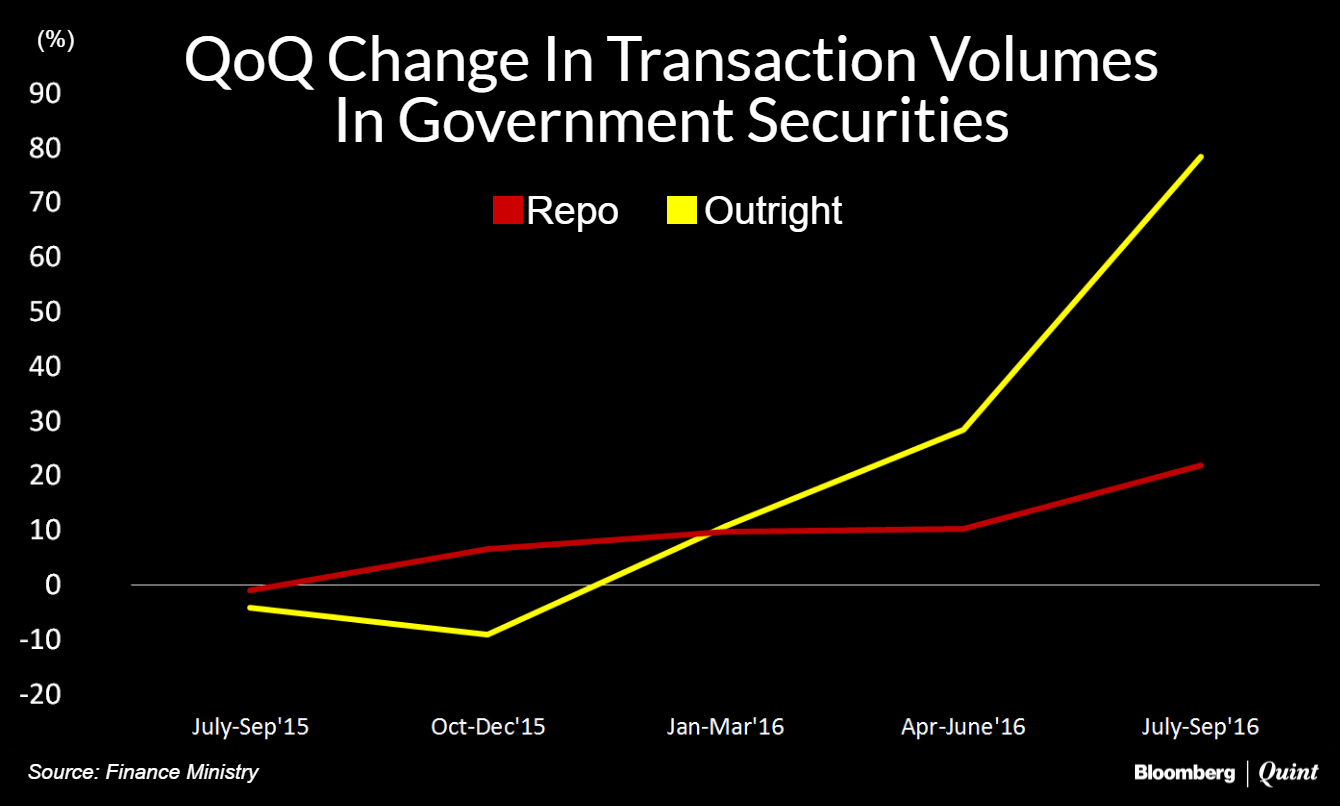
G-sec yields declined sharply across the curve during the quarter, with 10 yr segment gaining the most, on the back of softening of crude prices, increase in risk appetite globally after sharp correction post Brexit, passage of GST Bill by Upper House of Parliament, liquidity easing measures of RBI, expectation of rate cut from RBI, etc.The trading volume of Government securities on an outright basis during Q2 FY 17 increase by 78.45 per cent over the previous quarterPublic Debt Management Quarterly Report, Ministry of Finance
SoumyaJit Niyogi, Associate Director - Credit and Market Research at India Ratings said that increased activity in the government bond market is a healthy sign and reflects that monetary policy transmission is picking up.
“The market conditions were way better this (September-ended) quarter as compared to the last one,” Niyogi said. “Last year transmission was quite clogged even though we saw the Reserve Bank of India cut rates multiple times but things are looking better this time around.”
There have been open market operations worth Rs 1.05 lakh crore by the RBI in the first quarter of the financial year itself, so the transmission of rates happened which drove volumes. It's a healthy sign because activity should pick up whenever interest rates fall but I don't know if it's sustainable in the long term.SoumyaJit Niyogi, Associate Director, Credit and Market Research, India Ratings
R Sivakumar, Head of Fixed Income at Axis Mutual Fund, said that activity in the markets is usually preceded by a fall in yields as seen in the previous quarter. Sivakumar added that the government bond market has already been pricing in rate cuts by the RBI better than the banking system.
“I don't think g-sec market ever had issues with transmitting rate. It is the banking system where rates prove to be more sticky,” Sivakumar said.
The government, in its report said that long term bonds benefited most from the increase in trading volumes.
Trading increased in medium and longer end of bond market (> 7 year) during the quarter vis-à-vis previous quarter. Reflecting the increased trading activity in 10-year benchmark securities, share of ‘10 years and above' maturity range increased and accounted for the highest share of trading volumes during Q2 of FY 16-17.Public Debt Management Quarterly Report, Ministry of Finance
The report on public debt management functions is released every quarter. Apart from highlighting the increased trading activity, the report detailed the government's borrowings during the quarter.
The government issued dated securities worth Rs 1.76 lakh crore during the last quarter which took the overall borrowing during the first half of the current financial year to Rs 3.41 lakh crore or 56.8 percent of the budgeted expenditure.
Meanwhile, the public debt of the central government rose by 3 percent during the three months ended September compared to the previous quarter. Internal debt constituted 92.3 percent of the total public debt.

-
Talking Points This Week: Tech Nerves, FII Buying, And A Faraway Banking Shock

The global markets are not shining this Diwali. The exception in the large markets is, India.
-
Midterm Rally Lasted A Day. The Hard Reality Of A Divided US May Last Two Years | Opinion
Between a contested AI boom, a debt ceiling that arrives in 2027 and a president with every incentive to act alone, the next two years may prove more volatile than the first day's rally suggests.
-
Blue Wave Will Derail the AI Trade but Won't Dismantle the AI Era | Unhedged Position
The Democrats' sweep of the US Congress will see politics collide with economic forces both over the long and short term.
-
It's Time To Take The GST Council's Bet On Trust Global
Payment records can prove India's services exports, and clear, proportionate rules can bring foreign digital sellers into the tax net.
-
Opinion | India at 38: From Innovation Overperformer to Innovation Powerhouse
India now has 453 VC-backed deep science startups, 18 of them late-stage, after 117 percent growth since 2020. Laurus Labs, at USD 9.3 billion, is the most valuable deep science company in any middle-income economy outside China.
-
Navigating Energy Crossroads: S Jaishankar's Call For Diversified Supply Chains At G20 Ministerial Meeting
As geopolitical fault lines continue to test maritime trade routes and commodity flows, Jaishankar's message remains pertinent: true economic resilience requires open markets, protected transit lines, and a genuine commitment to multilateral cooperation rather than coercion.
-
Indians Are Travelling, But Not Every Journey Is A Holiday | The Week In Whys
Pilgrims, patients and working women are the real travellers, and the system hasn't quite caught up with them.
-
Getting To Work Costs Women More | The Reason Why
It is not just about women paying more than men. It is about women paying much more in cities than in villages.
-
AI Bias In Investing Cannot Be Eliminated, But It Can Be Governed
Framing is a particularly important example as identical financial information presented in terms of gains rather than losses can lead an LLM to reach a different assessment.









