Top Africa Oil Producers On Opposite Debt Paths, World Bank Says
(Bloomberg) -- Africa's two biggest oil producers are on a contrasting debt trajectory, according to the World Bank.
Angola's public debt will decline to 61.9% of gross domestic product this year from 85.7% in 2021, while Nigeria will see its debt service-to-revenue ratio balloon to 102.3% in the same period, the World Bank said in its biannual Africa's Pulse report.
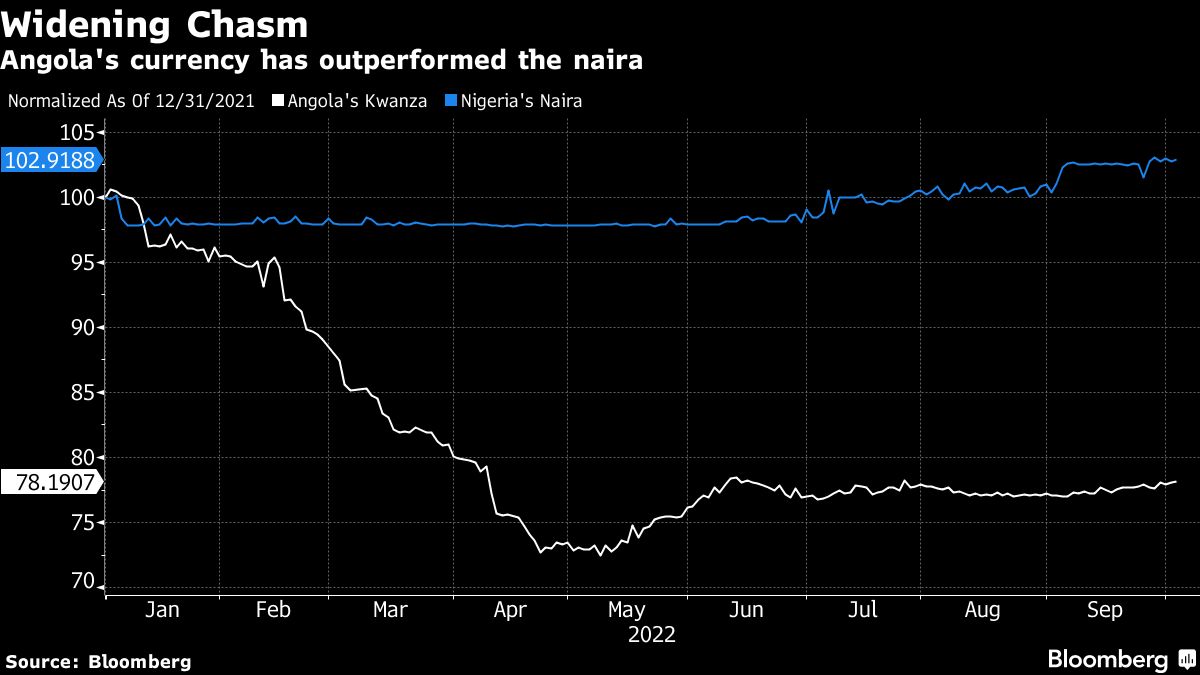
President Muhammadu Buhari's government in Nigeria has refused to remove fuel subsidies that may result in the nation's budget deficit widen to 12.4 trillion naira ($28 billion) next year -- almost three times total revenue. In Angola, the currency has surged and the government has come up with policies to attract overseas investors.

“Public debt in Nigeria is a concern,” the World Bank said in the report. “The combination of low production in the oil industry and unsustainable subsidies is one of the main obstacles to attaining debt sustainability.”
Nigeria spent 982 billion naira in the first quarter subsidizing gasoline, providing the nation's drivers with among the cheapest pump prices in the world. The World Bank and International Monetary Fund have repeatedly urged the government to remove the subsidy.
Debt Distress
More than two-thirds of sub-Saharan African nations with debt above 70% of GDP don't have mining or other resources, according to the report. Eritrea's debt-to-GDP will rise to 234.9%, while Ghana's will be at 104.6% of GDP.
Meanwhile, rising commodity prices and higher interest rates are making debt servicing costlier for nations in the world's second-largest continent.
Eight out of 38 African countries eligible for loans from the World Bank's International Development Association are in debt distress, according to the report. Another 14 “are at high risk of joining them.”
The World Bank expects the region's economic growth to slow to 3.3% in 2022 from 4.1% last year. It also cut Nigeria's growth forecast for 2022 to 3.3% from 3.8%, while Angola will expand 3.1% this year from 0.8% in 2021.
Angola's economic performance “is on the back of rising private consumption, government expenditure, and current account surplus,” according to the report. “The government has started reaping the benefits from its efforts to improve revenue mobilization by increasing the efficiency of tax collection and reducing tax evasion.”
More stories like this are available on bloomberg.com
©2022 Bloomberg L.P.

-
Love, Sex Aur Dhokha: The Audacious Plot To Spy On Jensen Huang

A Taipei dinner, a Singapore chip buyer and a suspected Chinese asset: inside the alleged spy operation that got close to NVIDIA's Jensen Huang.
-
Ten Things I Learnt This Samvat
Patience can be a trap. Cheap stocks can stay cheap. Leverage can wipe you out. What did Samvat 2082 teach us? Niraj Shah writes on 10 lessons from the year gone by.
-
Talking Points This Week: Tech Nerves, FII Buying, And A Faraway Banking Shock
The global markets are not shining this Diwali. The exception in the large markets is, India.
-
Midterm Rally Lasted A Day. The Hard Reality Of A Divided US May Last Two Years | Opinion
Between a contested AI boom, a debt ceiling that arrives in 2027 and a president with every incentive to act alone, the next two years may prove more volatile than the first day's rally suggests.
-
Blue Wave Will Derail the AI Trade but Won't Dismantle the AI Era | Unhedged Position
The Democrats' sweep of the US Congress will see politics collide with economic forces both over the long and short term.
-
It's Time To Take The GST Council's Bet On Trust Global
Payment records can prove India's services exports, and clear, proportionate rules can bring foreign digital sellers into the tax net.
-
Opinion | India at 38: From Innovation Overperformer to Innovation Powerhouse
India now has 453 VC-backed deep science startups, 18 of them late-stage, after 117 percent growth since 2020. Laurus Labs, at USD 9.3 billion, is the most valuable deep science company in any middle-income economy outside China.
-
Navigating Energy Crossroads: S Jaishankar's Call For Diversified Supply Chains At G20 Ministerial Meeting
As geopolitical fault lines continue to test maritime trade routes and commodity flows, Jaishankar's message remains pertinent: true economic resilience requires open markets, protected transit lines, and a genuine commitment to multilateral cooperation rather than coercion.
-
Indians Are Travelling, But Not Every Journey Is A Holiday | The Week In Whys
Pilgrims, patients and working women are the real travellers, and the system hasn't quite caught up with them.









