Timing The Market Versus Time In The Market

Timing may appear to be almost everything in the stock market, but we still believe in time. The top 100 performing days of the past two decades account for 60 percent of the market's total return over this period. Imagine if in your timing wisdom, you missed those 100 trading days – or vice versa.
Equity returns come in clusters. Indeed, these clusters, both on the upside and the downside, are hard to foretell. Most people use a combination of fundamental and technical analyses, and mostly intuition, to figure this out. However, we cannot wish away the vagaries of stock returns.
Take the BSE Sensex as a depressing example of the difficulties for a fundamental or technical analyst.
Imagine if someone through some analysis decided to stay out of the market for these 100 days; that person would have missed 1.5 percent of the action in time terms and 60 percent in return terms.
The same is the story on the reverse. If somehow we could have avoided the worst 100 days in the market, the total return is bumped up by 505 percent, and if someone chose only those days to be in the market, the best performing market in the world over the past 22 years – yes, India has been the best performing market in the world over the past two decades – slips into being the worst.
We are all trying to time our market moves, and such data underpins the importance of timing. However, given the limited tools at our disposal to accurately time market moves, time in the market could be the most important return driver.
Idle Periods And Big Moves
The BSE Sensex, the bellwether index for Indian equities, is up 824 percent over the past 22 years – an annual compounded return of 11 percent. This return has not come in a straight line, even though it appears so on a chart. A logarithmic chart gives a better picture of the underlying volatility.
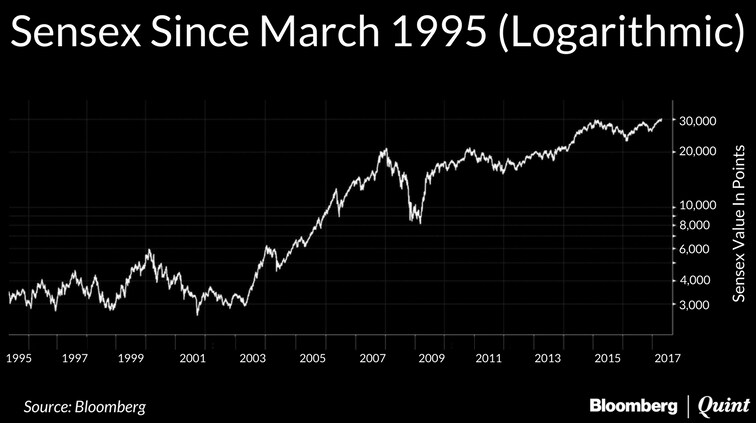
But even such a chart does not tell us about how clustered the index returns are.
For that one has to download returns and sort them in ascending or descending order. When this is done, we get shocking results: 100 days account for about three-fifth or 500 percent of the 824 percent return of the past 22 years. This happens because returns from stocks are not distributed in a Gaussian or bell curve fashion as is assumed in almost all finance theory. We ran the distribution of daily returns for the BSE Sensex over the past two decades, and the distribution is very different from a normal one.
If returns were distributed under a bell curve, the market's 11 percent fall on May 17, 2004, and then again on October 24, 2008, should have happened only once in one billion years, instead of twice in a decade. Both were 7-sigma events.
We are not even trying to figure out the likelihood of the 10-sigma 17 percent rise that the market had on May 18, 2009, since that should have not happened in all the days gone by since this planet was formed.
Instinctively, most investors want to be in a stock or the market when it is rising, and the opposite when it is falling or stagnant. However, foretelling these trends is not easy even with the best tools at your disposal. A lot of the time, money lies in stocks idling and not producing any return. However, investors need to hang on because these periods are followed by big moves.
Big moves come in clusters, giving the false impression that they are easy to call. That appearance is misleading given the erratic behaviour of these return clusters.
The interesting thing about these big moves is their absence at the beginning of the bull market in 2003 and today – arguably the beginning of another bull market.
Timing may appear to be almost everything, but time is essential. Since we do not have a model to forecast the return clusters in stocks or the market, the only way to make money consistently in equities is to be in them for a long period.
Ridham Desai is managing director at Morgan Stanley India and also serves as head of equity research and India equity strategist.
The views expressed here are those of the author's and do not necessarily represent the views of Bloomberg Quint or its editorial team.

-
Why Amazon And Flipkart Are Struggling To Beat Meesho In India's Smaller Cities

With 274 million users and lowest-cost logistics, Meesho is defending its value commerce crown against giants like Amazon and Flipkart.
-
High US Salaries, No Green Card Certainty: The Financial Calculation Facing Indian H-1B Families
The suspension of PERM processing at eight technology employers does not cancel existing H-1B visas. What it does is force a question many Indian families have been avoiding: is the US salary worth tying your career and family plans to one employer?
-
Swiggy vs Eternal: Food Delivery's Two Rivals Are No Longer In The Same Race
Eternal is building a private AI assistant, dark.ai. Swiggy is still working out how to make Instamart pay, with an operating loss of Rs 895 crore in the July-September quarter while Blinkit stayed profitable.
-
Where You Live Shapes How You Get To Work | The Reason Why
Two-wheelers are the most popular way to get to work in India, accounting for nearly 43% of workplace commutes.
-
Unhedged Position: Can India See An Indonesia-Style Time Correction?
The Nifty is trading below levels it first clocked in 2024. Is there, then, as I have suggested in the headline, potential that the current time correction drags on painfully for the next three-five, even ten years?
-
Navigating Friction And Energy Realities: An Analysis Of Marco Rubio's October Visit To India
Occurring at a critical juncture marked by stalled trade negotiations and escalating geopolitical pressures over global energy supplies, the visit offers a profound window into modern US-India relations.
-
India Exports Capital. Why Not Export Trusteeship?
The big question, then, is whether India can build an institution that global borrowers, investors, banks, and lawyers can trust, even without an Indian connection.
-
France's Economy & Politics Are In Crisis | The Reason Why
Let's look at how the French economy and politics evolved under Nicolas Sarkozy, Franois Hollande and Emmanuel Macron.
-
You May Inherit The Business. You Must Earn Its Credibility.
Succession tests the founder's ability to share authority as much as it tests the next generation's readiness to assume it.
-
Signing Deals Is One Thing; Making Them Work Is Another | The Week In Whys
Sometimes, things don't turn out as planned. Indian companies have lost some bids to rivals, some projects won't produce until 2030.










