Tim Cook Joins Billionaire Club As Apple's Value Nears $2 Trillion
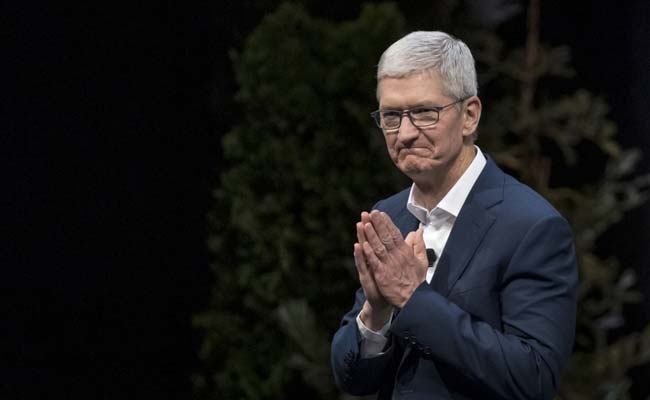
Nine years after Steve Jobs stepped down and thrust Tim Cook to the top of Apple Inc., the company is more valuable than ever -- and so is Cook. Apple's share price rose almost 5 per cent last week, leaving the company Jobs co-founded 44 years ago in his parents' California home on the cusp of stock-market milestone: a market value of nearly $2 trillion.
It was valued at about $350 billion when Jobs died. Mr Cook, meantime, has joined one of the most elite clubs for CEOs who didn't actually found the companies they run: his net worth has eclipsed $1 billion, according to calculations by the Bloomberg Billionaires Index.
Mr Cook's net worth estimate is based on an analysis of regulatory filings and applying the market performance of a typical wealthy investor to his proceeds from share sales. Mr Cook, 59, said in 2015 that he plans to give most of his fortune away and has already gifted million of dollars worth of Apple shares. His wealth could be lower if he's made other undisclosed charitable gifts.
Josh Rosenstock, a spokesman for Apple, declined to comment.
"This tech cycle has been way bigger and longer than I thought," said Hussein Kanji, a partner at venture capital firm Hoxton Ventures who expressed caution about Apple's long-term outlook after Jobs left the company. "Out of all these stocks, Apple has become the greatest cash generation machine in history."
FAANG Stocks
Apple's market value and Cook's riches reflect the rise of the FAANG stocks, a phrase that didn't even exist in the Jobs era. It also comes as Cook and his fellow Big Tech CEOs -- Jeff Bezos of Amazon.com Inc., Sundar Pichai of Alphabet Inc. and Mark Zuckerberg of Facebook Inc. -- face antitrust investigations into what their critics characterize as monopolistic powers.
While Mr Bezos and Mr Zuckerberg have huge stakes in the companies they founded, Cook's path to the 10-figure-club was more incremental. The vast majority of his estimated wealth comes from equity awards he's received since joining Apple in 1998, where he has drawn plaudits for mastering the company's complex supply chain.
He got a massive award of restricted shares on his first day as CEO. The equity has paid out in annual increments, with part of them contingent on Apple's stock outperforming at least two-thirds of firms in the S&P 500. Barring a sudden drop in Apple's stock price, Cook is poised to receive his ninth payout from the award, consisting of 560,000 shares, later this month.
Around half of those will likely be withheld for taxes but the remainder should boost Cook's fortune by another $100 million. He currently owns 847,969 shares directly, or about 0.02 per cent of Apple shares, worth around $375 million. Proceeds from previous share sales, dividends and other compensation add another $650 million to his net worth, according to calculations by Bloomberg. Apple stock rose 1.4 per cent to $450.79 at 2:07 p.m. on Monday.
Mammoth Positions
Mr Cook's stake is small compared with the mammoth positions founders like Mr Bezos, Mr Zuckerberg and Tesla Inc.'s Elon Musk control at their respective companies. Apple shares are distributed widely among different investors and executives, so the world's most valuable company has minted very few billionaires among its employees.
When Mr Jobs stepped down in August 2011 and died soon after, Mr Cook had already filled in as interim CEO on several occasions. But investors and analysts were concerned that Apple wouldn't be able to innovate as much as it did in the past.
While Apple over the past decade hasn't revealed a new product as groundbreaking as the iPhone, the company still has thrived. Mr Cook has overseen the development of devices like the iPhone X and Apple Watch, new services like Apple Music, and research on new frontiers like self-driving cars and augmented-reality glasses.
Even the pandemic, which has hammered many other parts of the economy, has been a boon to Apple and other big tech companies as people have gotten even more reliant on their products and services.
Their recent success stands in contrast to the economic upheaval caused by the coronavirus: a growing string of bankruptcies, tens of millions unemployed and massive public deficits.
When Apple reported results recently, Mr Cook acknowledged the hardship facing legions of families and businesses.
"We do not have a zero-sum approach to prosperity," he said on a conference call. "Especially in times like this, we are focused on growing the pie, making sure our success isn't just our success."

-
A New Samvat Wishlist: Inclusive Prosperity And Human Development

India has strengthened its economic foundations through infrastructure, digital access and enterprise. Its next growth chapter must deepen productivity, create better livelihoods and widen participation in prosperity.
-
Love, Sex Aur Dhokha: The Audacious Plot To Spy On Jensen Huang
A Taipei dinner, a Singapore chip buyer and a suspected Chinese asset: inside the alleged spy operation that got close to NVIDIA's Jensen Huang.
-
Ten Things I Learnt This Samvat
Patience can be a trap. Cheap stocks can stay cheap. Leverage can wipe you out. What did Samvat 2082 teach us? Niraj Shah writes on 10 lessons from the year gone by.
-
Talking Points This Week: Tech Nerves, FII Buying, And A Faraway Banking Shock
The global markets are not shining this Diwali. The exception in the large markets is, India.
-
Midterm Rally Lasted A Day. The Hard Reality Of A Divided US May Last Two Years | Opinion
Between a contested AI boom, a debt ceiling that arrives in 2027 and a president with every incentive to act alone, the next two years may prove more volatile than the first day's rally suggests.
-
Blue Wave Will Derail the AI Trade but Won't Dismantle the AI Era | Unhedged Position
The Democrats' sweep of the US Congress will see politics collide with economic forces both over the long and short term.
-
It's Time To Take The GST Council's Bet On Trust Global
Payment records can prove India's services exports, and clear, proportionate rules can bring foreign digital sellers into the tax net.
-
Opinion | India at 38: From Innovation Overperformer to Innovation Powerhouse
India now has 453 VC-backed deep science startups, 18 of them late-stage, after 117 percent growth since 2020. Laurus Labs, at USD 9.3 billion, is the most valuable deep science company in any middle-income economy outside China.
-
Navigating Energy Crossroads: S Jaishankar's Call For Diversified Supply Chains At G20 Ministerial Meeting
As geopolitical fault lines continue to test maritime trade routes and commodity flows, Jaishankar's message remains pertinent: true economic resilience requires open markets, protected transit lines, and a genuine commitment to multilateral cooperation rather than coercion.









