There Won't Be Single Job Loss Due To Banks' Merger: Nirmala Sitharaman
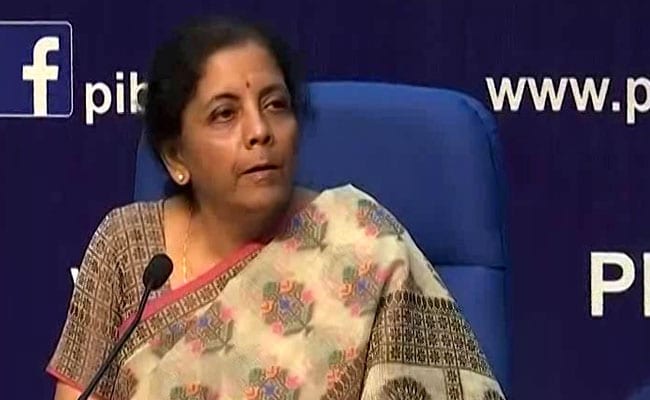
Finance Minister Nirmala Sitharaman on Sunday allayed fears of job losses following the proposed merger of public sector banks, saying not even one employee shall be removed following the amalgamation. "Absolutely, ill informed. I want to assure every union in every one of these banks to please recall what I have said last Friday. When we spoke about amalgamation of banks I have very clearly underlined the fact that there shall not be one employee removed. Not at all", she told reporters here.
She was replying to a question on the bank employees unions opposing the merger plan on the ground it would lead to loss of jobs.
Ms Sitharaman on Friday unveiled a mega plan to merge public sector banks into four as part of plans to create fewer and stronger global-sized lenders as the government looked to boost economic growth from a five-year low.
Ms Sitharaman, who was here to address officers of Customs, Goods and Service Tax and Income Tax department, said there would not be any closure of banks and no bank was being asked to do something new.
"More capital is being given to banks and they will continue to do more of what they were doing earlier," she said. On August 23, Ms Sitharaman had announced a raft of measures to boost the economy, including capital infusion of Rs 70,000 crore into public sector banks.
She had also unveiled a mega plan on Friday to merge public sector banks into four to create fewer and stronger global-sized lenders The All India Bank Employees' Union had alleged that Indian Bank may face closure following its merger with Allahabad Bank.
To a question on this, Ms Sitharaman said Indian Bank would be the anchor bank after the merger. She said when a bank receives capital, it is for them to function more of what they were expected to do as core business, which was to attract business and lend. "Second, another bank in this region is Indian Overseas Bank which continues without any amalgamation added to it. It is also something you should keep in mind", she said.
Asked whether there was any slowdown in the economy, she said the government was responding to it sectorally, based on their requirement.
"Every sector of the Indian economy, when it approaches us, we hear them out for solutions that they want and we respond to it. Suggestions (from them) and what would they want and what they expect from the government of India and I respond totem. I have already done (it) twice and I will do so mo renumber of times. Every industry which has approached me I will respond", she said. Citing an example, she said the automobile sector was in a transition phase to produce engines and components meeting BS-VI fuel norms (from the earlier BS-IV), which comes into effect from April 1, 2020.
The Minister said it was not the Union government's decision, but a Supreme Court order two years ago that automobile companies shall not produce any BS-IV vehicle after March 31 2020, be it scooters or any other vehicle.
To a query about the automobile industry seeking a Good sand Service Tax rate cut, she said it should be decided by the GST Council. Asked what was her message to people who had lost their jobs and those fearing job losses, Ms Sitharaman said, "I can only say we are responding to the industry requirements. Across the board there is no one particular answer that I can give, saying this is the magic wand. Sectorally, what they want, we are responding," she said.
Ms Sitharaman said the government understands that the contours and tone of issues for each sector varied from one to the other. "The automobile (sector) has an issue, agriculture has a different issue. So each sector has a sectoral requirement which we want to respond", she said.

-
High US Salaries, No Green Card Certainty: The Financial Calculation Facing Indian H-1B Families

The suspension of PERM processing at eight technology employers does not cancel existing H-1B visas. What it does is force a question many Indian families have been avoiding: is the US salary worth tying your career and family plans to one employer?
-
Swiggy vs Eternal: Food Delivery's Two Rivals Are No Longer In The Same Race
Eternal is building a private AI assistant, dark.ai. Swiggy is still working out how to make Instamart pay, with an operating loss of Rs 895 crore in the July-September quarter while Blinkit stayed profitable.
-
Where You Live Shapes How You Get To Work | The Reason Why
Two-wheelers are the most popular way to get to work in India, accounting for nearly 43% of workplace commutes.
-
Unhedged Position: Can India See An Indonesia-Style Time Correction?
The Nifty is trading below levels it first clocked in 2024. Is there, then, as I have suggested in the headline, potential that the current time correction drags on painfully for the next three-five, even ten years?
-
Navigating Friction And Energy Realities: An Analysis Of Marco Rubio's October Visit To India
Occurring at a critical juncture marked by stalled trade negotiations and escalating geopolitical pressures over global energy supplies, the visit offers a profound window into modern US-India relations.
-
India Exports Capital. Why Not Export Trusteeship?
The big question, then, is whether India can build an institution that global borrowers, investors, banks, and lawyers can trust, even without an Indian connection.
-
France's Economy & Politics Are In Crisis | The Reason Why
Let's look at how the French economy and politics evolved under Nicolas Sarkozy, Franois Hollande and Emmanuel Macron.
-
You May Inherit The Business. You Must Earn Its Credibility.
Succession tests the founder's ability to share authority as much as it tests the next generation's readiness to assume it.
-
Signing Deals Is One Thing; Making Them Work Is Another | The Week In Whys
Sometimes, things don't turn out as planned. Indian companies have lost some bids to rivals, some projects won't produce until 2030.
-
FOMC Wall, PERM Suspension, Hospital Stocks | Talking Points This Week
A PERM suspension would directly affect green-card sponsorship rather than H-1B visas, so the near-term earnings impact could remain relatively limited. The key question is whether this marks a new phase in US scrutiny of Indian IT.









