Theaters in China Screen Movies and Text Messages From Viewers' Mobile Phones
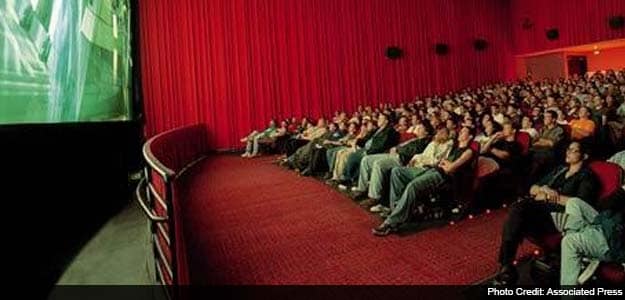
The triumph of the smartphone-obsessed, or the coolest wave of the future?
In the new "bullet screen," or danmu, model of movie watching recently introduced in select theaters in China, the bullets are not projectiles but text messages, which audience members send via their mobile phones while watching the film. The messages are then projected onto the screen, so that at any time the scene may be overlaid with multiple comments scrolling across the action.
It might seem hellish to those still keen on the solitary escapism of a traditional movie experience. But the bullet screen is meant to appeal to younger audiences for whom mobile phones have become lifelines and sharing every thought - even about something as banal as the air-conditioning in the cinema - has become a way of life. In the last month, several theaters around China have been experimenting with bullet screen showings of films like the 3-D animated feature "The Legend of Qin" and the third installment of the blockbuster young-adult franchise "Tiny Times."
Since the release of "Tiny Times 3" in July, its distributor, Le Vision Pictures, has organized several bullet-screen showings in Beijing as part of a post-release marketing strategy.
"We wanted to create a social experience and promote it among young people," said Enya Sun, a public relations manager at Le Vision Pictures. "If it was a Zhang Yimou film," she said, referring to the celebrated Chinese director, "we probably wouldn't do it, because it would be less focused on young people. But if it's a movie oriented to very young people, we could potentially do it on a national scale."
The idea behind bullet screens originated in Japan, where they were first popularized by a Japanese video portal called Nicodou devoted to animation, comics and games. Its success inspired similar Chinese sites.
While comments can be so numerous that they obscure the entire screen, many bullet-screen proponents say the point is often not to watch the video in any case, but to get together and "tucao," Chinese for "spit and joke around," about the silliness of the video.
"Even when the videos are boring, the viewers are getting together and entertaining each other," Hiroyuki Nishimura, the Japanese founder of Nicodou, said in a 2008 interview with Wired magazine.
The feedback from viewers appears to have been positive.
"Implementing a bullet screen doesn't require that much technological capability, and it is a good strategy for attracting audiences to somewhat controversial films," said a user called Wuyun Zhuangban Zhe, writing on his Tencent WeChat public account about his experience at a "bullet screen" showing of "Tiny Times 3."
In a photo posted in his description, audience members can be seen hunched over bright mobile phone screens as the film is projected on the screen before them. The user also noted that audience members could send text messages noting their seat number to the screen when their mobile phone batteries were running low, whereupon a theater worker would appear with a portable battery to recharge their phones.
A theater manager surnamed Zhang at the Luxin Cinema in Shandong province told the China Youth Daily newspaper that for an Aug. 6 bullet screen showing of "The Legend of Qin," 90 percent of the seats were filled, mostly by young people who texted in their thoughts at about 0.1 renminbi, or 10 cents, per message.
"Right now everyone thinks this is pretty novel and pretty cool," Zhang told the newspaper. "But in the long run this might have an impact on people's attention spans during movies."
Others remain wary of where bullet screens might take the viewing experience, expressing concern about a possible barrage of advertisements, abusive texts or other questionable content in real-time messages on the screen.
He Ping, a Chinese film director and former secretary general of the China Film Directors Association, voiced concern to China Youth Daily that the popularization of bullet screens might subvert the aesthetic intentions of the filmmakers.
"If these bullet screens become widespread in the future, they should first be authorized by the writers and directors of the film," He said.
© 2014, The New York Times News Service

-
High US Salaries, No Green Card Certainty: The Financial Calculation Facing Indian H-1B Families

The suspension of PERM processing at eight technology employers does not cancel existing H-1B visas. What it does is force a question many Indian families have been avoiding: is the US salary worth tying your career and family plans to one employer?
-
Unhedged Position: Can India See An Indonesia-Style Time Correction?
The Nifty is trading below levels it first clocked in 2024. Is there, then, as I have suggested in the headline, potential that the current time correction drags on painfully for the next three-five, even ten years?
-
Navigating Friction And Energy Realities: An Analysis Of Marco Rubio's October Visit To India
Occurring at a critical juncture marked by stalled trade negotiations and escalating geopolitical pressures over global energy supplies, the visit offers a profound window into modern US-India relations.
-
India Exports Capital. Why Not Export Trusteeship?
The big question, then, is whether India can build an institution that global borrowers, investors, banks, and lawyers can trust, even without an Indian connection.
-
France's Economy & Politics Are In Crisis | The Reason Why
Let's look at how the French economy and politics evolved under Nicolas Sarkozy, Franois Hollande and Emmanuel Macron.
-
You May Inherit The Business. You Must Earn Its Credibility.
Succession tests the founder's ability to share authority as much as it tests the next generation's readiness to assume it.
-
Signing Deals Is One Thing; Making Them Work Is Another | The Week In Whys
Sometimes, things don't turn out as planned. Indian companies have lost some bids to rivals, some projects won't produce until 2030.
-
FOMC Wall, PERM Suspension, Hospital Stocks | Talking Points This Week
A PERM suspension would directly affect green-card sponsorship rather than H-1B visas, so the near-term earnings impact could remain relatively limited. The key question is whether this marks a new phase in US scrutiny of Indian IT.
-
Everything, Everywhere, All At Once: Dalal Street's Week To Forget | Joining The Dots
Visa curbs, a Starlink spat and cancer drug caps: what connects this week's shocks for Indian markets
-
India Is Going Abroad For Critical Minerals. But It May Take Years To Pay Off | The Reason Why
Although India's steps are in the right direction, they remain modest compared with India's growing dependence.









