The Unmaking Of Make In India
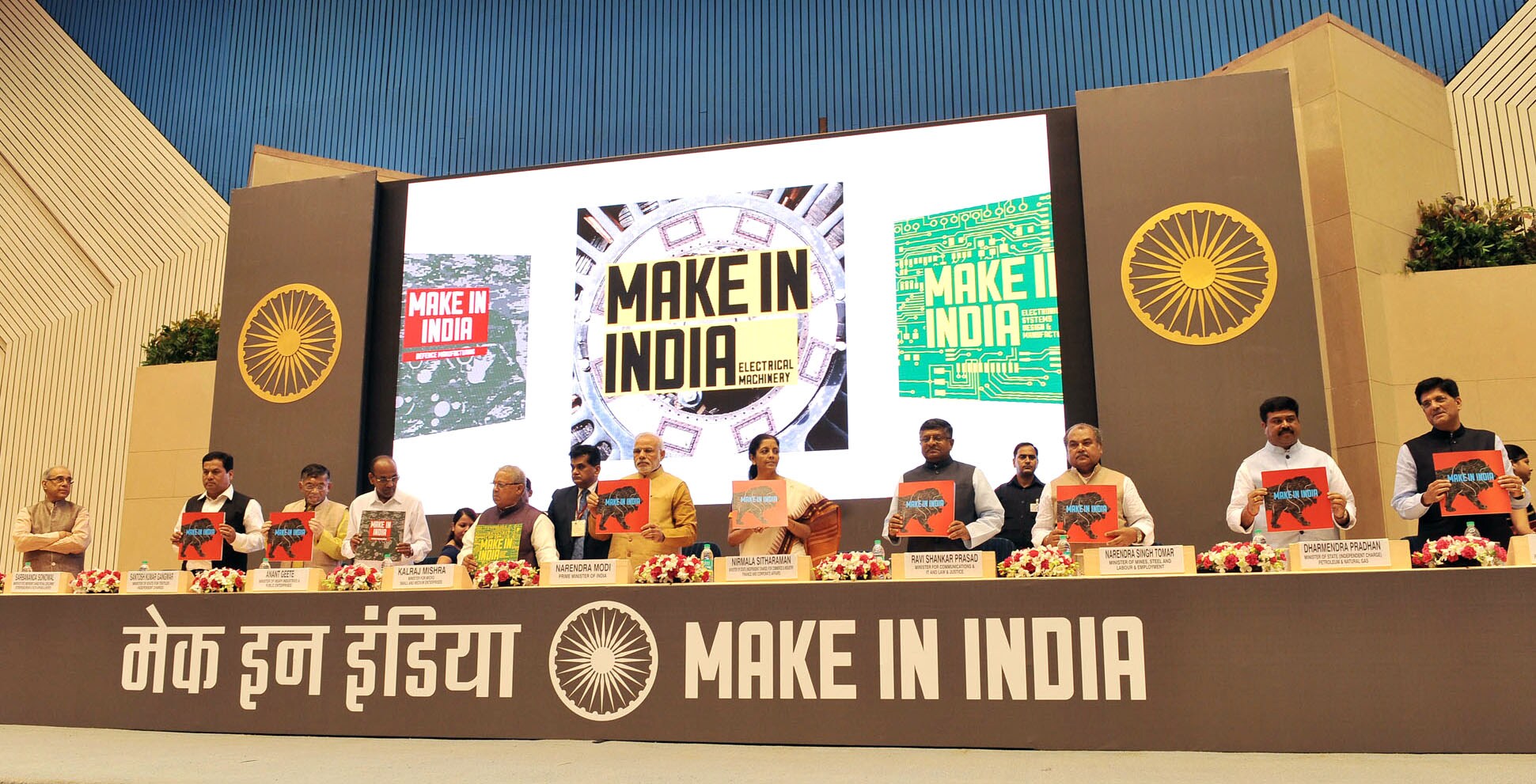
Remember Make in India? On Feb. 13, 2016, Prime Minister Narendra Modi declared: “we want the share of manufacturing in our GDP to go up to 25% in the near future.” The programme's stated goal was to hit this target by 2022 and to generate 100 million manufacturing jobs in India.
So where do we stand one year before our deadline? In a very dismal place, and not only because of the Covid-19 pandemic.
Rather than adding 100 million manufacturing jobs, India lost 24 million jobs between 2016-17 and 2020-21, according to a recent analysis by Ashoka University's Centre for Economic Data and Analysis. Covid-19 was only the last straw: 11 million jobs had already been lost before the pandemic hit.

Rather than rising to 25%, the share of manufacturing in the overall economy plunged to 14% in 2020-21 from 17% in 2015-16. For all his rhetoric of reviving Indian manufacturing to compete with China, Modi has done much worse than his predecessor Manmohan Singh. Is that the impression you get from reading India's ‘free and fair' media?

With domestic manufacturing spiralling downwards, the Modi government has instead been talking up buoyant foreign direct investment flows to India. The government recently celebrated record FDI flows of $82 billion in 2020-21, of which $28 billion was accounted for by one transaction: the sale of Reliance Jio stock to Facebook, Google, and KKR. FDI in recent years has mostly flowed to information technology, computers, e-commerce, and transportation. Manufacturing gets relatively little, as this chart shows:

To summarise, Make in India has failed to achieve any of its stated goals. Rather, every indicator has worsened, be it the share of manufacturing in the economy or the number of jobs generated in manufacturing. The pandemic is no excuse: it only accelerated a slide that had been underway for several years.
This might explain why the government's rhetoric has shifted to Atmanirbhar Bharat, or self-sufficiency. Who needs results when you can just move the goalposts?
This article was originally published on the author's Chunauti blog.
Amitabh Dubey is President of Professionals' Congress - Delhi, and a member of the Indian National Congress' Uttar Pradesh manifesto committee.
The views expressed here are those of the author and do not necessarily represent the views of BloombergQuint or its editorial team.

-
Blue Wave Will Derail the AI Trade but Won't Dismantle the AI Era | Unhedged Position

The Democrats' sweep of the US Congress will see politics collide with economic forces both over the long and short term.
-
It's Time To Take The GST Council's Bet On Trust Global
Payment records can prove India's services exports, and clear, proportionate rules can bring foreign digital sellers into the tax net.
-
Opinion | India at 38: From Innovation Overperformer to Innovation Powerhouse
India now has 453 VC-backed deep science startups, 18 of them late-stage, after 117 percent growth since 2020. Laurus Labs, at USD 9.3 billion, is the most valuable deep science company in any middle-income economy outside China.
-
Navigating Energy Crossroads: S Jaishankar's Call For Diversified Supply Chains At G20 Ministerial Meeting
As geopolitical fault lines continue to test maritime trade routes and commodity flows, Jaishankar's message remains pertinent: true economic resilience requires open markets, protected transit lines, and a genuine commitment to multilateral cooperation rather than coercion.
-
Indians Are Travelling, But Not Every Journey Is A Holiday | The Week In Whys
Pilgrims, patients and working women are the real travellers, and the system hasn't quite caught up with them.
-
Getting To Work Costs Women More | The Reason Why
It is not just about women paying more than men. It is about women paying much more in cities than in villages.
-
AI Bias In Investing Cannot Be Eliminated, But It Can Be Governed
Framing is a particularly important example as identical financial information presented in terms of gains rather than losses can lead an LLM to reach a different assessment.
-
Joining The Dots | Dark Skies, Steady Diya: Why Hope Holds This Diwali
With war, a weak rupee and foreign outflows weighing on sentiment, policymakers at the NDTV World Summit and market veterans at NDTV Profit Ignite: Diwali Edition offered the same advice: stay invested and filter out the noise.
-
The Curious Case of Equitas Small Finance Bank And A CEO Who Quit For Stock
PN Vasudevan believes persistent investor concerns over a perceived conflict of interest had become a governance overhang on Equitas Small Finance Bank's stock, even as the lender improved profitability and asset quality.










