The Rise of Alibaba, and a Tycoon
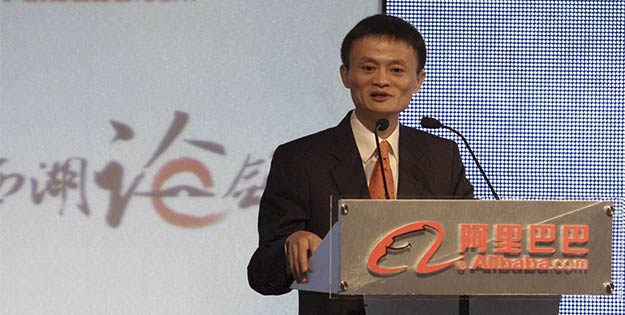
The first time Jack Ma used the Internet, in 1995, he searched for "beer" and "China" but found no results. Intrigued, he created a basic Web page for a Chinese translation service with a friend. Within hours, he received a handful of emails from around the world requesting information.
It was an introduction to the power of the Web that would drive Ma to create the Alibaba Group four years later.
Today, Alibaba is China's largest online retailer, with merchandise volumes that lag behind only Wal-Mart, worldwide. The e-commerce giant is also moving forward with plans for a stock sale that is expected to rival Facebook's $16 billion offering two years ago. If successful, the deal would help vault Alibaba and Ma, who owns 8.9 percent of the company, to the highest ranks of technology industry titans.
Ma's ascent to dot-com billionaire is remarkable for not following the traditional script. Unlike Facebook's Mark Zuckerberg, Apple's Steve Jobs or Microsoft's Bill Gates, Ma, 49, has no background in computing and professes not to understand technology. Raised during China's Cultural Revolution, Ma began his career as an English teacher.
Instead, his role at Alibaba has always been as the company's main strategist, a flamboyant motivator in chief to his staff and a relentless opponent to those who have competed against him. Alibaba's two main websites, Taobao Marketplace and Tmall.com, now account for 60 percent of the packages shipped through the Chinese postal system.
"He effectively represents millions of people who now depend on Alibaba for their livelihood," said Duncan Clark, who has known Ma since the late 1990s and is the chairman of BDA China, a consulting firm in Beijing. "That's a constituency. He's a politician with a small 'p.'"
He has also proved to be a serial disrupter - an outsider with a knack for creating new markets by reimagining old industries like retailing or finance. Alibaba and Ma are shaking up some of China's most staid, state-dominated industries, starting ventures in banking and finance and mobile phone communications. He is even moving into the department store business and film production.
"Innovation in many industries has been triggered by outsiders," Ma wrote last June in an opinion article in The People's Daily, the official newspaper of the Communist Party - an unusual move for a private sector entrepreneur.
He was putting the country's state banks on notice. Publication of the article coincided with the start of Yu'e Bao, a high-interest money market product that Alibaba initiated to attract investment from its customers' online payment accounts. As of February, 81 million people had signed up for the product, which had $40 billion in assets under management.
"The finance industry needs a disrupter, it needs an outsider to come in and carry out a transformation," Ma wrote in the article.
He brings his own flair to the role.
At a 2009 stadium rally to celebrate the anniversary of Alibaba, he emerged onstage wearing a waist-length blond wig, a black leather jacket with red flame and metal stud accents, sunglasses and lipstick. Raising a microphone, he ripped into a stilted rendition of "Can You Feel the Love Tonight?," eliciting cheers from the crowd of 16,000 employees.
Since the beginning, Ma has shown a knack for thinking differently.
At a time when few Chinese households had their own computers, Ma in 1995 made the decision to leave teaching to set up an online business. In his hometown, Hangzhou, Ma established one of the country's first officially registered Internet companies, a business index site called China Pages.
Cui Luhai, who was then running a computer animation business, met with Ma at the China Pages office to learn more about his plans. "It was a pretty empty space with only one desk set up in the middle of the room," said Cui, today a lecturer in new media at the China Academy of Art. "There was only one very old PC desktop surrounded by a lot of people," he said. Ma, it turned out, had spent much of his money on registering the business and appeared to have little money left for hardware.
Ma struggled in his early efforts to get government support for his new venture.
In a memoir-style documentary about Alibaba called "Crocodile in the Yangtze," Porter Erisman, a Mandarin-speaking American who worked at Alibaba from 2000 to 2008, presents footage of one of many visits Ma paid to officials in Beijing in the mid-1990s. Ma appears in a button-down blue denim shirt, sitting over a boxy old laptop computer in a smoky government office and explaining his business.
"Nowadays, foreigners can use computers from any desktop to find products from around the world," Ma explains. "They can order directly from Hong Kong, Taiwan, Singapore, but they can't order anything from China because right now there's nothing from China on the Internet," he says. "I hope the various departments will support us."
But Ma's pitches were rebuffed. He soon left China Pages in 1997 to work at a unit of China's Commerce Ministry helping to create websites. In early 1999, he struck out on his own again, to start Alibaba.
The company's first site, Alibaba.com, was a business-to-business marketplace that connected Chinese exporters with overseas buyers.
In 1999, the company lured Joseph C. Tsai, a Taiwan-born former lawyer who had been educated at Yale and was working in a private equity business in Hong Kong. Together, Ma and Tsai brought in Goldman Sachs and SoftBank as investors.
Ma began Taobao, the company's consumer-to-consumer platform, in 2003, at a time when eBay's Chinese unit dominated the business. Fighting for market share, Ma decided to keep Taobao free, although it was hemorrhaging money.
"From a Wall Street investors' perspective, he was willing to run Alibaba into the ground to defeat eBay ," says Mr. Erisman, the filmmaker. "The only thing worse than a smart competitor is a crazy one who is willing to just spend all their money with no hope of making profit."
At a news conference in October 2005, Ma told reporters that Taobao had gained nearly 70 percent of the market share for online shopping in China. "Pretty soon we'll be the only one left. EBay's days are numbered," he said. In 2006, eBay announced that it was effectively leaving the Chinese market and folding its operations into an Internet company controlled by Li Ka-shing, the Hong Kong billionaire.
"I had always wished that I was born in a period of war. I could have been a general," Ma once said of his youth. "I thought about what I could have achieved in war."
As the company moves toward an initial public offering, Ma seems focused on his legacy.
He remains a hands-on executive chairman and oversees strategy at Alibaba, but in May 2013 he stepped down from his role as chief executive. The next day, he announced that he had been appointed the chairman of the Nature Conservancy's board of directors for China. He has grown increasingly concerned over rampant pollution of the soil and water in China, something he has partly blamed for his father-in-law's recent death from cancer.
In late April, Ma and Tsai, a co-founder, announced that they would donate shares representing 2 percent of Alibaba's stock - a grant worth several billion dollars - to charitable trusts that would finance initiatives in the environment, medicine and education. Such a large donation is seldom seen in China, and the move was cheered by other prominent philanthropists, including Gates of Microsoft, Warren E. Buffett and Michael Bloomberg, the former mayor of New York.
Ma "wasn't the type of person who starts a business keeping 90 percent of the equity for himself and really hoarding all of the wealth and riches," said one Western executive who has known him for over a decade, declining to be named because of his company's policy against speaking publicly about business contacts.
"In the earliest days, when Alibaba.com was first forming, he was giving equity to all of the high school students who were working with him," said the executive. "He was bringing everyone along."
© 2014, The New York Times News Service

-
Where You Live Shapes How You Get To Work | The Reason Why

Two-wheelers are the most popular way to get to work in India, accounting for nearly 43% of workplace commutes.
-
High US Salaries, No Green Card Certainty: The Financial Calculation Facing Indian H-1B Families
The suspension of PERM processing at eight technology employers does not cancel existing H-1B visas. What it does is force a question many Indian families have been avoiding: is the US salary worth tying your career and family plans to one employer?
-
Unhedged Position: Can India See An Indonesia-Style Time Correction?
The Nifty is trading below levels it first clocked in 2024. Is there, then, as I have suggested in the headline, potential that the current time correction drags on painfully for the next three-five, even ten years?
-
Navigating Friction And Energy Realities: An Analysis Of Marco Rubio's October Visit To India
Occurring at a critical juncture marked by stalled trade negotiations and escalating geopolitical pressures over global energy supplies, the visit offers a profound window into modern US-India relations.
-
India Exports Capital. Why Not Export Trusteeship?
The big question, then, is whether India can build an institution that global borrowers, investors, banks, and lawyers can trust, even without an Indian connection.
-
France's Economy & Politics Are In Crisis | The Reason Why
Let's look at how the French economy and politics evolved under Nicolas Sarkozy, Franois Hollande and Emmanuel Macron.
-
You May Inherit The Business. You Must Earn Its Credibility.
Succession tests the founder's ability to share authority as much as it tests the next generation's readiness to assume it.
-
Signing Deals Is One Thing; Making Them Work Is Another | The Week In Whys
Sometimes, things don't turn out as planned. Indian companies have lost some bids to rivals, some projects won't produce until 2030.
-
FOMC Wall, PERM Suspension, Hospital Stocks | Talking Points This Week
A PERM suspension would directly affect green-card sponsorship rather than H-1B visas, so the near-term earnings impact could remain relatively limited. The key question is whether this marks a new phase in US scrutiny of Indian IT.
-
Everything, Everywhere, All At Once: Dalal Street's Week To Forget | Joining The Dots
Visa curbs, a Starlink spat and cancer drug caps: what connects this week's shocks for Indian markets









