From Karunanidhi To Kalaignar
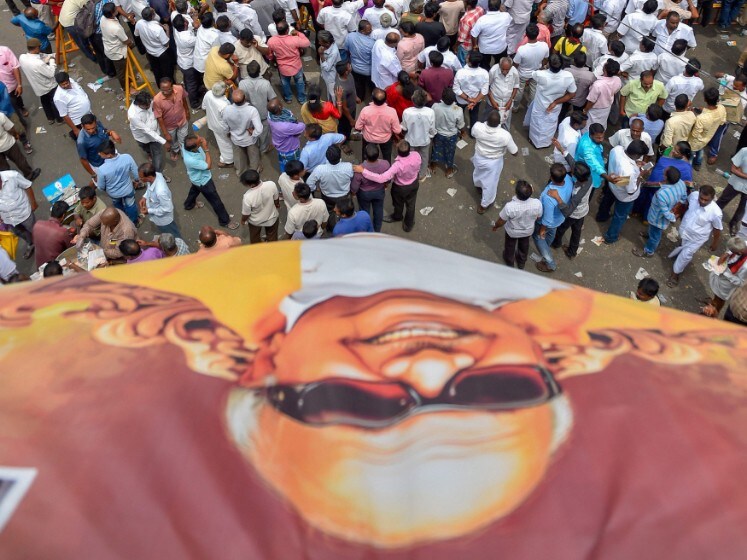
To the follower, he was ‘Thalaivar' - leader. To the outsider, he was a five-time chief minister. To his opponents, a shrewd political strategist. To a linguaphile, he was Tamil incarnate. To one and all, he was Kalaignar – the artist.
The death of Muthuvel Karunanidhi brings to end an important era in the history of Indian politics. One that witnessed the rise of regional identity, promoted language and atheism as a plank for self-respect and set social justice as its goal. All under the umbrella banner called the Dravidian movement. His demise marks the exit of the last of the Dravidian Trinity - Periyar (EV Ramaswamy), Anna (CN Annadurai) and Kalaignar (M Karunanidhi).
Indian politicians usually suffer long lives. Karunanidhi too braced the dust and heat of 94 summers. He leaves behind a long and illustrious list of accomplishments. He ruled the state as Chief Minister five times.
He co-founded the Dravida Munnetra Kazhagam and led the party as its president unchallenged for five decades.
His larger-than-life personality left an indelible impact on the heart and soul of Tamil society across politics, literature, cinema and popular culture. But then, Kalaignar was one of a kind.
 @kalaignar89) ">
Mass Leader
Born as Dakshinamoorthy in 1924, Karunanidhi entered politics at the age of 14. He burst into prominence first as a playwright, poet, and screen-writer and spent a large part of his life writing propaganda films for the Dravidian movement. His skills were put to use in those times when cinema was the main vehicle for propagating Dravidian ideals. By age 33, Karunanidhi became a member of the state legislature and his proximity with Annadurai cemented his position in the DMK and later in government.
What's remarkable about the growth of Karunanidhi's stature was that it ran parallel to the meteoric rise of Tamil Nadu's most popular filmstar-turned-politician, MG Ramachandran.
For Karunanidhi to have found and built his own political space during the MGR era, speaks volumes of his talent and acumen. It is akin to recognising Dravid's brilliance during the Tendulkar era.

The evolution from Karunanidhi to Kalaignar was carefully crafted over the next four decades. His oratory ensured his mass appeal. Every speech began with his trademark phrase “My beloved brethren more important than my life”.
It swayed millions in his favour.
His signature style dark glasses ensured only he could see, and his yellow towel—which came later—ensured only he could be seen.
But, his biggest asset remained his ability to gauge the popular mood of the Tamil masses. He always knew which way popular opinion was swinging and he could milk it effortlessly with his emotional appeals.
In government, Karunanidhi built himself a reputation as a hard taskmaster. He was perceived as a workaholic with a keen attention to detail. But it is also undeniable that it was under his leadership that the state spiraled irreversibly into an abyss of corruption and nepotism. The turning point was the Veeranam scam investigated by the Sarkaria commission that subsequently led to the dismissal of the DMK government in 1976.
Supporting the Tamil cause in Sri Lanka might be a politically expedient move but for a democratically elected state government in India to support heinous acts of violence in Sri Lanka was calamitous. As was proved when India's Prime Minister Rajiv Gandhi was assassinated by the LTTE. By the time the Jain Commission absolved Karunanidhi of abetting the Tigers, the political damage had been done.

Role At The Centre
The misuse of Article 356 led Karunanidhi to firmly rally behind federal autonomy and the need for greater powers to states. Over the years, he was among the few leaders from the South to understand the increasing clout of regional political forces and the reality of coalition governments. He played the role of kingmaker twice – once in the formation of the United Front government under Deve Gowda in 1996 and subsequently, under Inder Kumar Gujral in 1997. But not once during any of these situations did he ever fancy a political career beyond the state.
“I am a state leader,” he often said.
As a politician, Karunanidhi was not ideologically intransigent; he could be pragmatic and if the situation so demanded, he could stoop to conquer.
For instance, he could play ball with the Vajpayee government in 1999, even though a truck with the Bharatiya Janata Party was considered anathema by Dravidian ideologues. At the same time, he was sharp enough to read the winds of change and promptly switched sides to the Congress-led UPA before the 2004 elections.
MK Versus Jaya
Perhaps his most challenging and storied rivalry was with the estimable Jayalalithaa. In the period between 1991 to 2013, Karunanidhi and Jayalalithaa fought bitterly as Tamil Nadu sank into politics of vendetta. Characterised by court cases, police raids, arrests, abuses, it was a phase when political courtesies had little meaning in the state. Both Karunanidhi and Jayalalithaa were feisty characters who made no bones about the fact that they hated each other.

Media's Darling
One area where Karunanidhi clearly scored over Jayalalithaa was the way he interacted with the media. He simply loved the attention he received. Ask any Chennai journalist and he or she will definitely have a personal Kalaignar story to tell you. He used wit and repartee to great effect, you could never get a straight answer out of him.
His felicity with Tamil and his gift of wordplay meant he would flummox and disarm you effortlessly. Once a right-wing leader threatened to behead Kalaignar if he continued to hurt Hindu sentiments. In Tamil, the word “thala seevi” means “to chop or behead” and colloquially it also means “to comb”. When reporters rushed to Kalaignar's residence and asked him for a reaction to the threat of beheading, Kalaignar smiled and pointed to his bald pate and said “Ask him to come and comb my hair….it's been a while since I have done it myself”. That was Kalaignar for you.
I find this new medium (social media) very useful and interesting.https://t.co/sMrzOyi6b9 #DMK2016 pic.twitter.com/NNOCZg0Qz3
May 14, 2016Kalaignar's Legacy
Politicians have an acute sense of history and legacy. So did Kalaignar. He often quoted Anna who said, “you need a heart to bear anything”. It is that spirit of resilience, never-say-die attitude that built Karunanidhi in his lifetime. His greatest contributions to Tamil language, cinema or politics are dwarfed by his lifelong devotion to the cause of his people. Whether or not his politics appealed to you his place in history is undeniable – as one of Tamil Nadu's greatest. And as one of India's greatest Tamils.
Harsha Subramaniam is Executive Producer at Bloomberg.

-
High US Salaries, No Green Card Certainty: The Financial Calculation Facing Indian H-1B Families

The suspension of PERM processing at eight technology employers does not cancel existing H-1B visas. What it does is force a question many Indian families have been avoiding: is the US salary worth tying your career and family plans to one employer?
-
Unhedged Position: Can India See An Indonesia-Style Time Correction?
The Nifty is trading below levels it first clocked in 2024. Is there, then, as I have suggested in the headline, potential that the current time correction drags on painfully for the next three-five, even ten years?
-
Navigating Friction And Energy Realities: An Analysis Of Marco Rubio's October Visit To India
Occurring at a critical juncture marked by stalled trade negotiations and escalating geopolitical pressures over global energy supplies, the visit offers a profound window into modern US-India relations.
-
India Exports Capital. Why Not Export Trusteeship?
The big question, then, is whether India can build an institution that global borrowers, investors, banks, and lawyers can trust, even without an Indian connection.
-
France's Economy & Politics Are In Crisis | The Reason Why
Let's look at how the French economy and politics evolved under Nicolas Sarkozy, Franois Hollande and Emmanuel Macron.
-
You May Inherit The Business. You Must Earn Its Credibility.
Succession tests the founder's ability to share authority as much as it tests the next generation's readiness to assume it.
-
Signing Deals Is One Thing; Making Them Work Is Another | The Week In Whys
Sometimes, things don't turn out as planned. Indian companies have lost some bids to rivals, some projects won't produce until 2030.
-
FOMC Wall, PERM Suspension, Hospital Stocks | Talking Points This Week
A PERM suspension would directly affect green-card sponsorship rather than H-1B visas, so the near-term earnings impact could remain relatively limited. The key question is whether this marks a new phase in US scrutiny of Indian IT.
-
Everything, Everywhere, All At Once: Dalal Street's Week To Forget | Joining The Dots
Visa curbs, a Starlink spat and cancer drug caps: what connects this week's shocks for Indian markets
-
India Is Going Abroad For Critical Minerals. But It May Take Years To Pay Off | The Reason Why
Although India's steps are in the right direction, they remain modest compared with India's growing dependence.









