Book Excerpt: The Case That Cemented The ‘Basic Structure’ But Divided The Bench
Excerpted from ‘‘The cases that India forgot', By Dr. Chintan Chandrachud, with permission from Jaggaurnaut Books.
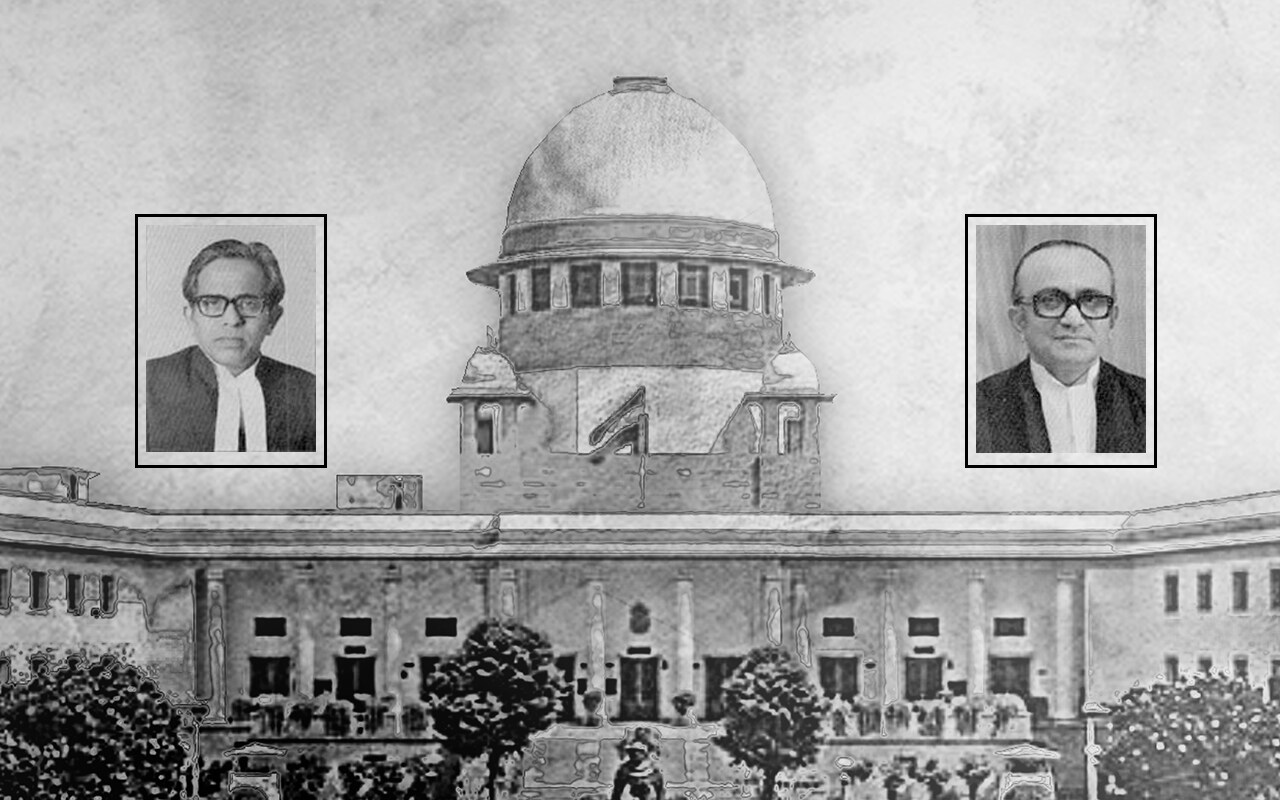
The Minerva Mills case undoubtedly set the tone for the future of the basic structure doctrine in India. However, it also brought to light the uncomfortable dynamics among the two most senior judges of the Supreme Court. Justice Bhagwati's complaints about the way in which the case was managed (foreshadowed in his decision from the last day before the vacation) were more fully expressed in his substantive judgement issued after the vacation. Citing Justice Chandrachud's own complaint in the Kesavananda case that there was no opportunity for a free and frank exchange of thoughts' among the judges before judgement was handed down, he noted:
I hoped that after the completion of the argument on questions of such momentous significance, there would be a ‘free and frank exchange of thoughts' in a judicial conference either before or after the draft judgment was circulated by my Lord the Chief Justice and I would either be able to share the views of my colleagues or if that was not possible, at least try to persuade them to agree with my point of view. But, I find myself in the same predicament in which the learned Chief Justice found himself [in the Kesavananda case].
Asked about Justice Bhagwati's criticism in an interview after his retirement, Justice Chandrachud admitted that the judges did not have the chance to review one another's draft judgements, but noted that they had several opportunities to exchange views about the case. Other judges on the panel confirmed this.
This was not the only occasion in his judgement that Justice Bhagwati would accuse his colleague of double standards. He cited a passage from Justice Chandrachud's own judgement in the Kesavananda case, emphasizing that fundamental rights and directive principles of state policy both shared an equally important position in the constitutional scheme, in support of his decision to uphold Article 31C in the Minerva Mills judgement. Justice Chandrachud had noted that ‘the basic object of conferring freedoms on individuals [through fundamental rights]' was to achieve the objectives set out in the directive principles. Parliament was inspired, said Justice Bhagwati, by the same philosophy in making the constitutional amendment as ‘the noble philosophy eloquently expressed in highly inspiring and evocative words, full of passion and feeling' by Justice Chandrachud in the Kesavananda judgement. It had long been speculated that Justice Bhagwati's rancour arose from Justice Chandrachud's prior elevation to the Supreme Court (resulting in a long tenure as chief justice), even though Bhagwati had been appointed a high court judge earlier than his colleague.
Justice Bhagwati himself received a fair share of criticism both before and after the decision in the Minerva Mills case was pronounced. It transpired that after the hearing had concluded and while the case was still awaiting judgement, Justice Bhagwati wrote an effusive letter congratulating Indira Gandhi on her election victory, praising her ‘iron will', ‘uncanny insight and dynamic vision' and her ‘heart which is identified with the misery of the poor and the weak'. The criticism of failing to consult colleagues came full circle.
Just as Justice Chandrachud had complained about the lack of discussion among the judges in the Kesavananda case and was at the receiving end of the same criticism in the Minerva Mills case, Justice Bhagwati made the same complaint in the Minerva Mills case and was the recipient of it in a prominent case involving judicial appointments a few years later.
Even as lawyers and political commentators lamented the state of the ‘bench divided', the Congress government was predictably displeased with the majority decision in the Minerva Mills case. After all, the way in which the case played out was that the Congress government's amendments to the Constitution were struck down, while the Janata government's amendments remained unaffected. Law minister and MP from Secunderabad, P. Shiv Shanker, criticized the judgement at every available opportunity. On one occasion, he described the judgement as betraying a ‘conservative and retrograde outlook' for the judiciary. At a National Seminar on Constitutional Law held at Siddharth College, Bombay, Shiv Shanker commented – in the presence of no less than Justice Bhagwati – that had the court kept in mind the principles laid down in the Preamble, the controversy of the supremacy of fundamental rights over directive principles could have been avoided.
It soon became clear that the government's reaction would not stop at displeasure.
Several political parties offered suggestions and questioned the government on how it would react to the decision. One MP from the Communist Party asked whether the government would be willing to hold broad-based consultation among political parties. Shiv Shanker saw no purpose being served in such consultations. Another MP asked whether the government intended to organize a full-scale parliamentary debate on the issue – a suggestion that was also rejected. The law minister also dismissed the idea of a presidential reference seeking the advisory opinion of the Supreme Court. Criticism of the judges that decided the case in the Rajya Sabha led retired Supreme Court Justice M. Hidayatullah (then vice president and, therefore, chairman of the Rajya Sabha) to remind members on several occasions of the constitutional provision that prevented discussion on the conduct of judges in Parliament.
Still more radical suggestions to overturn the Supreme Court's judgement were on the table. These included organizing a popular referendum on constitutional amendment, and converting' the houses of Parliament into an interim Constituent Assembly with the power to ‘amend' any provision of the Constitution, including its basic structure. The option ultimately selected by the law minister was, or at least appeared, somewhat more benign. He elected to ask the Supreme Court to reconsider its decision through a review petition. According to the law minister, the timing of filing the petition was a matter of litigation ‘strategy' – a euphemism for filing at a moment when it was likely to arise for hearing before judges that were sympathetic to the government's position.
As it happened, the government did not wait long. About five weeks after the judgement, it filed a review petition at the Supreme Court seeking a reconsideration of the Minerva Mills judgement.
Justice Bhagwati's criticism of Justice Chandrachud's management of the case turned out to be the linchpin of the government's case.
The government argued that the judgement was not a decision of the court at all, but only consisted of the opinions of individual judges. This argument was innovative, but also inherently weak – for judges to consult with one another was always desirable, but never strictly necessary. Besides, it would hardly set a good precedent to allow unsuccessful litigants to have judgements reviewed based on the internal dynamics of the decision-making process.
Palkhivala described the government's attempt to have the decision reviewed as a ‘shocking exhibition of the arrogance of power'. He staunchly opposed the petition when it arose for hearing. His argument was that the only reason the Supreme Court was even willing to consider the petition in an oral hearing rather than dismissing it on the papers was that it had been filed by the government: ‘[I]f Minerva Mills had lost and filed an application of this nature, would you have entertained it?' Chief Justice Chandrachud tried to calm Palkhivala down with some humour: ‘Anyone is welcome to file an application. Someone can file a suit saying that the Supreme Court belongs to him. We will examine that too appropriately.' Ultimately, the hearing was adjourned with no fixed date for the next hearing, on the basis that one of the judges on the bench, Justice Kailasam, was scheduled to retire the following day. The review petition died a natural death and the government did not ultimately pursue it.
Chintan Chandrachud is an Associate at Quinn Emanuel Urquhart & Sullivan LLP, London. He is the author of Balanced Constitutionalism: Courts and Legislatures in India and the United Kingdom.
The views expressed here are those of the author's and do not necessarily represent the views of Bloomberg Quint or its editorial team.

-
Opinion | India at 38: From Innovation Overperformer to Innovation Powerhouse

India now has 453 VC-backed deep science startups, 18 of them late-stage, after 117 percent growth since 2020. Laurus Labs, at USD 9.3 billion, is the most valuable deep science company in any middle-income economy outside China.
-
Navigating Energy Crossroads: S Jaishankar's Call For Diversified Supply Chains At G20 Ministerial Meeting
As geopolitical fault lines continue to test maritime trade routes and commodity flows, Jaishankar's message remains pertinent: true economic resilience requires open markets, protected transit lines, and a genuine commitment to multilateral cooperation rather than coercion.
-
Indians Are Travelling, But Not Every Journey Is A Holiday | The Week In Whys
Pilgrims, patients and working women are the real travellers, and the system hasn't quite caught up with them.
-
Getting To Work Costs Women More | The Reason Why
It is not just about women paying more than men. It is about women paying much more in cities than in villages.
-
AI Bias In Investing Cannot Be Eliminated, But It Can Be Governed
Framing is a particularly important example as identical financial information presented in terms of gains rather than losses can lead an LLM to reach a different assessment.
-
Joining The Dots | Dark Skies, Steady Diya: Why Hope Holds This Diwali
With war, a weak rupee and foreign outflows weighing on sentiment, policymakers at the NDTV World Summit and market veterans at NDTV Profit Ignite: Diwali Edition offered the same advice: stay invested and filter out the noise.
-
The Curious Case of Equitas Small Finance Bank And A CEO Who Quit For Stock
PN Vasudevan believes persistent investor concerns over a perceived conflict of interest had become a governance overhang on Equitas Small Finance Bank's stock, even as the lender improved profitability and asset quality.
-
Talking Points This Week: AI Cash Burn, A Tiger Comeback And An India That Still Finds Its Own Path
India is not immune to higher oil or tighter global liquidity, yet its earnings base is broader, its domestic policy levers are still available.
-
Foreign Investors Own Half Of HDFC Bank and ICICI Bank. An LTCG Cut Could Matter Most Here
Foreign portfolio investors have US$115 billion parked in HDFC Bank, ICICI Bank. If the government cuts long-term capital gains tax, Jefferies says returning foreign money could land here first.










