Musk Leaves China With Tesla Driving Software Hurdles Cleared

(Bloomberg) -- Elon Musk's quick visit to China paid immediate dividends, with Tesla Inc. clearing two key hurdles to introduce its driver-assistance system to the world's biggest auto market.
The US carmaker will partner with Chinese tech giant Baidu Inc. for mapping and navigation functions to support what it calls Full-Self Driving, or FSD, according to people familiar with the matter. Tesla has also passed a key data-security and privacy requirement, which would help ease some of the concerns over bringing FSD to market in China.
Tesla shares rose as much as 6.6% in premarket US trading, while Baidu jumped 2.4% in Hong Kong.
The developments came after Tesla Chief Executive Office Elon Musk made an unannounced trip to China on Sunday, seeking approval for driver-assistance software that could help arrest the carmaker's revenue decline. While the company's suite of features require constant supervision and don't make Teslas autonomous, the company charges $8,000 for them in the US, or $99 a month for a subscription.
The Wall Street Journal reported Monday that Chinese officials told Tesla that Beijing has tentatively approved the company's plan to launch FSD in the country, citing people familiar with the matter.
Read More: Musk Makes Surprise China Visit in Search of Tesla Revenue Boost
Musk met Sunday with Premier Li Qiang, who as the Chinese Communist Party secretary for Shanghai helped the company set up what is now its top plant globally. His private jet left Beijing on Monday, according to FlightRadar24.
While Tesla initially enjoyed a red-carpet welcome in China, its fortunes have faded recently as it faces tougher competition from domestic EV makers led by BYD Co. Tesla's share of China's auto market shrank to around 6.7% in the fourth quarter of 2023, from 10.5% in the first quarter of last year, according to Bloomberg calculations based on China's Passenger Car Association data.
Advanced driver-assistance systems are becoming increasingly common in China, with many local players including Xpeng Inc. and Xiaomi Corp. using them as a selling point for vehicles. Carmakers also have had success in charging extra for driver-assist features, which Tesla could use after having cut prices to levels that may have wiped out the operating profit it's earning from the market.
Approval for FSD in China would be a major boost for Tesla, which is coming off its first year-over-year decline in quarterly revenue since 2020. Even after slashing prices, the company sold fewer cars in the first quarter. Musk is cutting headcount by at least 10% and looking to accelerate new models, including less-expensive vehicles, that could be ready by early 2025, if not before year-end.
Musk's surprise China visit is “a watershed moment,” Wedbush Securities senior analyst Dan Ives said in an interview with Bloomberg Television. “This could open up FSD in China, which I view as unlocking what really could be the golden opportunity for them.”
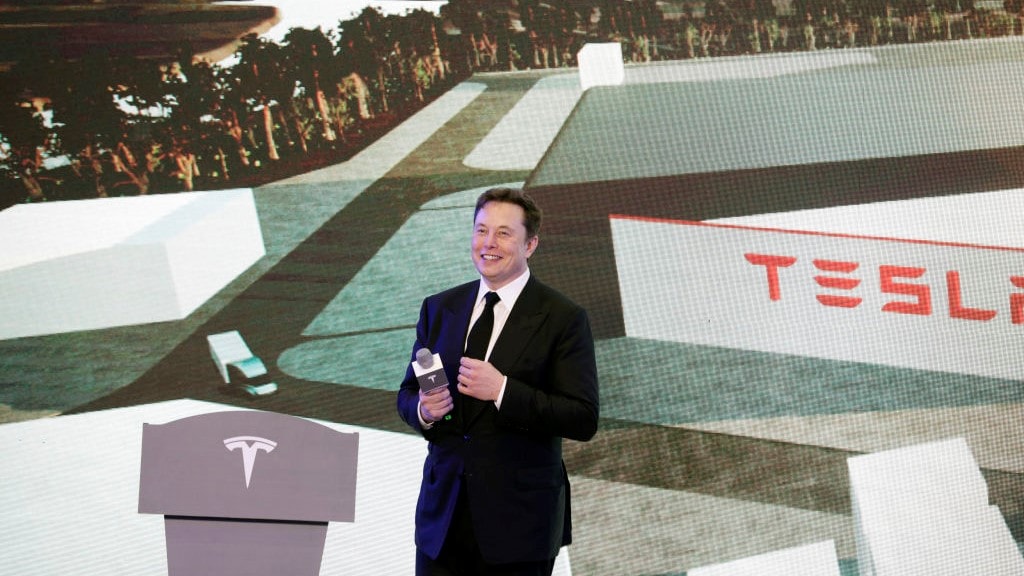
Teaming with Baidu — one of about only 20 qualified suppliers with the country's top-level mapping credentials that can be applied in driver-assistance functions — will allow Tesla to tap the Chinese company's lane-level navigation and mapping services. Tesla has been using Baidu for in-car mapping and navigation since 2020.
While getting the green light for FSD in China might help Tesla claw back some lost ground, its driver-assistance systems have proved problematic in the US. The top US auto-safety regulator just opened a probe into the company's less-capable Autopilot system, citing 20 crashes that have occurred since December involving vehicles that received an over-the-air software update to prevent misuse.
During an earnings call last week, Musk emphasized the importance of autonomous-driving development, saying that people who doubt Tesla's ability to “solve” autonomy shouldn't invest in the company.
(Updates with Tesla share move in the third paragraph.)
More stories like this are available on bloomberg.com
©2024 Bloomberg L.P.

-
Opinion | India at 38: From Innovation Overperformer to Innovation Powerhouse

India now has 453 VC-backed deep science startups, 18 of them late-stage, after 117 percent growth since 2020. Laurus Labs, at USD 9.3 billion, is the most valuable deep science company in any middle-income economy outside China.
-
Navigating Energy Crossroads: S Jaishankar's Call For Diversified Supply Chains At G20 Ministerial Meeting
As geopolitical fault lines continue to test maritime trade routes and commodity flows, Jaishankar's message remains pertinent: true economic resilience requires open markets, protected transit lines, and a genuine commitment to multilateral cooperation rather than coercion.
-
Indians Are Travelling, But Not Every Journey Is A Holiday | The Week In Whys
Pilgrims, patients and working women are the real travellers, and the system hasn't quite caught up with them.
-
Getting To Work Costs Women More | The Reason Why
It is not just about women paying more than men. It is about women paying much more in cities than in villages.
-
AI Bias In Investing Cannot Be Eliminated, But It Can Be Governed
Framing is a particularly important example as identical financial information presented in terms of gains rather than losses can lead an LLM to reach a different assessment.
-
Joining The Dots | Dark Skies, Steady Diya: Why Hope Holds This Diwali
With war, a weak rupee and foreign outflows weighing on sentiment, policymakers at the NDTV World Summit and market veterans at NDTV Profit Ignite: Diwali Edition offered the same advice: stay invested and filter out the noise.
-
The Curious Case of Equitas Small Finance Bank And A CEO Who Quit For Stock
PN Vasudevan believes persistent investor concerns over a perceived conflict of interest had become a governance overhang on Equitas Small Finance Bank's stock, even as the lender improved profitability and asset quality.
-
Talking Points This Week: AI Cash Burn, A Tiger Comeback And An India That Still Finds Its Own Path
India is not immune to higher oil or tighter global liquidity, yet its earnings base is broader, its domestic policy levers are still available.
-
Foreign Investors Own Half Of HDFC Bank and ICICI Bank. An LTCG Cut Could Matter Most Here
Foreign portfolio investors have US$115 billion parked in HDFC Bank, ICICI Bank. If the government cuts long-term capital gains tax, Jefferies says returning foreign money could land here first.










