TCS Q2 Results Preview: Five Things To Watch

Tata Consultancy Services Ltd. will kick off the second-quarter earnings season on Wednesday.
The net profit of India's biggest IT services firm is likely to have risen in the July–September period amid flat revenue growth, according to Bloomberg estimates.
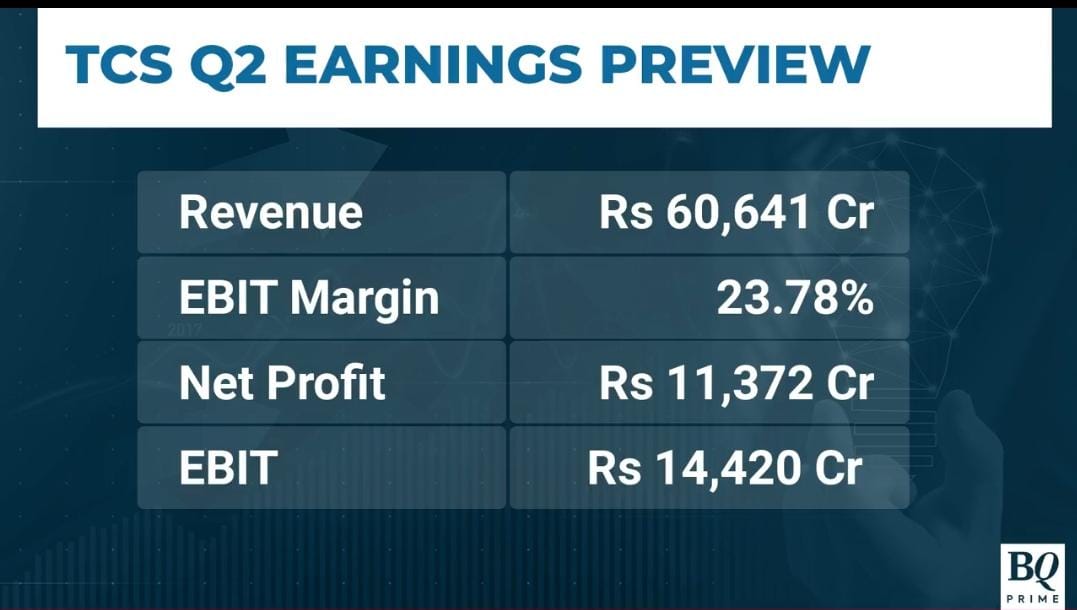
Here are five things to watch out for in TCS' Q2 results:
1. Revenue Growth
TCS is likely to clock a revenue of Rs 60,353 crore as compared with Rs 59,381 crore in the first quarter, according to Bloomberg. Net profit is expected to rise 3% sequentially to Rs 11,409 crore.
Essentially, TCS is staring at another subdued quarter. Investors will look for cues from the management on how the rest of the fiscal will pan out.
2. Dealmaking
TCS signed some mega deals in the second quarter—$800 million from Jaguar Land Rover and $1.1 billion from the U.K.'s National Employment Savings Trust.
The order book for the second quarter is estimated at $11–13 billion. But discretionary deals are still hard to come by. The deal pipeline—though healthy—isn't meaningfully converting into revenue.
3. Return To Office
TCS, which is India's biggest private employer, wants all employees to return to the office, marking an end to working from home. While that could aid utilisation levels, overhead costs will also go up.
4. Hiring Plans
In the first quarter, TCS had a net headcount addition of 523 people, while its peers—Infosys Ltd., HCL Technologies Ltd., and Wipro Ltd.—recorded a decline in headcount.
TCS is unlikely to step up hiring at this juncture of the fiscal and will look to make the most of its bench strength.
5. Buyback
The TCS board will also consider a share buyback—its fifth in six years—which can potentially be its biggest ever.
In March 2022, the company repurchased shares worth Rs 18,000 crore. This time, it can easily go up to Rs 22,000 crore.
Shares of TCS closed 0.22% lower at Rs 3,629.20 apiece on the BSE as compared with a 0.87% advance in the benchmark Sensex on Tuesday.

-
A New Samvat Wishlist: Inclusive Prosperity And Human Development

India has strengthened its economic foundations through infrastructure, digital access and enterprise. Its next growth chapter must deepen productivity, create better livelihoods and widen participation in prosperity.
-
Love, Sex Aur Dhokha: The Audacious Plot To Spy On Jensen Huang
A Taipei dinner, a Singapore chip buyer and a suspected Chinese asset: inside the alleged spy operation that got close to NVIDIA's Jensen Huang.
-
Ten Things I Learnt This Samvat
Patience can be a trap. Cheap stocks can stay cheap. Leverage can wipe you out. What did Samvat 2082 teach us? Niraj Shah writes on 10 lessons from the year gone by.
-
Talking Points This Week: Tech Nerves, FII Buying, And A Faraway Banking Shock
The global markets are not shining this Diwali. The exception in the large markets is, India.
-
Midterm Rally Lasted A Day. The Hard Reality Of A Divided US May Last Two Years | Opinion
Between a contested AI boom, a debt ceiling that arrives in 2027 and a president with every incentive to act alone, the next two years may prove more volatile than the first day's rally suggests.
-
Blue Wave Will Derail the AI Trade but Won't Dismantle the AI Era | Unhedged Position
The Democrats' sweep of the US Congress will see politics collide with economic forces both over the long and short term.
-
It's Time To Take The GST Council's Bet On Trust Global
Payment records can prove India's services exports, and clear, proportionate rules can bring foreign digital sellers into the tax net.
-
Opinion | India at 38: From Innovation Overperformer to Innovation Powerhouse
India now has 453 VC-backed deep science startups, 18 of them late-stage, after 117 percent growth since 2020. Laurus Labs, at USD 9.3 billion, is the most valuable deep science company in any middle-income economy outside China.
-
Navigating Energy Crossroads: S Jaishankar's Call For Diversified Supply Chains At G20 Ministerial Meeting
As geopolitical fault lines continue to test maritime trade routes and commodity flows, Jaishankar's message remains pertinent: true economic resilience requires open markets, protected transit lines, and a genuine commitment to multilateral cooperation rather than coercion.









