Tata Motors Bets on New Sedan to Revive Weak India Sales
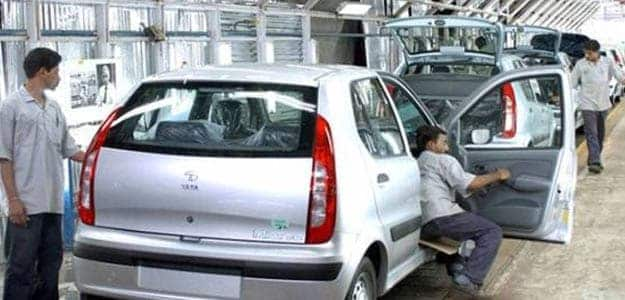
Tata Motors Ltd will launch a passenger car this month, its first new offering in four years, in a bid to regain market share and plug losses in its domestic business, which was also hard hit by the slowing economy.
The car, called Zest, is a compact sedan built on a new platform and, in a departure from previous models, boasts user-friendly features such as touch-screen control panels.
Tata Motors' domestic business has posted losses in four of the last eight quarters and Ranjit Yadav, head of passenger vehicles, said the Zest was key to the automaker's revamped domestic strategy.
"The Zest is the first step and an important proof point of what we want to do with our passenger vehicle business," Yadav told Reuters. "We have taken some hard calls in the last 12 to 18 months to set right our fundamentals."
Tata Motors, India's biggest automaker by revenue, dominates the trucks and buses segment, but its passenger cars have failed to lure customers away from local rival Maruti Suzuki India Ltd and foreign competitors including Hyundai Motor Co and Honda Motor Co.
Tata's domestic car sales fell 39 per cent year-on-year in the year that ended on March 31 and its market share also dropped to 4.2 per cent at end-June from 10.2 per cent two years ago, industry data showed.
Lack of a product pipeline, an image that its cars are not cool because they are used as taxis and the legacy of its ultra-cheap Nano, perceived as a poor man's car, has put Tata Motors out of favour with buyers.
In the past, the automaker has relied on its trucks and buses, as well as on the strong sales at its luxury unit Jaguar Land Rover, to offset the weak performance at home.
But with trucks and buses sales declining as India's economy battles the longest spell of below 5 per cent growth in quarter of a century, Tata Motors has now shifted its focus to cars.
It also wants to capitalise on any improvement in the economy under the new government of Prime Minister Narendra Modi, executives say. Car sales in India, expected to be the world's third-largest car market by 2018, are likely to rise this year after posting a decline for two consecutive years.
Investors, however, say it won't be easy for Tata Motors to convince buyers of the merits of its passenger cars after being largely absent from that market for so long.
"It will be more of a challenge for Tata because it is in very different segments," said Walter Rossini, a Milan-based portfolio manager for Gestielle India, which manages Indian stocks including Tata Motors shares. "For them it would help to focus more on their commercial vehicle business in India and luxury international business."
Some analysts said Tata has taken a well-calculated risk by launching a compact sedan because of the popularity of smaller, fuel-efficient vehicles. Deepesh Rathore, analyst at Emerging Markets Automotive Advisors, however, said the company still had to change its image, adding: "It will not happen in a hurry."
As part of its new strategy, Tata Motors plans to launch two new vehicles every year until 2020. The Zest will be followed by the Bolt hatchback later this year, said Yadav.
($1 = 60.0650 Indian Rupees)
Copyright: Thomson Reuters 2014

-
Opinion | India at 38: From Innovation Overperformer to Innovation Powerhouse

India now has 453 VC-backed deep science startups, 18 of them late-stage, after 117 percent growth since 2020. Laurus Labs, at USD 9.3 billion, is the most valuable deep science company in any middle-income economy outside China.
-
Navigating Energy Crossroads: S Jaishankar's Call For Diversified Supply Chains At G20 Ministerial Meeting
As geopolitical fault lines continue to test maritime trade routes and commodity flows, Jaishankar's message remains pertinent: true economic resilience requires open markets, protected transit lines, and a genuine commitment to multilateral cooperation rather than coercion.
-
Indians Are Travelling, But Not Every Journey Is A Holiday | The Week In Whys
Pilgrims, patients and working women are the real travellers, and the system hasn't quite caught up with them.
-
Getting To Work Costs Women More | The Reason Why
It is not just about women paying more than men. It is about women paying much more in cities than in villages.
-
AI Bias In Investing Cannot Be Eliminated, But It Can Be Governed
Framing is a particularly important example as identical financial information presented in terms of gains rather than losses can lead an LLM to reach a different assessment.
-
Joining The Dots | Dark Skies, Steady Diya: Why Hope Holds This Diwali
With war, a weak rupee and foreign outflows weighing on sentiment, policymakers at the NDTV World Summit and market veterans at NDTV Profit Ignite: Diwali Edition offered the same advice: stay invested and filter out the noise.
-
The Curious Case of Equitas Small Finance Bank And A CEO Who Quit For Stock
PN Vasudevan believes persistent investor concerns over a perceived conflict of interest had become a governance overhang on Equitas Small Finance Bank's stock, even as the lender improved profitability and asset quality.
-
Talking Points This Week: AI Cash Burn, A Tiger Comeback And An India That Still Finds Its Own Path
India is not immune to higher oil or tighter global liquidity, yet its earnings base is broader, its domestic policy levers are still available.
-
Foreign Investors Own Half Of HDFC Bank and ICICI Bank. An LTCG Cut Could Matter Most Here
Foreign portfolio investors have US$115 billion parked in HDFC Bank, ICICI Bank. If the government cuts long-term capital gains tax, Jefferies says returning foreign money could land here first.










