Supreme Court Strikes Down Feb.12 Circular: What It Means For Banks
The Supreme Court has struck down the Reserve Bank of India's Feb. 12, 2018 circular, which had revamped the manner in which banks deal with stressed assets.
The circular had asked banks to start working on a resolution plan for accounts over Rs 2,000 crore immediately on default and finalise it within 180 days. If they failed to do, the account would have to be referred for insolvency proceedings under the Insolvency and Bankruptcy Act. The Feb. 12 circular had also discontinued existing restructuring schemes.
With the circular now struck down, banks will have greater discretion in referring accounts for insolvency. However, with no clear RBI-approved restructuring schemes in place, banks will need to devise their own restructuring schemes, said experts that BloombergQuint spoke to.
No Impact On NPAs, Provisioning
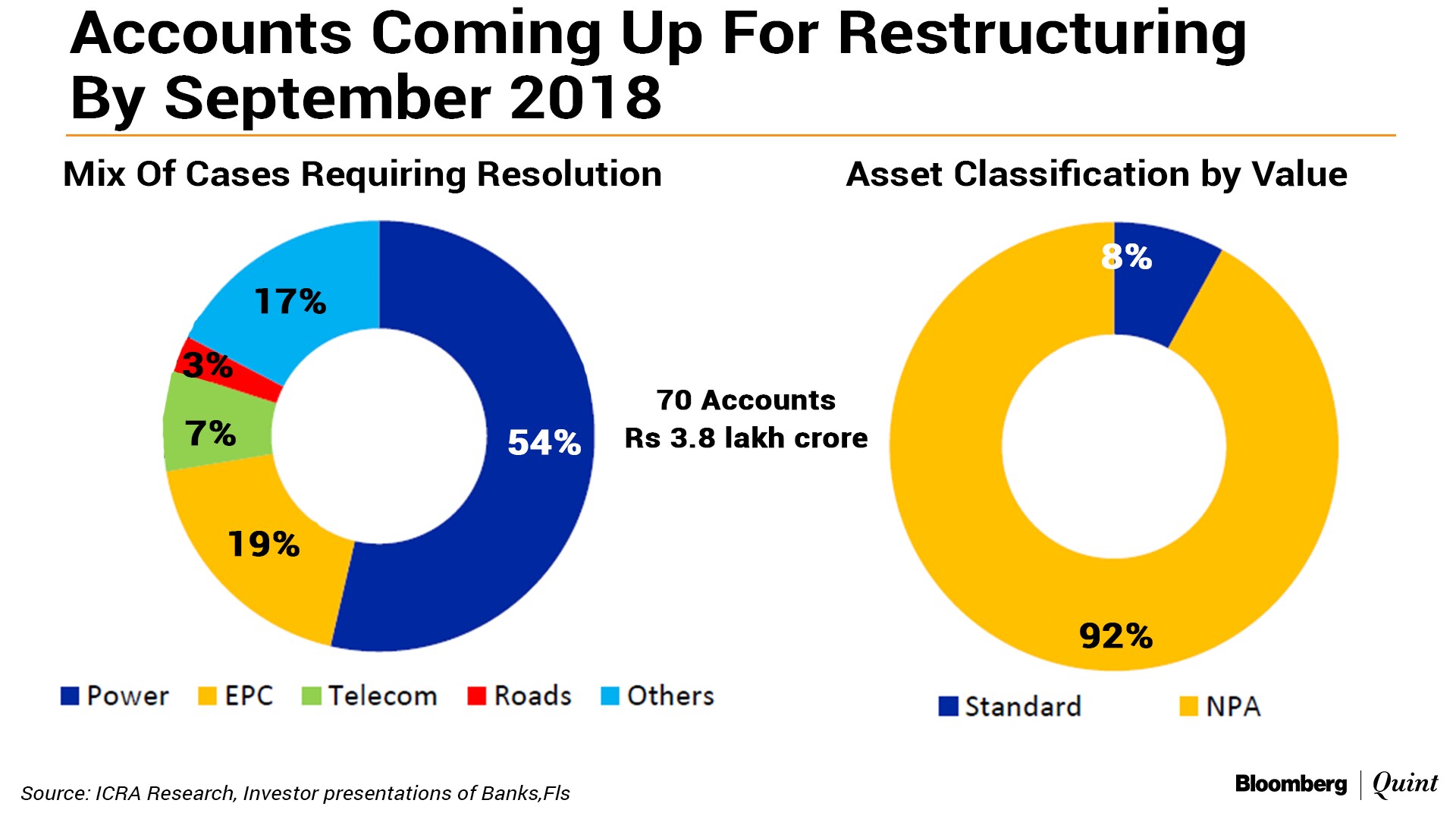
According to rating agency ICRA, loans worth about Rs 3.8 lakh crore across 70 large borrowers were impacted by the circular. This included about Rs 2 lakh crore in power sector loans across 34 borrowers. About 92 percent of these accounts were already tagged as non-performing and banks had made provisions of 25-40 percent on these accounts, said Anil Gupta, head of financial sector ratings at ICRA.
As such, there will be no immediate impact on bad loans or on provisions for the banks, Gupta explained. However, the expectation of resolution within a certain time frame will now change, Gupta added.
R Gandhi, former deputy governor of the Reserve Bank of India said that the regulator is fully within its rights to prescribe the length of time over which an overdue account needs to be classified and the extent of provisions required. There will be no impact on either NPAs or provisions as a result of the Supreme Court's order, he told BloombergQuint.
Restructuring Schemes: To Each Its Own
For accounts that are in default by one-day or more, banks can continue to try and work out resolution plans. However, since earlier restructuring schemes like Strategic Debt Restructuring and the Scheme For Sustainable Structuring of Stressed assets have been withdrawn, banks will need to devise their own restructuring plans.
“This means that, as of now, it is up to every bank to devise a scheme as it sees fit as long as it takes provisions once the account is restructured and stick to the rules as defined under the ‘Income Recognition and Asset Classification or IRAC' rules,” said Abizer Diwanji, partner and national leader for financial services at EY.
J. Sagar Associates, which represented the Association of Power Producers in challenging the RBI's circular, said that the RBI may need to issue revised guidelines for restructuring.
“In light of the Supreme Court judgment, RBI may have to issue revised guidelines / circulars for restructuring of stressed assets keeping in view the observations of the Supreme Court. There is also a question mark over existing processes which may have been completed / nearing completion,” said the law firm in an emailed statement.
Gandhi said that banks were anyway given freedom under the Feb. 12 circular to devise their own restructuring plans and that will continue.
No Rush To Go To NCLT
With the striking down of the Feb. 12 circular, banks would be under no pressure to implement it within a 180-day period. As such, the process of referring accounts for insolvency may get stretched out.
Banks may also be tempted to avoid going down the IBC route since the early experience has been mixed. According to a recent study by experts at the Indira Gandhi Institution of Developmental Research, larger cases have taken up to 500 days for resolution and smaller cases have taken up to 350 days. The prescribed time period under the IBC is 270 days.
Cyril Shroff, managing partner at Cyril Amarchand Mangaldas, however, felt that banks will continue using the IBC route. Having “tasted blood”, banks will continue to use that route but there will be no gun to their heads at anymore, Shroff told BloombergQuint while clarifying that he is yet to see the details of the Supreme Court order.
Hit To Credit Culture
The broader impact of the Supreme Court decision will perhaps be on the inroads that banks had made in trying to improve the credit culture.
On the one hand, the Feb. 12 circular had pushed banks into recognising stress immediately on default. On the other hand, the threat of a referral to the IBC had allowed banks to push borrowers into regularising their accounts.
Both these aspects were visible in data.
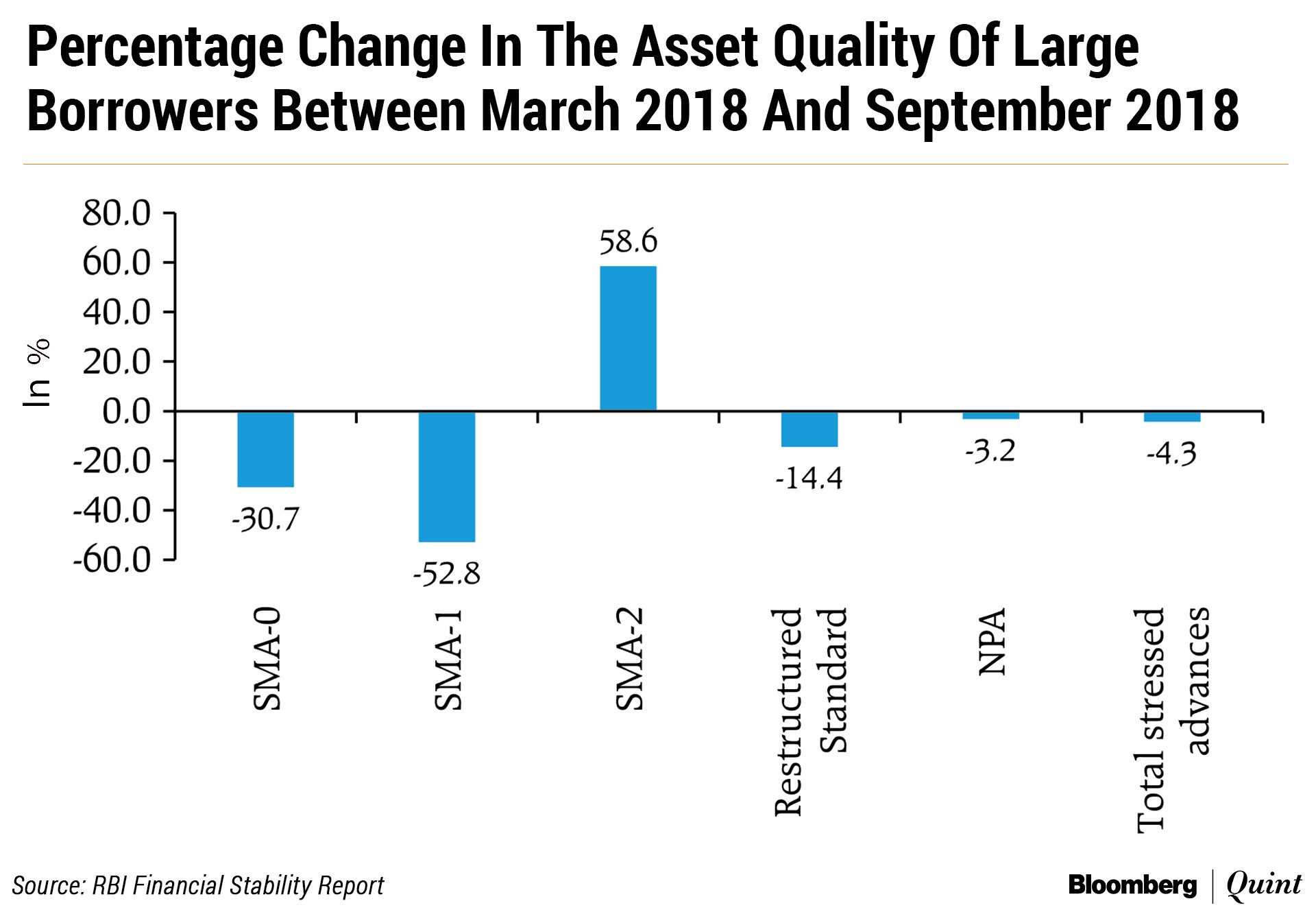
The RBI had previously introduced the special mention account (SMA) category for accounts which had been in default before they were classified as NPA. SMA-0 were accounts in default within 30 days of the due date, SMA-1 were in default between 31-60 days and SMA-2 were accounts in default between 61-90 days.
According to the RBI's financial stability report released in June last year, accounts under SMA-0 had shot up by 277 percent between March 2017 and March 2018, because banks had started to record defaults more diligently. Between March 2018 and September, the SMA-0 accounts actually fell by 30.7 percent, indicating that companies had begun regularising their payments and avoiding defaults.
“Voiding of the February 12 circular is credit negative for Indian banks,” said Srikanth Vadlamani, vice president of the financial institutions group at Moody's Investors Service.
The circular had significantly tightened stressed loan recognition and resolution for large borrowers. But, with the voiding, this may now have to be watered down...The resolution of stressed loans impacted by the circular will be further delayed as the process may have to be started afresh.Srikanth Vadlamani, Vice President Moody's Investors Service.

-
High US Salaries, No Green Card Certainty: The Financial Calculation Facing Indian H-1B Families

The suspension of PERM processing at eight technology employers does not cancel existing H-1B visas. What it does is force a question many Indian families have been avoiding: is the US salary worth tying your career and family plans to one employer?
-
Swiggy vs Eternal: Food Delivery's Two Rivals Are No Longer In The Same Race
Eternal is building a private AI assistant, dark.ai. Swiggy is still working out how to make Instamart pay, with an operating loss of Rs 895 crore in the July-September quarter while Blinkit stayed profitable.
-
Where You Live Shapes How You Get To Work | The Reason Why
Two-wheelers are the most popular way to get to work in India, accounting for nearly 43% of workplace commutes.
-
Unhedged Position: Can India See An Indonesia-Style Time Correction?
The Nifty is trading below levels it first clocked in 2024. Is there, then, as I have suggested in the headline, potential that the current time correction drags on painfully for the next three-five, even ten years?
-
Navigating Friction And Energy Realities: An Analysis Of Marco Rubio's October Visit To India
Occurring at a critical juncture marked by stalled trade negotiations and escalating geopolitical pressures over global energy supplies, the visit offers a profound window into modern US-India relations.
-
India Exports Capital. Why Not Export Trusteeship?
The big question, then, is whether India can build an institution that global borrowers, investors, banks, and lawyers can trust, even without an Indian connection.
-
France's Economy & Politics Are In Crisis | The Reason Why
Let's look at how the French economy and politics evolved under Nicolas Sarkozy, Franois Hollande and Emmanuel Macron.
-
You May Inherit The Business. You Must Earn Its Credibility.
Succession tests the founder's ability to share authority as much as it tests the next generation's readiness to assume it.
-
Signing Deals Is One Thing; Making Them Work Is Another | The Week In Whys
Sometimes, things don't turn out as planned. Indian companies have lost some bids to rivals, some projects won't produce until 2030.
-
FOMC Wall, PERM Suspension, Hospital Stocks | Talking Points This Week
A PERM suspension would directly affect green-card sponsorship rather than H-1B visas, so the near-term earnings impact could remain relatively limited. The key question is whether this marks a new phase in US scrutiny of Indian IT.









