Foreign Investors Drained $40 Billion From Emerging Asia Last Quarter, and It Could Get Worse
(Bloomberg) -- Some of Asia's biggest stock and bond markets outside China are seeing greater outflows than in previous market crises, and the process may just be getting underway.
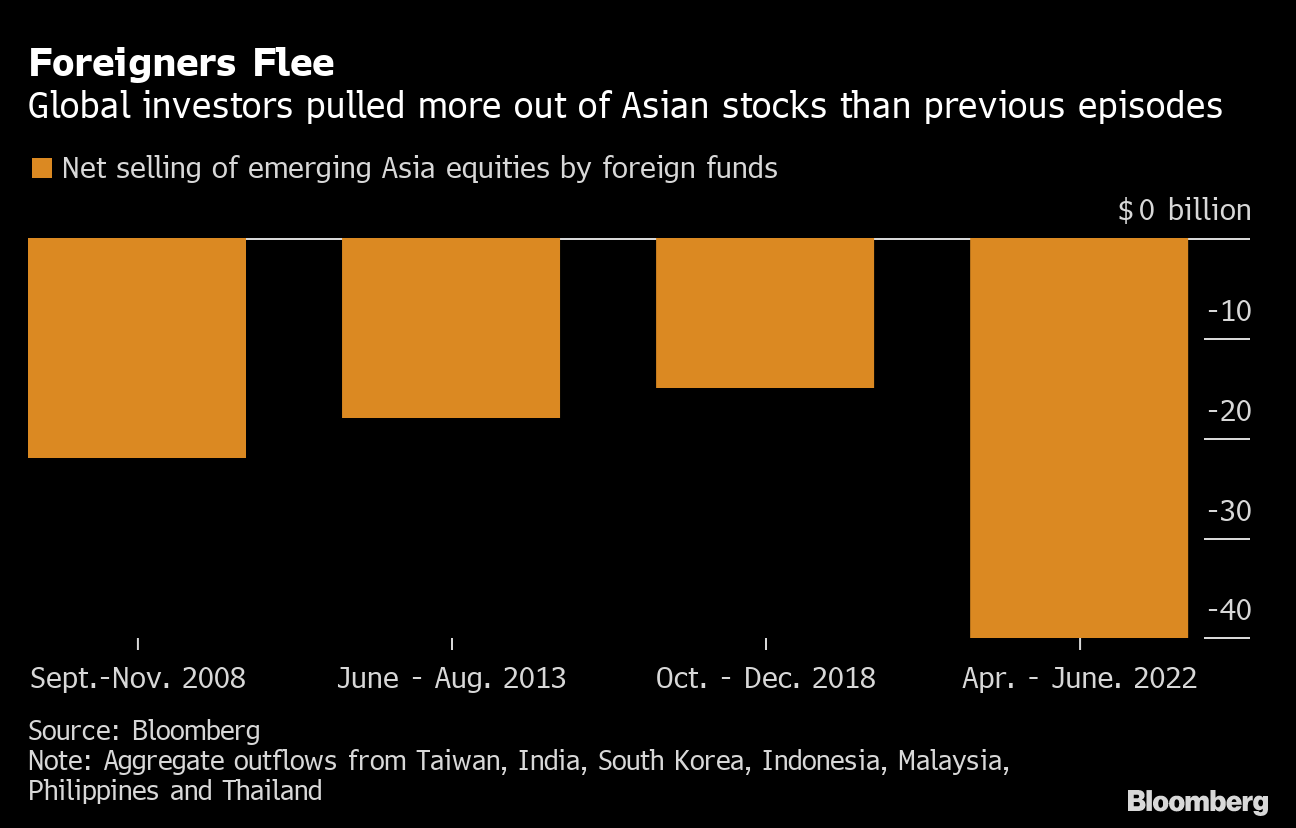
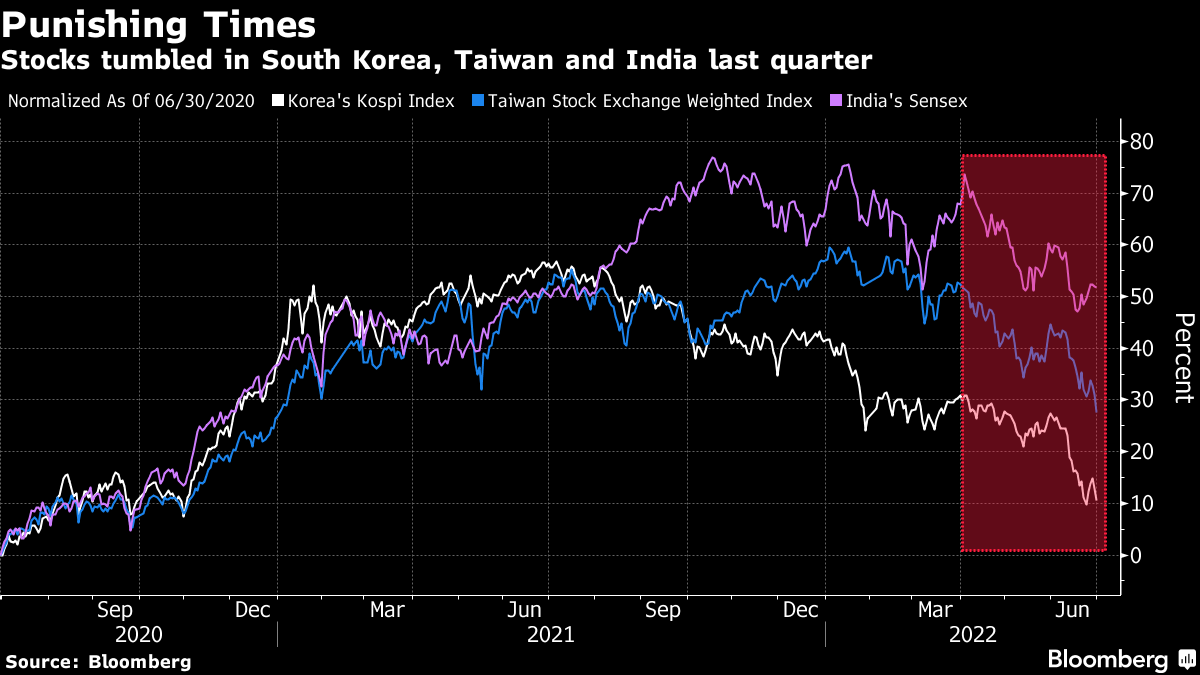
Global funds offloaded a net $40 billion of equities across seven regional markets last quarter, exceeding any three-month period characterized by systemic stresses since 2007. The steepest selling was in tech-heavy Taiwan and South Korea and energy-importing India, while foreign investors also made supersized outflows from Indonesian bonds.
Money managers are pulling out of higher-risk markets as rampant inflation and aggressive central bank interest-rate hikes sap the outlook for global growth. Fears of a US recession and supply-chain disruptions in Europe and China in a global economy still recovering from Covid-19 lockdowns are providing additional reasons to sell.
“We would expect investors to remain cautious toward export-oriented economies and markets with high valuation under the current backdrop,” said Pruksa Iamthongthong, senior investment director for Asia equities at abrdn plc in Singapore. “We expect the outlook to remain uncertain for the technology sector globally on rising recession risks.”
The total amount of equity outflows for the quarter is an aggregate of those from India, Indonesia, Korea, Malaysia, the Philippines, Taiwan and Thailand. The sum for the past three months was then compared with three previous episodes: the global financial crisis of 2008, the 2013 taper tantrum, and the peak of the Federal Reserve's last rate-hike cycle in 2018.
Foreigners withdrew a net $17 billion from Taiwan stocks, easily surpassing the outflows seen in any of the three previous periods. Indian shares saw $15 billion of sales, and Korea reported $9.6 billion, also exceeding the earlier periods.
Hawkish Fed
The Fed's aggressive tightening, which is pushing up US yields, is expected to keep drawing money away from the region. Swaps are pricing in a further 150 basis points of rate hikes from the US central bank this year.
“The reason foreign investors are selling shares in those markets is not because something has gone wrong in them, instead, it's because the Federal Reserve and other central banks are tightening their monetary policy,” said Mark Matthews, head of research for Asia Pacific at Bank Julius Baer in Singapore.
One of the main themes thrown up by the data is selling of technology shares, which account for more than half of Taiwan's equity benchmark and about a third of Korea's. Tech stocks have slumped around the world this year due to concern over slowing global growth, and their lofty valuations following gains they made during the Covid pandemic.
The weakening yen is also hurting the economy and equities in Taiwan and Korea given the two countries have similar export products to Japan, said Calvin Zhang, a fund manager at Federated Hermes in Pepper Pike, Ohio. This is leading to the fear that they will lose market share, he said.
Indian stocks meanwhile have come under pressure as the economy has suffered from surging oil prices, while the central bank has been rapidly raising interest rates to try and bring inflation under control.
‘Double Whammy'
“The double whammy for Asia –- rapidly tightening liquidity in developed markets and high fuel prices -– could continue to weigh on Asian currencies and depress flows into Asian financial markets for the time being,” Manishi Raychaudhuri, head of Asia Pacific equity research at BNP Paribas SA in Hong Kong, wrote in a research note last week.
There were bright spots too. Indonesia and Thailand saw inflows into their equity markets last quarter, while outflows in two other near neighbors Malaysia and the Philippines were relatively small.
Part of that may be down to the more dovish approach of central banks in Southeast Asia, which are seeking to slow-walk increases in borrowing costs as they nurture fragile post-Covid recoveries.
Bond Outflows
Bond markets were more mixed with Indonesia seeing outflows of about $3.1 billion, while Korea and Thailand saw money coming in.
Indonesian debt fell from favor as its high-beta bonds were sold more heavily than its regional peers amid fears of a global recession.
Moderate bond outflows from emerging Asia “should persist in the second half alongside the narrowing trend of Asia-US policy rate differentials and subdued outlook for Asian growth,” said Duncan Tan, a rates strategist at DBS Group Holdings Ltd. in Singapore.
The outlook for dollar-denominated corporate bonds in the region is also challenging given that spreads offered over Treasuries are becoming less attractive compared with their US peers. Yield premiums on investment-grade Asian bonds fell below those of US debt in late June for the first time in more than two years.
“Diminishing relative value versus the US will slow down fund inflows from developed markets or even lead to outflows,” said Joyce Liang, head of Asia Pacific credit research at BofA Securities in Hong Kong. “Risks are to the downside for spreads.”
(Updates to add comment from analyst in 12th paragraph)
More stories like this are available on bloomberg.com
©2022 Bloomberg L.P.

-
A New Samvat Wishlist: Inclusive Prosperity And Human Development

India has strengthened its economic foundations through infrastructure, digital access and enterprise. Its next growth chapter must deepen productivity, create better livelihoods and widen participation in prosperity.
-
Love, Sex Aur Dhokha: The Audacious Plot To Spy On Jensen Huang
A Taipei dinner, a Singapore chip buyer and a suspected Chinese asset: inside the alleged spy operation that got close to NVIDIA's Jensen Huang.
-
Ten Things I Learnt This Samvat
Patience can be a trap. Cheap stocks can stay cheap. Leverage can wipe you out. What did Samvat 2082 teach us? Niraj Shah writes on 10 lessons from the year gone by.
-
Talking Points This Week: Tech Nerves, FII Buying, And A Faraway Banking Shock
The global markets are not shining this Diwali. The exception in the large markets is, India.
-
Midterm Rally Lasted A Day. The Hard Reality Of A Divided US May Last Two Years | Opinion
Between a contested AI boom, a debt ceiling that arrives in 2027 and a president with every incentive to act alone, the next two years may prove more volatile than the first day's rally suggests.
-
Blue Wave Will Derail the AI Trade but Won't Dismantle the AI Era | Unhedged Position
The Democrats' sweep of the US Congress will see politics collide with economic forces both over the long and short term.
-
It's Time To Take The GST Council's Bet On Trust Global
Payment records can prove India's services exports, and clear, proportionate rules can bring foreign digital sellers into the tax net.
-
Opinion | India at 38: From Innovation Overperformer to Innovation Powerhouse
India now has 453 VC-backed deep science startups, 18 of them late-stage, after 117 percent growth since 2020. Laurus Labs, at USD 9.3 billion, is the most valuable deep science company in any middle-income economy outside China.
-
Navigating Energy Crossroads: S Jaishankar's Call For Diversified Supply Chains At G20 Ministerial Meeting
As geopolitical fault lines continue to test maritime trade routes and commodity flows, Jaishankar's message remains pertinent: true economic resilience requires open markets, protected transit lines, and a genuine commitment to multilateral cooperation rather than coercion.









